
By Panafrican.email Editorial Desk
STOCKHOLM — Sweden’s 2026 parliamentary election has resulted in five politicians of Somali origin taking seats in the country’s 349-member Riksdag, bringing a new level of Somali representation to Sweden’s national legislature.
The five lawmakers are Leila Ali Elmi, Mursal Isa, Mohamed Abdukani, Ilyas Hassan and Mohamed Abdukardir Ali, who is listed in the official parliamentary records as Mohamed Ali. They were elected representing the Green Party and the Left Party in constituencies including Gothenburg, Stockholm, Södermanland and Dalarna. (Riksdagen)
The new Riksdag began its work following the formal roll-call on September 28. Sweden’s Parliament lists Mohamed Abdukani as a Green Party member for Södermanland County, Leila Ali Elmi for Gothenburg Municipality and Mohamed Ali for Dalarna County. (Riksdagen)
A New Chapter in Somali Representation
Leila Ali Elmi is the most established member of the group. She first entered the Swedish Parliament in 2018 and was re-elected in 2022 and again in 2026. Her continued presence means that Somali-origin representation in the Riksdag is no longer limited to a single parliamentary term. (Dawan Africa)
The other four lawmakers enter the Riksdag as part of the new parliamentary term.
Mursal Isa represents the Green Party in Dalarna. Ilyas Hassan represents the Left Party in Stockholm. Mohamed Abdukani represents the Green Party in Södermanland, while Mohamed Abdukardir Ali, whose parliamentary listing uses the name Mohamed Ali, represents the Left Party in Dalarna. (Riksdagen)
Their election illustrates that the Swedish Somali community is participating in national politics through more than one political party.
Personal Votes Played a Role
Sweden’s electoral system allows voters to cast preference votes for individual candidates in addition to voting for a party.
That mechanism played a significant role in the election of some of the new lawmakers.
Mohamed Abdukani was elected from the Green Party’s Södermanland list after receiving 484 personal votes. Sweden’s Riksdag now officially lists him as an ordinary member representing Södermanlands län. (Riksdagen)
In Dalarna, Mohamed Abdukardir Ali also benefited from personal voting. Reporting on the result said he had been placed ninth on the Left Party’s regional list but received enough preference votes to move ahead of candidates above him and secure the parliamentary mandate. (Dawan Africa)
The results demonstrate how Sweden’s preference-voting system can affect which individual candidates ultimately enter Parliament.
Representation Across Party Lines
The five politicians do not belong to a single political organization.
Three are associated with the Green Party (Miljöpartiet), while two are associated with the Left Party (Vänsterpartiet). (Dawan Africa)
That distinction matters when describing the new representation. Somali heritage does not translate into a single political position.
The five lawmakers enter Parliament through different party organizations and therefore participate in Sweden’s political system within different ideological and parliamentary traditions.
For the Swedish Somali community, however, their simultaneous presence creates a notable moment of representation in the country’s national legislature.
Part of a Larger Parliamentary Change
The Somali-origin lawmakers were elected during a closely contested national election.
Sweden’s September 13, 2026 parliamentary election produced a Riksdag divided between two broad blocs. The centre-left opposition parties secured 176 of the 349 seats, while the outgoing right-leaning bloc won 173. (Reuters)
The narrow result has produced negotiations over the formation of Sweden’s next government.
On October 2, Reuters reported that Social Democratic leader Magdalena Andersson had been given a second opportunity to attempt to form a government after an earlier effort failed. (Reuters)
The five Somali-origin lawmakers therefore enter Parliament at a moment when coalition negotiations and parliamentary alignments remain unsettled.
From Migration to Representation
The significance of the election extends beyond the number five.
Sweden has one of Europe’s established Somali diaspora communities, and Somali-origin Swedes have participated in Swedish civic life for decades.
Leila Ali Elmi’s initial election in 2018 was itself a milestone. Her subsequent re-elections demonstrate that Somali-origin representation in the Riksdag has continued beyond a single electoral cycle.
The 2026 result expands that presence considerably.
Five members of the new Riksdag now have Somali backgrounds, while representing different constituencies and political parties.
Their presence also reflects a broader feature of contemporary European democracies: immigrant-origin communities are increasingly participating not only as voters but as candidates, elected representatives and lawmakers.
The Importance of Accurate Representation
The story has also generated misinformation online.
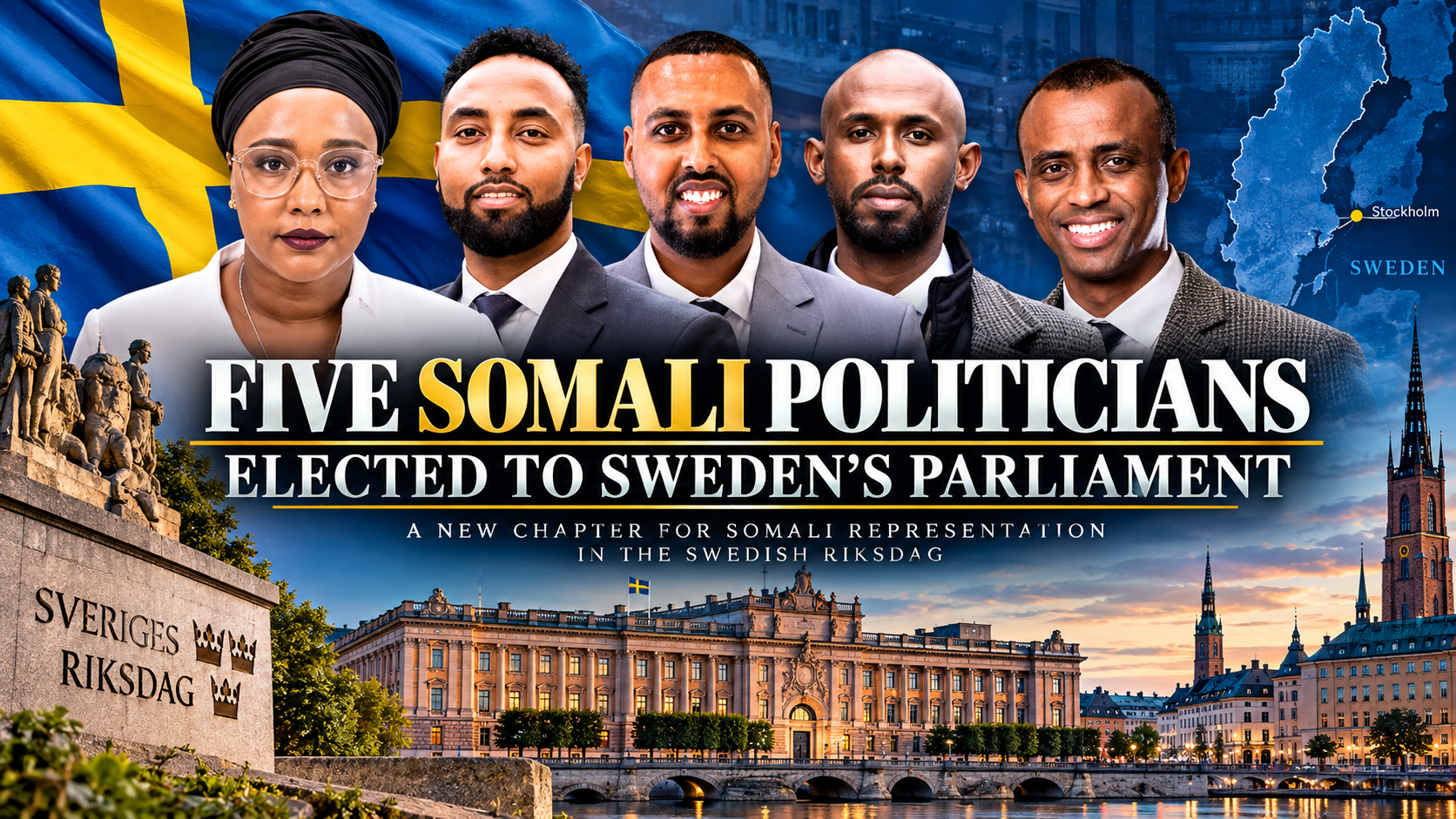
An image circulating on social media shows five people presented as the newly elected Somali-origin Swedish parliamentarians. Swedish reporting has identified the image as AI-generated, and one of the politicians quoted in coverage said she did not recognize some of the people depicted and had never been photographed together with them. (Sol Reporter)
That distinction is important.
The election itself is real, and Sweden’s Parliament has officially published the list of elected members. But an AI-generated image should not be treated as documentary photographic evidence of the five lawmakers standing together.
For news organizations, particularly in an era of rapidly generated synthetic images, separating a genuine political development from an artificial representation of that development is increasingly important.
A Swedish Story With a Global African Dimension

The election has significance beyond Sweden.
For communities across Africa and the African diaspora, the presence of Somali-origin lawmakers in a European national parliament represents another example of diaspora communities participating in the political institutions of countries where they have established new lives.
The five lawmakers will now participate in debates and votes concerning Sweden’s economy, immigration, education, climate policy, security, social welfare and foreign affairs.
Their individual political records and positions will develop within their respective parties and parliamentary committees.
What unites them in this particular story is not a common political platform, but their Somali heritage and their election to the same national legislature.
The New Riksdag
Sweden’s Parliament has 349 elected members. Its official post-election list confirms the new lawmakers and their constituencies, while parliamentary records show that Mohamed Abdukani, for example, formally began serving as an ordinary Green Party member on September 28, 2026. (Riksdagen)
The 2026 election has therefore produced a notable moment in the political history of Sweden’s Somali diaspora.
Five politicians of Somali origin have entered the Riksdag, representing two political parties and several constituencies.
Their presence provides a visible example of the changing composition of Swedish political institutions — while also demonstrating the importance of looking beyond viral images and social-media claims to verify who was actually elected.
For the Somali diaspora, the next chapter is no longer simply about whether representation is possible.
It is about what these newly elected lawmakers do with the parliamentary mandates they have received.
Leave a Reply