
By Panafrican.email Investigations Desk
Zimbabwe’s gold industry became the centre of an international money-laundering controversy after an undercover investigation by Al Jazeera exposed allegations involving gold smugglers, diplomats, businessmen and people connected to the country’s political establishment.
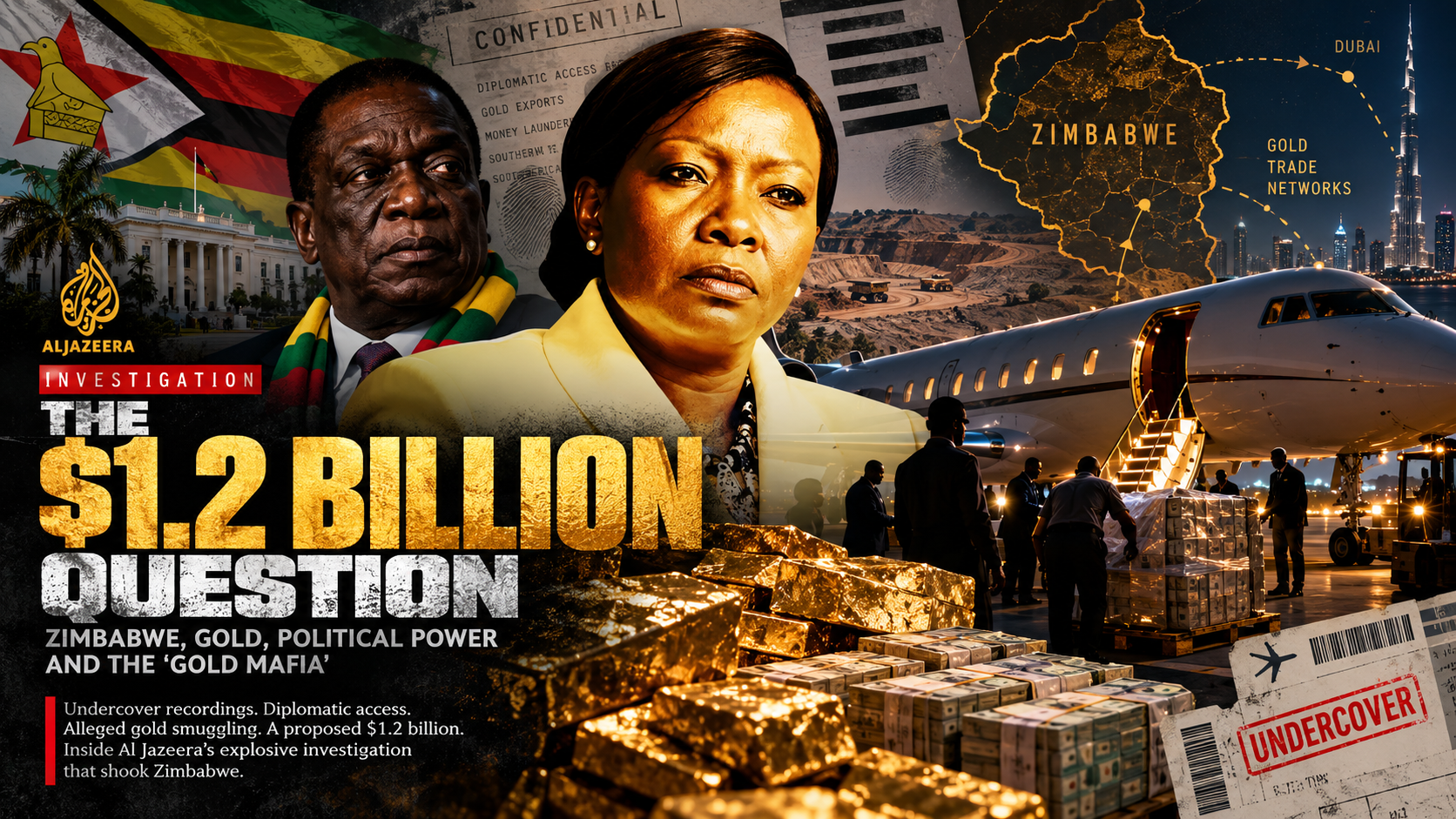
At the heart of one of the investigation’s most striking episodes was a telephone conversation involving Uebert Angel, a Zimbabwean ambassador-at-large, and Auxillia Mnangagwa, the country’s First Lady.
According to Al Jazeera’s Gold Mafia investigation, Angel discussed with undercover reporters a proposal involving the movement of as much as $1.2 billion in cash into Zimbabwe. The operation allegedly involved using aircraft to transport the money and subsequently converting or moving the funds through gold-related transactions.
The revelations raised questions about the intersection of Zimbabwe’s political establishment, the country’s lucrative gold industry and international networks accused of laundering illicit funds.
The phone call
The episode emerged from Al Jazeera’s four-part Gold Mafia investigation, which was published in 2023 following an extensive undercover operation across several countries.
Al Jazeera reporters posed as individuals looking to move large quantities of money and infiltrated networks involved in gold trading and alleged money laundering.
During one encounter, Angel contacted Auxillia Mnangagwa while speaking with the undercover journalists.
According to Al Jazeera, the conversation concerned people who wanted to move cash into Zimbabwe and whether aircraft would be provided by the prospective clients or by people connected to the Zimbabwean side.
Auxillia Mnangagwa reportedly told Angel to discuss the matter with “father”, referring to President Emmerson Mnangagwa.
Al Jazeera said it independently verified that the person speaking to Angel was Auxillia Mnangagwa. (Al Jazeera)
The significance of the exchange was not simply the amount of money allegedly involved. It was the apparent proximity of the conversation to Zimbabwe’s highest political office.
However, the investigation did not conclusively establish that President Mnangagwa personally authorised or participated in the proposed operation. Al Jazeera reported that its investigation raised questions about what the president knew and whether he was directly involved, but stopped short of proving direct participation. (Al Jazeera)
That distinction is important.
What was the ‘Gold Mafia’?
Al Jazeera’s investigation described a network of competing gold-smuggling and money-laundering operations operating across Southern Africa.
Zimbabwe occupied a central position because of its substantial gold production, its need for foreign currency and the country’s complicated relationship with international sanctions.
Gold can be particularly attractive to illicit financial networks because it is highly valuable, relatively portable and capable of being converted into legitimate-looking financial assets through international trading channels.

Al Jazeera reported that billions of dollars’ worth of gold were being moved from Zimbabwe toward international markets, including Dubai, with shell companies, invoices and intermediaries forming part of the broader financial ecosystem. (Al Jazeera)
The investigation alleged that some networks used gold transactions to transform questionable or illicit cash into apparently legitimate proceeds.
In simplified terms, the mechanism can work like this:
Cash → gold purchase → export → international sale → apparently legitimate proceeds
The complexity of international gold markets can make tracing the original source of money particularly difficult.
Why Zimbabwe’s gold industry matters
Gold is one of Zimbabwe’s most important sources of export revenue.
The country possesses significant mineral wealth, but years of economic instability, currency problems and restrictions on access to international financial systems have created strong incentives for businesses and individuals to seek alternative channels for moving money.
Al Jazeera reported that gold accounted for a substantial portion of Zimbabwe’s exports and that the country had become a major source of gold flowing through international trading hubs. (Al Jazeera)
The investigation also examined how sanctions and restrictions could create incentives for illicit financial networks.
Rather than making gold itself illegal, restrictions on Zimbabwe created an environment in which intermediaries could allegedly exploit the country’s need for foreign currency and access to international markets.
This created a potentially lucrative intersection between legitimate mineral commerce and illicit finance.
Uebert Angel and diplomatic access
Uebert Angel was appointed Zimbabwe’s ambassador-at-large for Europe and the Americas by President Mnangagwa.
According to Al Jazeera, Angel and his associate Rikki Doolan were recorded discussing ways to move large amounts of money into Zimbabwe.
The investigation reported that Angel offered the undercover reporters mechanisms for moving money through Zimbabwe and suggested that his diplomatic position could facilitate the process. (Al Jazeera)
In another part of the investigation, Al Jazeera reported that Angel offered to arrange a meeting with President Mnangagwa for a payment of $200,000.
The undercover journalists did not make the payment, and the proposed meeting did not take place. (Al Jazeera)
The allegations became particularly significant because Angel repeatedly invoked his access to senior political figures.
But claims made by an undercover subject about political access are not automatically proof that the political figures themselves participated in criminal activity.
That distinction remains central to understanding the investigation.
The $1.2 billion allegation
The most extraordinary figure connected to the investigation was $1.2 billion.
Al Jazeera reported that Angel was covertly recorded discussing the possibility of moving $1.2 billion in cash into Zimbabwe.
The proposed operation allegedly involved aircraft and diplomatic access.
In the conversation involving Auxillia Mnangagwa, Angel asked whether aircraft would be supplied by the people bringing the money or by the Zimbabwean side.
According to the published investigation, Auxillia Mnangagwa directed Angel to discuss the matter with President Mnangagwa. (Al Jazeera)
The conversation became one of the most controversial elements of the Gold Mafia investigation because it appeared to place an extremely large proposed financial transaction within conversations involving someone close to Zimbabwe’s presidency.
Yet there is another critical point: the investigation documented a proposed operation, not evidence that $1.2 billion was actually transported into Zimbabwe through the mechanism described.
The distinction between an offer, a proposal, an allegation and a completed transaction is essential.
Gold as a vehicle for moving wealth
The wider investigation examined why gold has become so attractive to international money launderers.
Unlike cash, gold can cross borders in different forms and can be sold through established international markets.
Once gold enters legitimate trading channels, determining exactly where the underlying money originated can become difficult.
Al Jazeera’s investigation described networks stretching from Southern Africa to Dubai and other international financial centres. (Al Jazeera)
This creates an important problem for African mineral-producing countries.
A country may possess extraordinary natural wealth while losing significant economic value through smuggling, under-declaration, corruption and illicit financial flows.
The problem therefore extends beyond gold.
It touches diamonds, precious metals, strategic minerals and other commodities whose value can be transferred internationally with relatively little physical volume.
The political question
The Gold Mafia revelations generated intense debate in Zimbabwe because several individuals appearing in the investigation had connections to government or political power.
Al Jazeera reported that its investigation uncovered multiple claimed links between gold-smuggling networks and people close to President Mnangagwa. It also reported that several individuals made claims about the president’s knowledge or protection of their activities. (Al Jazeera)
However, Al Jazeera itself acknowledged that the investigation did not conclusively establish the president’s direct involvement in the criminal schemes described by the people it investigated. (Al Jazeera)
That distinction matters because investigative journalism frequently captures people making claims about powerful individuals.
Those claims require corroboration.
The existence of a conversation with a political figure, relative or associate does not by itself prove that a criminal transaction occurred.
Government response
The revelations created significant political pressure.
Following the release of the investigation, Zimbabwe’s government announced that it would investigate people implicated in the gold-smuggling allegations. (Al Jazeera)
Several individuals and institutions named or discussed in the investigation denied wrongdoing.
The Reserve Bank of Zimbabwe said it took money laundering and illicit trade seriously and denied participating in such activities. Fidelity Gold Refinery also denied involvement in money laundering and gold smuggling. (Al Jazeera)
Uebert Angel also rejected allegations that he was involved in gold smuggling and money laundering.
These denials form an important part of the record and should be considered alongside the undercover material.

Why the story still matters
More than a sensational political scandal, the Gold Mafia investigation exposed a deeper structural problem facing mineral-rich African countries.
Natural resources can generate enormous wealth.
But when weak regulatory systems intersect with political connections, opaque financial networks and international commodity markets, mineral wealth can become a vehicle for capital flight rather than national development.
Zimbabwe’s gold story therefore raises questions that extend far beyond Harare.
Who owns the gold?
Who receives the export revenue?
Who controls the licenses?
Who verifies the source of the gold?
Who audits the money?
Who benefits when gold leaves the country?
And perhaps most importantly: how much of Africa’s mineral wealth actually remains in Africa?
From gold to Africa’s next mineral economy
Those questions are becoming increasingly important as global demand grows for Africa’s strategic resources.
Gold is only one component of the continent’s mineral economy.
Lithium, cobalt, copper, manganese, chromium, uranium, rare earth elements and other strategic resources are attracting increasing international investment.
The lesson from Zimbabwe is not that gold itself is inherently a problem.
The lesson is that valuable commodities require transparent systems capable of distinguishing legitimate commerce from illicit financial activity.
For African governments, this means stronger customs systems, transparent mining licenses, beneficial-ownership registers, reliable export data, independent financial oversight and cooperation between mineral regulators and anti-money-laundering agencies.
For journalists and civil society organizations, it means following the money as closely as they follow the minerals.
And for African citizens, it means asking whether the continent’s enormous natural wealth is ultimately being converted into public prosperity — or private fortunes.
The unanswered questions
The allegations surrounding the $1.2 billion proposal remain part of a much larger story.
The central questions are not simply whether one conversation took place.
They are whether proposed financial mechanisms were ever implemented, whether illicit money actually entered Zimbabwe through diplomatic or private channels, who ultimately controlled the transactions, and how much of the country’s gold production may have moved through unofficial networks.
The Gold Mafia investigation provided a rare glimpse into a hidden world in which gold, cash, diplomacy and political influence appeared to intersect.
But the full financial trail requires evidence beyond undercover conversations.
Bank records, customs declarations, aircraft manifests, company ownership documents, gold export records and court proceedings are ultimately needed to establish what happened.
Until such evidence is publicly established, the allegations should remain identified as allegations.
What is beyond dispute is that Zimbabwe’s gold industry has become a major battleground in the fight against illicit financial flows.
And the $1.2 billion question remains one of the most striking chapters in that story.
Panafrican.email will continue to follow the intersection of African mineral wealth, illicit financial flows, gold trading and political power across the continent.
Source context: Al Jazeera’s original investigation described a four-part undercover operation involving gold-smuggling and money-laundering networks across Southern Africa and published its key findings in March–April 2023.
Leave a Reply