
By Panafrican.email Intelligence Desk
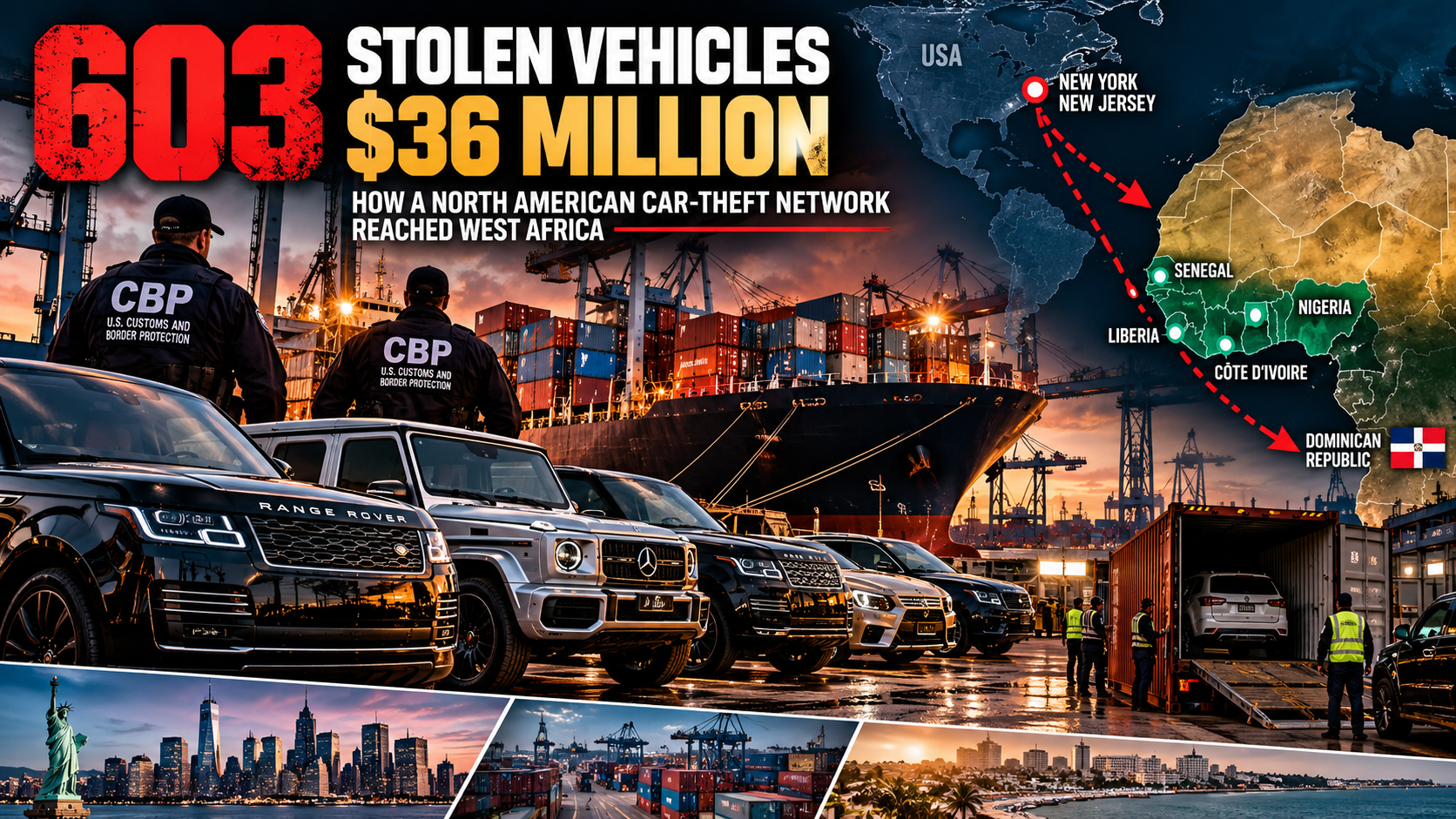
NEW YORK–NEW JERSEY — U.S. authorities have intercepted a record 603 stolen vehicles worth approximately $36 million at the ports of New York and New Jersey over the past year, exposing a transnational criminal pipeline linking vehicle theft in the United States to overseas markets, including West Africa.
U.S. Customs and Border Protection officials announced the seizures at Port Elizabeth, New Jersey, on October 1, describing the operation as the largest number of stolen vehicles ever seized by CBP in a single calendar year at a U.S. point of entry. (CBS News)
The vehicles included high-end luxury automobiles and SUVs. News 12 reported that vehicles displayed by authorities ranged from a Porsche valued at approximately $207,000 to Ram pickup trucks valued at around $91,000. (News 12 – Default)
But the significance of the seizure extends beyond the value of the vehicles.
According to law-enforcement officials, the investigation has exposed an international supply chain in which vehicles are stolen from American communities, moved through criminal networks, concealed in shipping containers and prepared for export to overseas buyers.
West Africa emerges as a major destination
Authorities said approximately half of the vehicles intercepted were destined for West Africa, while roughly 15% were headed toward the Dominican Republic. (Hudson County View)
The disclosure puts West Africa at the center of a complex transatlantic criminal economy.
Officials emphasized that the problem is not simply the movement of stolen cars. Investigators say overseas demand can create financial incentives for criminal groups operating inside the United States.
Michael McCarthy, special agent in charge of Homeland Security Investigations’ Newark Field Office, said investigators have traced networks from neighborhood theft crews through intermediaries, freight forwarders and overseas buyers.
The authorities’ description is significant because it illustrates how an apparently local crime — the theft of a vehicle from a driveway — can become part of an international logistics operation.
From American neighborhoods to shipping containers
Investigators say some theft crews have targeted homes specifically to obtain vehicle key fobs.

Criminal organizations allegedly recruit young people to check vehicle doors, break into residences or steal keys before taking high-value automobiles.
The stolen vehicles can then be moved to temporary storage locations, including garages and other facilities, before being transferred to freight operations.
Authorities say some criminals also use fraudulent documentation and altered vehicle-identification information to conceal the origins of the vehicles. (Hudson County View)
This creates multiple layers between the original theft and the eventual export.
By the time a vehicle reaches a port, investigators say, the person who stole it may have little or no direct relationship with the person attempting to export it.
That fragmentation makes the trade more difficult to investigate — and potentially more profitable for organizers.
Ghana and Nigeria appear in previous investigations
The connection to West Africa is not merely theoretical.
A 2025 investigation by the New Jersey Attorney General’s Office involved an alleged organized theft enterprise accused of stealing high-end vehicles and arranging their shipment to West African countries. Investigators said stolen vehicles were recovered from shipping containers at ports in Elizabeth, New Jersey, and Staten Island, New York. (njoag.gov)
In one case described by New Jersey authorities, a stolen BMW X7 was recovered from a container destined for Ghana.
The investigation alleged that vehicles were stolen from New Jersey residences, moved to facilities in the Bronx and then prepared for export.
Authorities said the enterprise allegedly involved theft crews, middle-level and high-level intermediaries and overseas financing.
The New Jersey Attorney General’s Office said the investigation involved more than 20 federal, state, county and local agencies. (njoag.gov)
A separate report from Hudson County View, citing officials at the October 2026 announcement, said authorities identified Ghana and Nigeria among the West African markets connected to luxury vehicles targeted by an alleged theft organization. (Hudson County View)
These cases do not establish that stolen vehicles entering Ghana or Nigeria are generally part of criminal activity. Rather, they demonstrate that investigators have identified specific alleged trafficking networks whose overseas destinations included West African markets.
The Ghana connection is attracting U.S. insurance investigators
The National Insurance Crime Bureau has separately identified Ghana as an important destination in its international stolen-vehicle recovery work.
According to the NICB, its foreign-operations initiative began its first phase in West Africa with a focus on Ghana after the country was identified as a potential destination for vehicles stolen in the United States.
The organization says that since 2024 it has recovered 30 vehicles from Ghana and repatriated another 19, while maintaining open cases in additional African countries. (NICB Document Download Center)
The NICB says stolen vehicles can be moved from North American ports using false documentation, false declarations and potentially altered VIN information.
Its stated objectives include gathering intelligence, developing relationships with local authorities and producing intelligence products related to international vehicle theft. (NICB Document Download Center)
For African customs, police, insurers, shipping companies and legitimate automobile dealers, the development presents a growing need for stronger vehicle-verification systems.
A sophisticated criminal economy
Authorities say today’s vehicle-theft networks can operate through both violence and fraud.
In some cases, young thieves allegedly carry out residential burglaries and vehicle thefts while higher-level organizers coordinate transportation and payment.
In other cases, criminals allegedly acquire vehicles through fraudulent transactions, manipulate documentation or use stolen identities and financial information.
The U.S. Justice Department has separately prosecuted an alleged New York stolen-car network involving approximately 100 vehicles. Prosecutors said the defendants allegedly concealed stolen vehicles by using fraudulent VINs, replacement certification labels and false titles before reselling them. (Department of Justice)
The cases demonstrate that the international trafficking problem is connected to a broader ecosystem of vehicle fraud.
Freight forwarders face scrutiny
The ports themselves have become a critical enforcement point.
CBP officials said the agency has issued more than 534 penalties totaling approximately $1.8 million against freight-forwarding companies for failures involving required shipment information. (Hudson County View)
That signals an important change in the investigation strategy.
Authorities are not only looking for the person who stole the car.
They are increasingly examining the entire chain:
Theft → storage → intermediary → documentation → freight forwarder → shipping container → port → overseas buyer.
Breaking any link in that chain can prevent a stolen vehicle from reaching its final market.
Why luxury SUVs?
Officials have pointed to overseas demand as one factor behind the criminal business.
Luxury SUVs can command substantial prices in overseas markets, while their relatively high ground clearance and utility can make them attractive to buyers in markets where road conditions vary significantly.
But investigators emphasize that demand alone does not explain the crime.
The stolen-vehicle trade is supported by organized networks capable of financing theft crews, moving vehicles between states, arranging documentation and connecting sellers with international buyers.
Four transnational organizations dismantled
According to officials at the October announcement, investigators have dismantled four transnational criminal organizations since 2021.
One organization was allegedly responsible for approximately 30% of the stolen vehicles stopped at Port Newark.
Authorities also said five members of one organization were convicted in federal court after being accused of conspiring to ship more than 60 stolen vehicles worth approximately $3.5 million to West Africa. (Hudson County View)
The cases illustrate why investigators increasingly describe organized vehicle theft as a transnational crime rather than simply a property crime.
The victims begin thousands of miles away
Behind the statistics are individual families.
A vehicle stolen from a driveway can disrupt a person’s ability to get to work, transport children, operate a small business or meet everyday obligations.
When the vehicle is recovered after being loaded into an export container, it may already have been declared a total loss by an insurance company.
CBP officials said that most recovered vehicles have already been reported stolen. Vehicles are transferred to agencies such as the Hudson County Sheriff’s Office or New Jersey State Police, which then work with insurance companies and vehicle owners. (Hudson County View)
Some vehicles may ultimately return to their owners. Others become the property of insurers after claims have been settled.
A West African problem that requires West African intelligence
The emerging trafficking pattern raises an important question for African governments:
How effectively can authorities identify stolen vehicles before they disappear into legitimate-looking commercial markets?
Vehicle trafficking crosses multiple jurisdictions.
A car can be stolen in New Jersey, moved to New York, placed into a container in Elizabeth, assigned export documentation, shipped across the Atlantic and arrive in an African port thousands of miles away.
Each jurisdiction sees only a portion of the transaction.
That makes information sharing essential.
Customs agencies, police forces, port authorities, insurers, shipping companies, vehicle-registration agencies and legitimate automobile dealers all possess pieces of the same puzzle.
The intelligence opportunity
For Africa’s law-enforcement and customs agencies, the growing U.S. investigations provide an opportunity to develop a more sophisticated vehicle-intelligence system.
Such a system could combine:
- VIN verification
- stolen-vehicle databases
- customs declarations
- shipping-container information
- vehicle registration records
- insurance claims
- port arrival data
- auction records
- import documentation
- dealer information
- suspicious transaction indicators
The goal would not be to criminalize legitimate automobile imports.
It would be to distinguish legitimate commerce from vehicles whose identification, ownership or export history does not withstand scrutiny.
Panafrican Intelligence Center assessment
The 603-vehicle seizure demonstrates something larger than a record enforcement operation at an American port.
It shows how organized crime is increasingly operating through global commercial infrastructure.
Shipping containers, freight companies, digital payments, vehicle marketplaces and international logistics systems can all be exploited by criminal organizations.
That makes ports such as Newark, Tema, Lagos, Abidjan and other major African gateways important nodes in the fight against transnational vehicle trafficking.
The evidence currently available does not justify portraying West Africa as a single destination for stolen American vehicles, nor does it establish that ordinary vehicle dealers or buyers in Ghana, Nigeria or other countries are knowingly participating in trafficking.
What the investigations do establish is narrower — and more consequential:
U.S. authorities have identified organized criminal networks attempting to move stolen high-value vehicles into West African markets, including Ghana, and are increasingly targeting the logistics and financial networks that make those shipments possible. (Hudson County View)
The next stage of the investigation should therefore move beyond the ports.
It should follow the vehicles.
Who ordered them? Who paid for them? Who received them? Which ports received them? Which companies cleared them? And how many ultimately entered legitimate or illicit markets?
Those questions sit at the intersection of African trade, maritime logistics, insurance, organized crime, automobile commerce and financial intelligence.
And they are precisely the kind of cross-border patterns that require an intelligence center capable of connecting information that is normally scattered across different countries and institutions.
Panafrican.email Intelligence Center will continue tracking the African end of the vehicle-trafficking pipeline as additional official information becomes available.
Important: Charges and allegations described in law-enforcement releases are allegations, and defendants are presumed innocent unless and until proven guilty in court.
Leave a Reply