
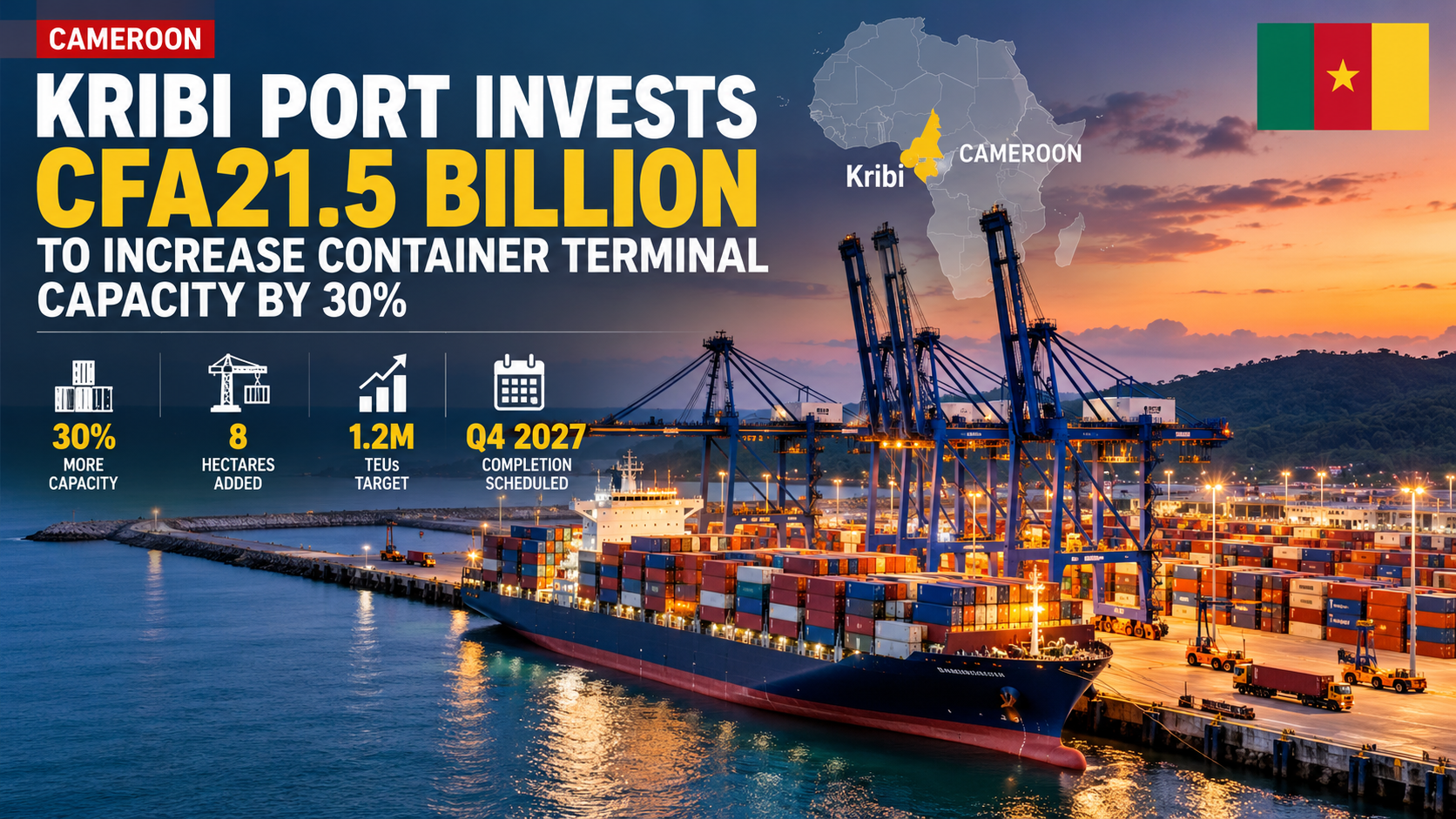
KRIBI, CAMEROON — Cameroon’s Kribi Container Terminal (KCT) has launched a CFA21.5 billion expansion project aimed at increasing the container terminal’s handling capacity by approximately 30%, as the deepwater port positions itself for stronger regional trade and potential growth in industrial cargo.
The expansion is expected to add approximately eight hectares to the terminal’s operational footprint. Construction began in early September 2026, with completion currently scheduled for the fourth quarter of 2027, according to information reported by Business In Cameroon and attributed to a source close to the project.
The project is being carried out by China Harbour Engineering Company (CHEC), the Chinese infrastructure group that was also involved in the construction of the Kribi deepwater port.
Preparing Kribi for Higher Container Volumes
The investment comes as KCT works toward a longer-term objective of handling as much as 1.2 million twenty-foot equivalent units (TEUs) per year.
A TEU is the standard measurement used by the global shipping industry to represent the capacity of a 20-foot shipping container. Increasing TEU capacity is therefore an important indicator of a port’s ability to accommodate larger volumes of international trade.
For Kribi, the expansion could strengthen the port’s role as a major maritime gateway for Cameroon and the wider Central African region.
The additional capacity is also being developed as authorities and investors anticipate possible increases in cargo generated by an industrial zone planned near the port.
That connection between port infrastructure and industrial development is strategically significant. Modern industrial zones require reliable maritime access for importing machinery, intermediate goods and raw materials while providing exporters with efficient routes to international markets.
CFA21.5 Billion Expansion
The reported cost of the project is CFA21.5 billion, making it a substantial new investment in Kribi’s logistics infrastructure.
The budget is higher than the CFA16.4 billion associated with an earlier investment or development phase at the terminal, underscoring the scale of the latest expansion.
The work involves extending the terminal’s operational area by eight hectares and increasing its ability to accommodate and process containers.
The investment reflects a broader trend across Africa, where ports are being expanded and modernized in response to growing regional trade, larger vessels, changing shipping routes and increasing demand for logistics infrastructure.
CHEC Returns to Kribi

CHEC’s involvement gives the project continuity with the original development of the Kribi port complex.
The Chinese engineering company played a major role in constructing the deepwater port and remains connected to the container terminal through its ownership stake.
The project was highlighted during the first visit to Kribi by Zhang Xiaoqiang, chairman of China Harbour Engineering Company, on October 2, 2026.
CHEC is one of several shareholders in Kribi Container Terminal.
Other shareholders include Africa Global Logistics (AGL), the international logistics company; CMA CGM, one of the world’s major shipping groups; and Cameroonian investors.
The combination of an international port operator, global shipping interests, logistics infrastructure and local investment gives KCT a potentially important position within Cameroon’s maritime economy.
Kribi’s Strategic Position
Kribi was developed as a deepwater port capable of receiving larger vessels than some of Cameroon’s older maritime facilities.
Its location on Cameroon’s southern Atlantic coast gives it access to international shipping routes while also positioning the port as a potential logistics gateway for Central Africa.
The port’s development has been closely linked to Cameroon’s ambitions to expand industrial production, improve export infrastructure and reduce logistics constraints.
Greater container capacity could be particularly important if industrial activity around Kribi accelerates.
The planned industrial zone could generate demand for the movement of machinery, manufactured products, minerals, agricultural commodities and other cargo.
For Cameroon, the objective is not simply to move more containers. The larger economic question is whether port infrastructure can become an engine for industrialization.
Competition for Central African Trade
Kribi is also developing within an increasingly competitive African port environment.
Across the continent, governments and private investors are committing billions of dollars to port modernization, container terminals, logistics corridors and industrial zones.
West Africa has seen major investments in ports such as Abidjan, Tema and Lomé, while East and Southern Africa are also expanding maritime infrastructure.
In Central Africa, Kribi competes and cooperates within a regional logistics environment that includes ports serving Cameroon, Gabon, Equatorial Guinea, Congo and the wider landlocked Central African market.
Improved capacity at Kribi could therefore have implications beyond Cameroon.
If road, rail and inland logistics connections are developed alongside the port, Kribi could potentially handle increasing volumes of cargo destined for markets farther inland.

Infrastructure Must Connect to the Hinterland
Port expansion alone does not guarantee increased trade.
The economic value of additional container capacity depends heavily on what happens beyond the terminal gates.
Efficient roads, railways, customs systems, warehouses, trucking networks and industrial facilities are necessary to move cargo from ships to businesses and consumers.
For Kribi, the development of stronger connections into Cameroon’s interior and neighboring Central African economies will therefore be an important factor in determining whether the new capacity translates into sustained economic growth.
The planned industrial development near the port could help address part of this challenge by creating cargo demand close to the maritime gateway.
A Larger Role for Cameroon in African Trade
The CFA21.5 billion expansion represents another step in Cameroon’s effort to build a larger and more modern logistics economy.
If the project reaches completion as scheduled in the fourth quarter of 2027, KCT will have additional space and capacity to accommodate growing container volumes.
The longer-term target of 1.2 million TEUs annually indicates that the terminal’s operators are planning beyond immediate demand and positioning Kribi for potentially much larger trade flows.
For Cameroon, the strategic opportunity is to transform Kribi from a port infrastructure project into a broader industrial and logistics platform.
That will depend on continued investment in transport connections, customs efficiency, industrial development and regional trade corridors.
Panafrican.email Intelligence Note
Status: Unverified
Panafrican.email has classified this report as unverified pending additional independent confirmation of the project’s financial details, construction schedule and capacity projections.
The reported figures are based on information attributed to Business In Cameroon, including reporting surrounding CHEC chairman Zhang Xiaoqiang’s October 2, 2026 visit to Kribi.
If confirmed, the CFA21.5 billion investment would represent a significant expansion of one of Central Africa’s most strategically important container terminals and could strengthen Kribi’s position in the competition for regional cargo.
Source: Business In Cameroon
Country: Cameroon
Region: Central Africa
Category: Economy / Infrastructure / Maritime Trade
Location: Kribi, Cameroon
Reported Investment: CFA21.5 billion
Expansion: Approximately 8 hectares
Expected Capacity Increase: 30%
Long-Term Target: Up to 1.2 million TEUs annually
Construction: China Harbour Engineering Company (CHEC)
Expected Completion: Q4 2027
Leave a Reply