
By PanAfrican.email
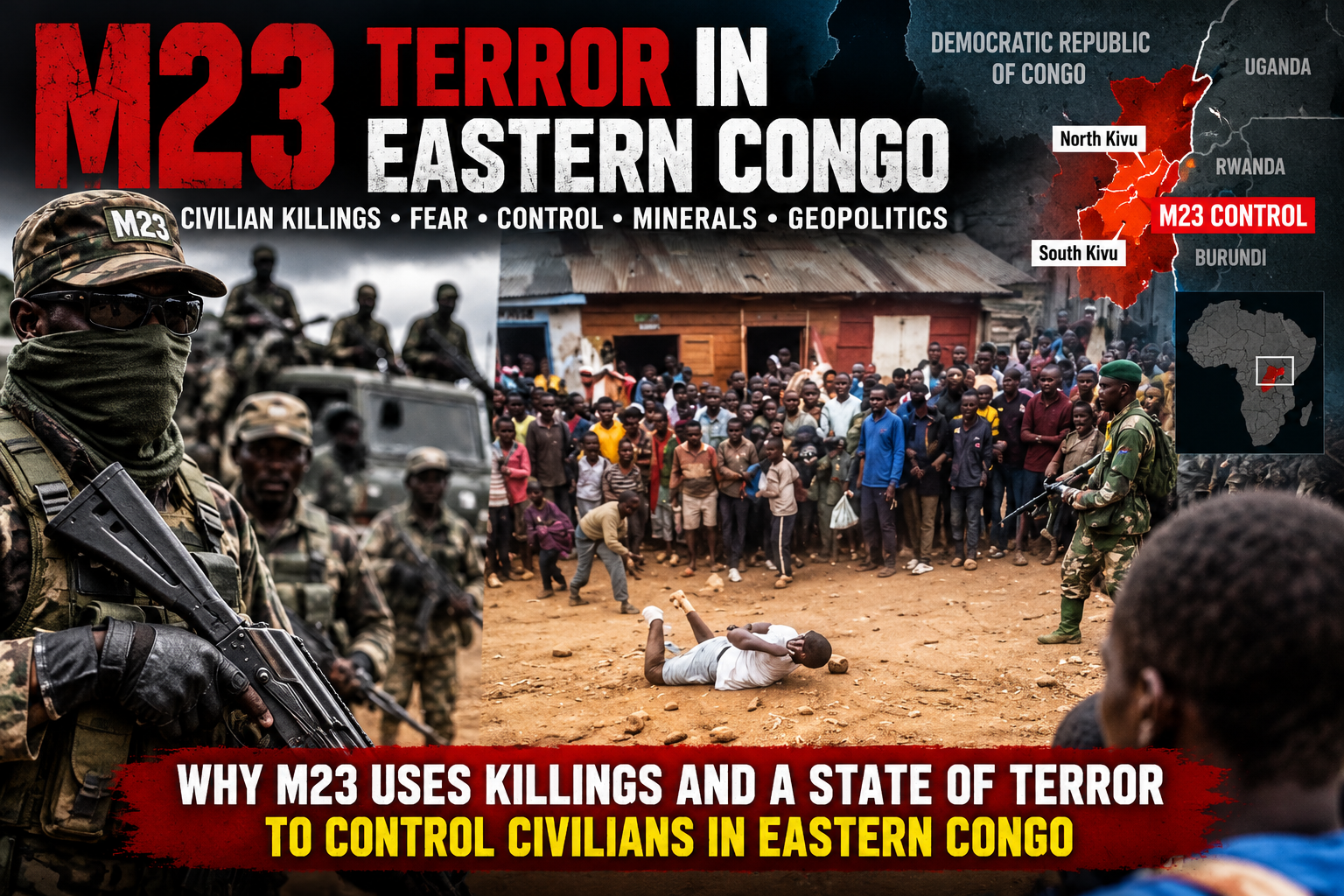
A disturbing image circulating on social media appears to show a man lying on the ground while a large crowd watches. The accompanying post describes the scene as being from an area occupied by the AFC-M23 coalition in eastern Democratic Republic of Congo.
The exact location and circumstances of this particular incident have not been independently established from the image alone. But the scene comes against a much larger and extensively documented pattern of violence in territory controlled by the M23.
The question therefore goes beyond one disturbing video or photograph:
Why would an armed movement use killings, public punishment, disappearances and fear to control a civilian population?
A war that has become a system of control
The M23’s resurgence has transformed the security landscape of North and South Kivu. After capturing major cities including Goma and Bukavu, the movement and its allies have exercised authority over large areas of eastern Congo.
Human Rights Watch has documented killings, arbitrary detention, forced recruitment, torture and other abuses by M23 and Rwandan forces. Its 2026 investigations describe systematic searches for people suspected of supporting opposing armed groups, particularly the Wazalendo, the Congolese army and the FDLR.
The United Nations has also reported patterns of summary executions and targeted killings in areas under AFC-M23 control. Civilians could become targets because they were suspected of belonging to an armed group, criticized M23 authorities, participated in civil society or political activity, or simply fell under suspicion during security operations.
That distinction is important.
Terror in a conflict zone does not necessarily require killing everyone. It requires convincing everyone that they could be next.
Why use terror against civilians?
There are several strategic reasons armed groups resort to this type of violence.
1. Eliminate perceived enemies
M23 has portrayed its military campaign partly as a fight against armed groups such as the FDLR and pro-government militias. Human Rights Watch found that civilians were sometimes accused of being associated with those groups and subsequently detained or killed.
The danger is that the distinction between combatant and civilian becomes blurred.
A young man who previously served in the Congolese army, a person suspected of helping the Wazalendo, a community leader, or someone accused of passing information can all become viewed as a potential enemy.
2. Create deterrence
Public violence sends a message beyond the immediate victim.
It tells an entire neighborhood:
Resistance has consequences.
That is one reason public punishments, executions, beatings and disappearances can become instruments of political control.
A person does not have to be killed for the entire community to be intimidated. Witnessing what happens to somebody else can be enough to discourage protest, information-sharing or cooperation with an opposing force.
UN investigators have described a broader pattern of intimidation and repression in AFC-M23-controlled territory, including killings associated with perceived resistance, criticism and violations of restrictions imposed by the authorities.
3. Control the population

Military victory is only one part of controlling territory.
An armed movement must also control:
- roads and checkpoints;
- local administration;
- communications;
- movement;
- recruitment;
- information;
- taxation and economic activity;
- and the population itself.
Human Rights Watch reported that M23 established systems of detention and recruitment, including the movement of civilians and captured fighters to training facilities. Some civilians and children were forcibly recruited.
Fear can therefore become a substitute for legitimacy.
Where an armed group lacks democratic legitimacy, coercion can become the mechanism through which orders are obeyed.
4. Prevent information from reaching the outside world
Conflict zones depend heavily on information.
A population that can freely communicate with journalists, humanitarian organizations, government forces or international investigators can potentially document abuses and identify perpetrators.
That makes intimidation particularly powerful.
If residents believe that filming an incident, speaking to journalists or reporting an M23 operation could make them a target, many will remain silent.
This creates an information vacuum in which abuses become harder to document.
5. Recruitment through fear
Another disturbing dimension is forced recruitment.
Human Rights Watch reported that M23 recruitment campaigns affected civilians as well as captured combatants and that children were among those forcibly recruited. Former detainees described beatings, harsh conditions and executions at detention and training facilities.
This creates a vicious cycle:
capture territory → control civilians → recruit manpower → expand military capacity → capture more territory.
The mineral dimension
Eastern Congo’s violence cannot be separated entirely from the region’s extraordinary mineral wealth.
North Kivu contains major deposits of minerals including coltan, while other parts of the region contain gold, tin and tungsten.
Recent investigations by Amnesty International documented killings, torture, arbitrary detention, forced labor, forced recruitment and pillage at mining sites controlled by M23, including a coltan mine near Rubaya and a gold mine in South Kivu.
That does not mean every act of violence is automatically a mining operation.
But control over territory containing valuable resources can provide armed movements with additional economic and strategic incentives.
The result is a dangerous combination:
territory + armed power + minerals + weak civilian protection.
The people trapped in the middle
The most important point is that eastern Congo’s civilians are not simply statistics in a geopolitical contest.
They are communities living between competing armed forces.
The M23 and its Rwandan allies have been accused of serious abuses. At the same time, the Congolese army and allied Wazalendo forces have also been accused by UN investigators and human-rights organizations of serious violations against civilians.
That broader reality matters because civilians should not have to choose which armed group is allowed to abuse them.
Is this simply “rebel violence”?
The evidence suggests something more complicated.
M23 has developed from an insurgent movement into an organization exercising territorial authority across substantial parts of eastern Congo.
That changes the nature of the alleged abuses.
When an armed group controls a city, operates checkpoints, conducts arrests, establishes detention facilities and regulates civilian behavior, its conduct begins to resemble de facto governance through coercion.
That is why allegations of systematic killings, disappearances, forced recruitment and intimidation are so serious.
Human Rights Watch has said that some documented abuses could constitute war crimes and potentially crimes against humanity, depending on the legal findings and evidence.
A fragile peace process
The violence is occurring despite diplomatic efforts.
As of October 2026, African Union mediation efforts are continuing, with an AU delegation recently meeting AFC-M23 representatives in Goma. Fighting nevertheless continues in parts of North and South Kivu, demonstrating the gap between diplomatic agreements and conditions on the ground.
For civilians, a ceasefire on paper means little if armed men continue to control their streets.
The real test of peace is whether a Congolese farmer can return to his field, whether a young man can travel without being accused of belonging to an enemy militia, whether a family can report an abuse without disappearing, and whether children can attend school without being recruited.
The question Congo cannot escape
The disturbing image circulating online should not be treated as proof of a specific crime without establishing where and when it was recorded.
But it represents something larger that is documented.
Eastern Congo has entered a period in which armed control, political rivalry, ethnic suspicion, mineral wealth and civilian vulnerability intersect.
The fundamental question is no longer simply who controls the territory.
Who protects the people living there?
Until civilians have protection from arbitrary arrest, forced recruitment, torture, sexual violence, disappearance and unlawful killing—regardless of which armed faction controls their neighborhood—the conflict will continue producing the same cycle of fear.
And in eastern Congo, fear itself has become part of the battlefield.
Leave a Reply