
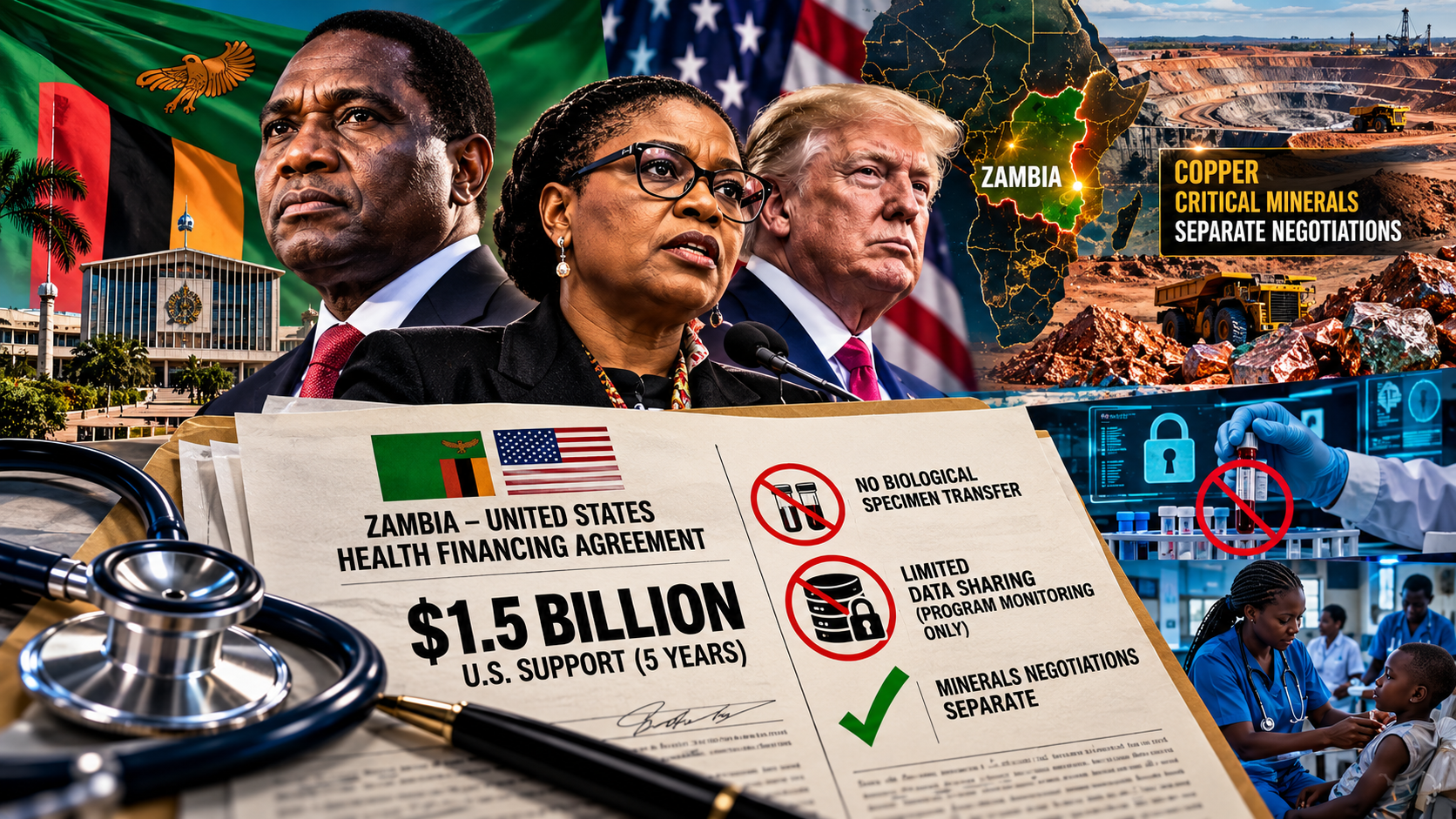
LUSAKA — Zambia has signed a five-year health financing agreement with the United States worth more than $1.5 billion in U.S. support, after months of negotiations over patient data, biological specimens and the country’s strategic mineral resources.
The agreement represents more than a new injection of money into Zambia’s health system. It is also a diplomatic test of how African governments negotiate the terms attached to foreign financing.
And in Lusaka, officials are making one point unmistakably clear: health cooperation and mineral negotiations are separate tracks.
The Clauses That Almost Stopped the Deal
The agreement had been delayed after Zambia objected to provisions concerning the handling of health information and biological specimens.
Under the revised arrangement, Zambia says it will not send biological specimens to the United States, while information shared with Washington will be limited to data necessary to monitor and evaluate U.S.-funded health programs. (Ministry of Foreign Affairs Zambia)
Health Minister Professor Roma Chilengi said the government had negotiated the removal of the provisions that created concerns over data protection, intellectual property, benefit sharing and specimen transfers.
That negotiation matters because biological samples and health databases are no longer simply public-health resources. They can also become valuable assets for medical research, diagnostics, pharmaceutical development and disease surveillance.
Zambia’s position was therefore about more than paperwork.
It was about control.
The Money
Under the final agreement, the United States will provide more than $1.5 billion over five years for priority health programs.
Zambia has separately committed $975 million toward its health system over the same period. The Zambian Ministry of Foreign Affairs puts the U.S. contribution at more than $1.5 billion. (Ministry of Foreign Affairs Zambia)
The agreement is expected to support health-worker recruitment, medicines, disease surveillance and other health-system priorities.
Chilengi has also said the agreement will allow Zambia to recruit additional health workers and strengthen the country’s capacity to respond to disease outbreaks. (The Washington Post)
But the financial commitment comes with a broader strategic shift.
Washington is increasingly seeking bilateral health arrangements in which African governments gradually assume more responsibility for domestic health spending while U.S. assistance becomes more targeted.
The Minerals Question
Then there is copper.
Zambia is one of Africa’s major copper producers and possesses deposits of minerals considered strategically important to the global energy and technology industries.
Earlier negotiations generated controversy over whether Washington’s health financing discussions were connected to negotiations over critical minerals.
Zambia has now formally separated the two issues.
Foreign Minister Mulambo Haimbe said the health agreement was no longer tied to a Critical Minerals Framework. The two countries can negotiate mineral issues separately. (Ministry of Foreign Affairs Zambia)
That separation may ultimately prove to be one of Lusaka’s most important negotiating victories.
The message is straightforward:
Health assistance will not determine who gets access to Zambia’s mineral wealth.
A Question of Sovereignty
The dispute over data reveals another layer of the agreement.
For years, African countries have been asked to provide extensive health information to international partners in the name of disease surveillance and public-health coordination.
But the strategic question is becoming increasingly difficult to ignore:
Who controls the data?
Who decides what constitutes necessary information?
Who owns biological samples?
Who benefits when African health information contributes to the development of new diagnostics, medicines or technologies?
The United States has said health data and specimens obtained through similar arrangements can potentially be shared with American non-government entities for the development of diagnostics and medical treatments. (The Washington Post)
That model has generated resistance in several African capitals.
Zambia chose negotiation rather than outright rejection.
Ghana, Zimbabwe and Namibia
Zambia’s decision comes against a wider African debate.
Other governments, including Ghana, Zimbabwe and Namibia, have resisted or rejected similar U.S. health arrangements because of concerns surrounding data sovereignty and specimen sharing. (AP News)
At least nine African countries have entered agreements containing data and specimen-sharing provisions, according to reporting based on U.S. agreements. (The Washington Post)
That creates an emerging continental divide.
Some governments see the agreements as necessary financing for overstretched health systems.
Others see the conditions as a potential transfer of strategic assets — health data, biological material and intellectual property — without sufficient guarantees that African populations will receive an equitable share of the resulting benefits.
The American Pivot
The agreement also reflects Washington’s changing relationship with Africa.
The Trump administration has pursued a more transactional approach to foreign assistance, moving away from the traditional model associated with the U.S. Agency for International Development and toward bilateral arrangements.
The philosophy is increasingly simple:
America provides financial and technical assistance.
African governments increase domestic contributions.
And both sides negotiate specific strategic interests directly.
For Zambia, that negotiation has now produced a different outcome from the original framework.
Lusaka accepted the financing.
But it also demanded changes to the terms.
Zambia’s Precedent
The significance of the agreement may therefore extend beyond Zambia’s hospitals and clinics.
The Lusaka negotiations demonstrate that African governments can challenge provisions in major international agreements and still reach a financing arrangement.
The lesson for other governments is potentially important.
Foreign financing does not necessarily have to mean surrendering control over national health data.
Health partnerships do not necessarily have to be linked to mineral negotiations.
And development assistance can be negotiated as a partnership rather than accepted as a package.
The real test, however, begins now.
Zambia has secured the revised terms.
The question is whether those terms will be implemented exactly as promised — and whether the country’s health system ultimately receives the long-term benefits that the agreement is supposed to deliver.
For Lusaka, the negotiation may have been about $1.5 billion.
But underneath the numbers was a much larger question:
Who controls Zambia’s health system, its data — and ultimately its strategic future?
Leave a Reply