
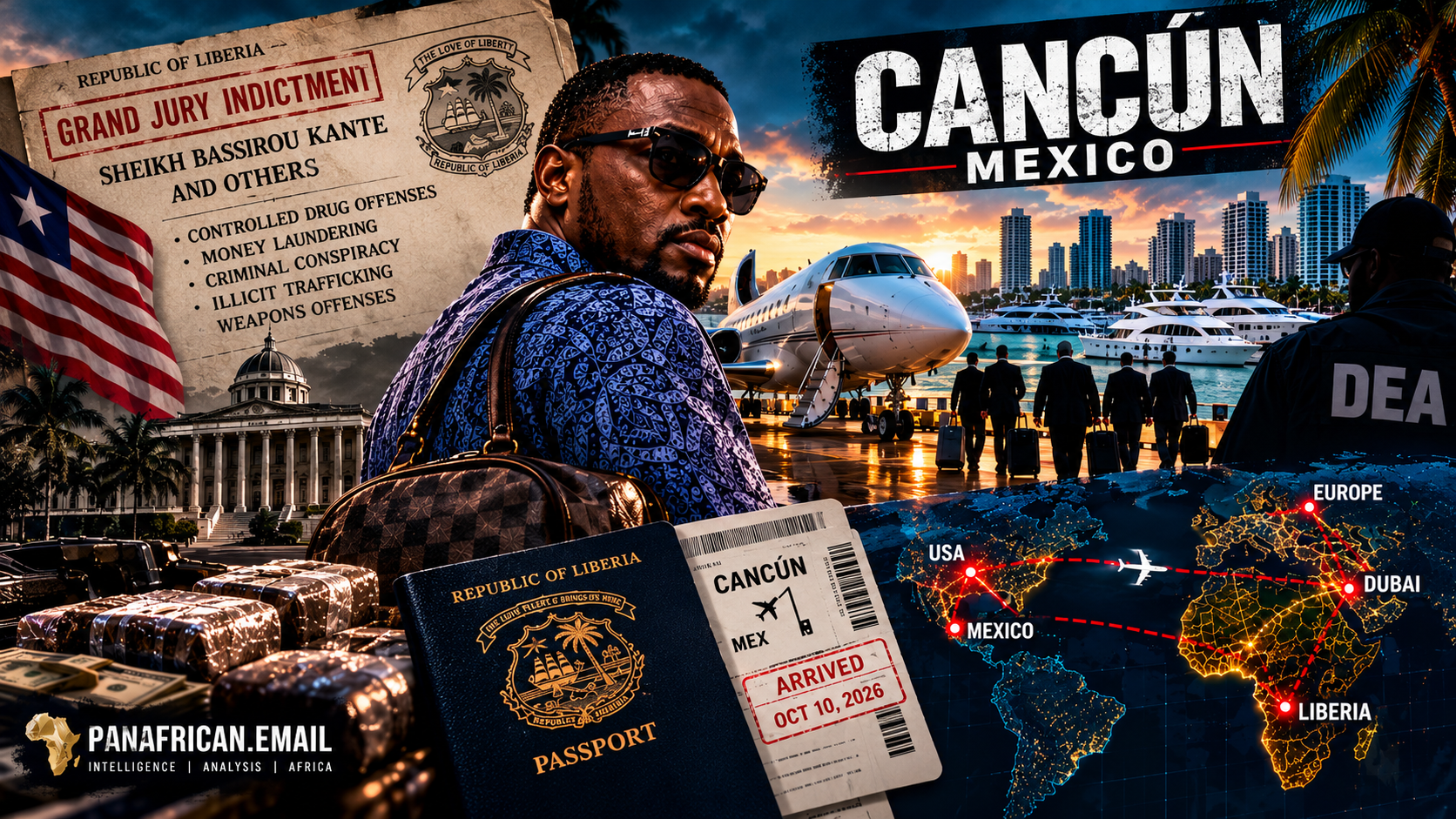
MONROVIA — October 10, 2026 — At first glance, the image looked almost ordinary.
A marina. Bright sky. White yachts. Calm water.
Then came the caption.
Sheikh Bassirou Kante had arrived in Mexico.
For investigators following Liberia’s sprawling narcotics investigation, geography suddenly became part of the story.
Because Kante is not an ordinary traveler in this case.
He is one of the names appearing in Liberia’s newly unsealed indictment against former Vice President Jewel Howard-Taylor and other defendants accused of involvement in an alleged transnational drug-trafficking and money-laundering network.
And Kante is also described in reporting as the man whose recorded communications with Howard-Taylor became a critical part of the government’s case.
Now, according to a social-media post shown by Liberian media, he says he is in Mexico.
The question is not simply where Kante is.
The question is what his location means.
The Man in the Middle
The government’s case traces part of its chain through Kante.

According to the indictment and reporting on the government’s allegations, Kante introduced Howard-Taylor to foreign nationals investigators identify as connected to the alleged trafficking network. Prosecutors say those contacts eventually led to meetings, financial discussions and communications that became part of the investigation. (THE LIBERIAN INVESTIGATOR)
The indictment returned by a Montserrado County grand jury on October 7 names Kante alongside Howard-Taylor, several Liberian officials and foreign nationals. The defendants face charges including controlled-drug offenses, illicit trafficking, conspiracy, facilitation, solicitation, money laundering and weapons-related offenses. (Liberia News Network)
The allegations remain allegations.
Every defendant is presumed innocent unless convicted.
But the legal architecture is now in place.
The case has moved from investigation into prosecution.
And Kante sits close to the center of the evidence.
The Recorded Conversation
According to investigative reporting, Kante cooperated with investigators and was equipped with recording equipment before communicating with Howard-Taylor.
The alleged purpose was straightforward: obtain evidence.
The consequences were anything but.
A recorded call reportedly became one of the most important pieces of evidence used against the former vice president. FrontPageAfrica has reported that Kante contacted Howard-Taylor and referenced a “gift” allegedly connected to the same people he had introduced to her years earlier. (FrontPage Africa Online)
That creates a classic evidentiary battlefield.
The prosecution sees a recorded conversation.
The defense sees a cooperating source whose motives, credibility and relationship with investigators can be attacked.
And there is another problem.
Kante is now himself named in the indictment.
The Witness Who Became a Defendant
This changes the equation.
A cooperating source is one thing.
A cooperating source who is simultaneously facing criminal allegations is something else.
Defense lawyers can ask the questions that prosecutors would prefer to keep away from the center of the courtroom:
What did Kante receive for cooperating?
What was promised?
Was his own exposure reduced?
What instructions did investigators give him?
How was the recording made?
Was the conversation complete?
Was anything omitted?
What was Kante’s personal interest in producing evidence against Howard-Taylor?
And perhaps the most important question:
Why should a court believe him?
These questions do not prove the government’s case is false.
Nor do they prove Kante is unreliable.
They are simply the questions that a defense team is entitled to ask when a cooperating source becomes central to a prosecution.
The American Shadow
There is another layer.
Kante’s legal history does not begin in Liberia.
Reporting from Liberia says he was arrested in Maryland in 2022 in connection with federal financial crimes, later pleaded guilty and was placed on supervised release. U.S. authorities subsequently issued an arrest warrant after he allegedly went unaccounted for in October 2024. Reporting says the U.S. Marshals Service has continued seeking information concerning his whereabouts. (Liberia News Network)
That means the Liberia investigation is intersecting with an older American legal problem.
Two jurisdictions.
Two separate legal processes.
One individual.
And now, apparently, Mexico.
The Mexico Question
There is no verified evidence establishing that Kante traveled to Mexico to escape either American or Liberian authorities.
That distinction matters.
The social-media post shown to Panafrican.email indicates that Kante announced that he had arrived in Mexico. It does not establish his purpose for traveling there.
He could be traveling for business.
He could be traveling for personal reasons.
He could be relocating.
Or the trip could have nothing whatsoever to do with the Liberian prosecution.
Anything beyond that is speculation.
But timing matters in intelligence work.
The Mexico announcement comes immediately after Liberia’s grand jury returned the indictment and the court issued a writ directing authorities to arrest the defendants named in the case. (Liberia News Network)
That makes his whereabouts newsworthy even if his motive remains unknown.
The International Dimension
The alleged network described by Liberian prosecutors is not confined to one country.
The indictment names foreign nationals from Europe alongside Liberian citizens and officials. Investigators have described alleged connections involving Liberia, Dubai and other international locations. (Liberia News Network)
The alleged cocaine operation therefore presents the characteristics of a transnational investigation:
Africa.
Europe.
The Middle East.
North America.
And now potentially Mexico—although Kante’s presence there has not yet been independently established by authorities in the sources reviewed.
The geography is important because international criminal cases are rarely solved by one arrest.
They are solved by following money, communications, passports, phones, travel records, financial transfers and relationships across borders.
The Weak Point
Every intelligence operation has a pressure point.
In this case, the pressure point may be the evidence connecting the alleged network to Howard-Taylor.
The prosecution has recordings.
The defense will attack the circumstances surrounding those recordings.
The prosecution has alleged financial transactions.
The defense can challenge their origin, meaning and connection to narcotics proceeds.
The prosecution has Kante.
The defense can examine Kante.
And if Kante is outside Liberia, another question emerges:
Will the prosecution be able to put him before the court?
That question could become more important as the case moves toward trial.
The Former Vice President
Howard-Taylor has denied the allegations.
Her office has said that she welcomes the opportunity to challenge the government’s evidence in court and maintains that she is innocent. (Women Voices Newspaper)
Her defense is likely to focus heavily on evidence.
Not headlines.
Not political narratives.
Evidence.
Was she knowingly involved in a trafficking operation?
Did she understand the source and purpose of any money she allegedly received?
What exactly do the recordings prove?
What did Kante tell investigators?
And what did he leave out?
Those questions belong in court.
The Bigger Battle
Liberia’s government is attempting to demonstrate that it has uncovered an international criminal network capable of exploiting political, security and commercial relationships.
The defense will attempt to demonstrate that the government has overreached—or failed to establish the required links between association, communication, money and criminal intent.
Those are fundamentally different stories.
And the court will ultimately have to decide which one survives scrutiny.
For now, the Mexico image is only a signal.
It is not proof of flight.
It is not proof of obstruction.
It is not proof of guilt.
But it is a development worth watching because Sheikh Bassirou Kante is no longer merely a name on the edge of Liberia’s biggest political drug prosecution. He is one of the people around whom the evidence, the allegations and the international dimensions of the case converge.
The next move may tell us more than the last one.
If Mexican authorities confirm his presence, if U.S. authorities comment on his status, or if Liberian prosecutors seek his return, the meaning of the photograph changes immediately.
Until then, there is only one safe conclusion:
Kante is somewhere new. The case is entering its most consequential phase. And Liberia’s courtroom battle is beginning to look increasingly international.
Editor’s note: This article distinguishes allegations from established facts. All defendants are presumed innocent unless proven guilty in court. Panafrican.email has not independently verified Kante’s current location in Mexico or the reason for his travel.
Leave a Reply