
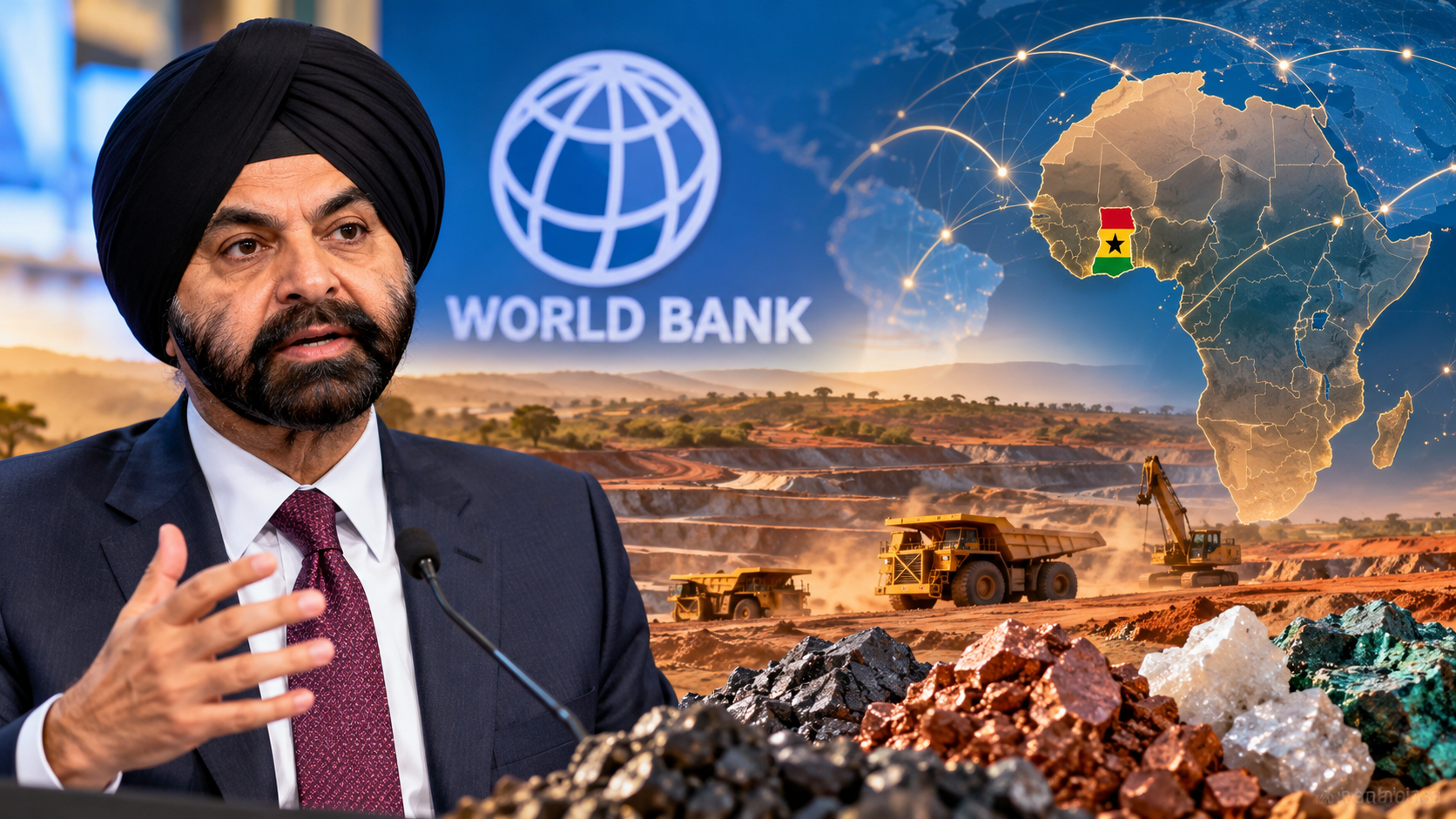
ACCRA, GHANA — The World Bank is setting an ambitious five-year target to expand its financing for critical minerals, with President Ajay Banga saying the institution intends to quintuple its critical minerals business as governments and investors race to secure the resources underpinning the global energy and technology transition.
According to a report attributed to Australasia Global Mining News, Banga disclosed the target during prepared remarks to a plenary session at the International Monetary Fund and World Bank annual meetings in Bangkok.
The World Bank has also identified 20 countries it believes could become partners in critical-minerals development projects, signaling a broader effort to move beyond financing individual mining operations and toward strategic partnerships around mineral supply chains.
For countries across Africa, the development could have significant implications.
A New Battle Over Critical Minerals
Critical minerals have become increasingly important to the global economy as demand grows for electric vehicles, renewable-energy infrastructure, advanced electronics, batteries, telecommunications equipment and other technologies.
The competition is no longer limited to securing deposits.
Governments are increasingly focused on who controls the processing, refining, transportation and manufacturing stages that turn mineral resources into strategic industrial inputs.
Banga’s stated objective therefore points toward a potentially larger role for the World Bank in helping mineral-producing countries develop the infrastructure and investment ecosystems needed to capture more value from their natural resources.
The reported fivefold expansion would represent a major increase in the institution’s focus on the sector over the coming five years.
Why Ghana Matters
Ghana is already one of Africa’s major mineral-producing economies, with gold forming the backbone of its mining industry. The country’s wider mineral potential could become increasingly important as international institutions and investors look for diversified sources of strategic resources.
The World Bank’s identification of 20 potential partner countries places Ghana within a broader conversation about how mineral-rich developing economies can participate in emerging critical-mineral supply chains.
For Ghana, the opportunity is not simply about extracting more resources.
The larger strategic question is whether the country can attract investment into processing, refining, infrastructure, logistics, energy and industrial manufacturing rather than remaining primarily an exporter of raw materials.
That distinction could determine how much economic value remains inside Ghana.
From Mining to Mineral Intelligence
The global critical-minerals race is also changing the way investors evaluate African markets.
Geological potential is only one part of the equation. Investors increasingly need to understand infrastructure, political risk, energy availability, transportation corridors, environmental requirements, government policy, licensing systems and the proximity of mineral deposits to processing and export infrastructure.
This creates a growing demand for mineral intelligence that connects geological information with economic and geopolitical analysis.
For African governments, the same information can be used to negotiate investment agreements from a stronger position and identify opportunities for domestic industrial development.
Africa’s Strategic Position
Africa possesses significant mineral resources, but the continent has historically captured a relatively limited share of the value generated after extraction.
The next phase of the minerals economy could therefore become a contest over value addition.
If international development institutions significantly increase financing for critical minerals, African countries could have an opportunity to use that capital to develop infrastructure and industrial capacity around mineral deposits.
But financing alone will not guarantee that outcome.
Countries will need clear regulatory frameworks, transparent licensing, reliable energy systems, transport infrastructure, skilled labor and policies that encourage local processing.
The challenge will be ensuring that increased foreign investment translates into durable domestic economic capacity.
The Question Behind the Fivefold Target
The World Bank’s reported target raises a larger question: What will critical-minerals financing actually finance?
If capital primarily supports extraction, producing countries could see increased mining activity without a corresponding transformation in their industrial economies.
If financing extends into processing, refining, transportation, energy and manufacturing, the impact could be substantially larger.
That distinction will be particularly important for African economies seeking to move from commodity exporters toward industrial producers.
What to Watch
For Ghana and other African mineral-producing countries, several developments will be important to monitor:
- Which 20 countries the World Bank ultimately identifies as priority partners.
- Which minerals and projects qualify for expanded financing.
- Whether financing reaches processing and refining rather than extraction alone.
- How much private capital is mobilized alongside World Bank financing.
- Whether African governments secure stronger local-value and industrial-development requirements.
- Whether new mineral projects create regional supply chains rather than isolated export operations.
The reported announcement comes at a time when critical minerals are becoming increasingly intertwined with economic security, industrial policy and geopolitical competition.
For Ghana, the opportunity is potentially significant—but the strategic objective should extend beyond digging minerals out of the ground.
The central question for the next five years may be whether Africa can use the new wave of critical-minerals investment to build industries around its resources, rather than simply supplying the resources to industries elsewhere.
Source: Australasia Global Mining News, as provided in the intelligence report.
Status: Unverified. The reported World Bank target and list of 20 countries should be independently confirmed before being treated as an official World Bank announcement.
Leave a Reply