
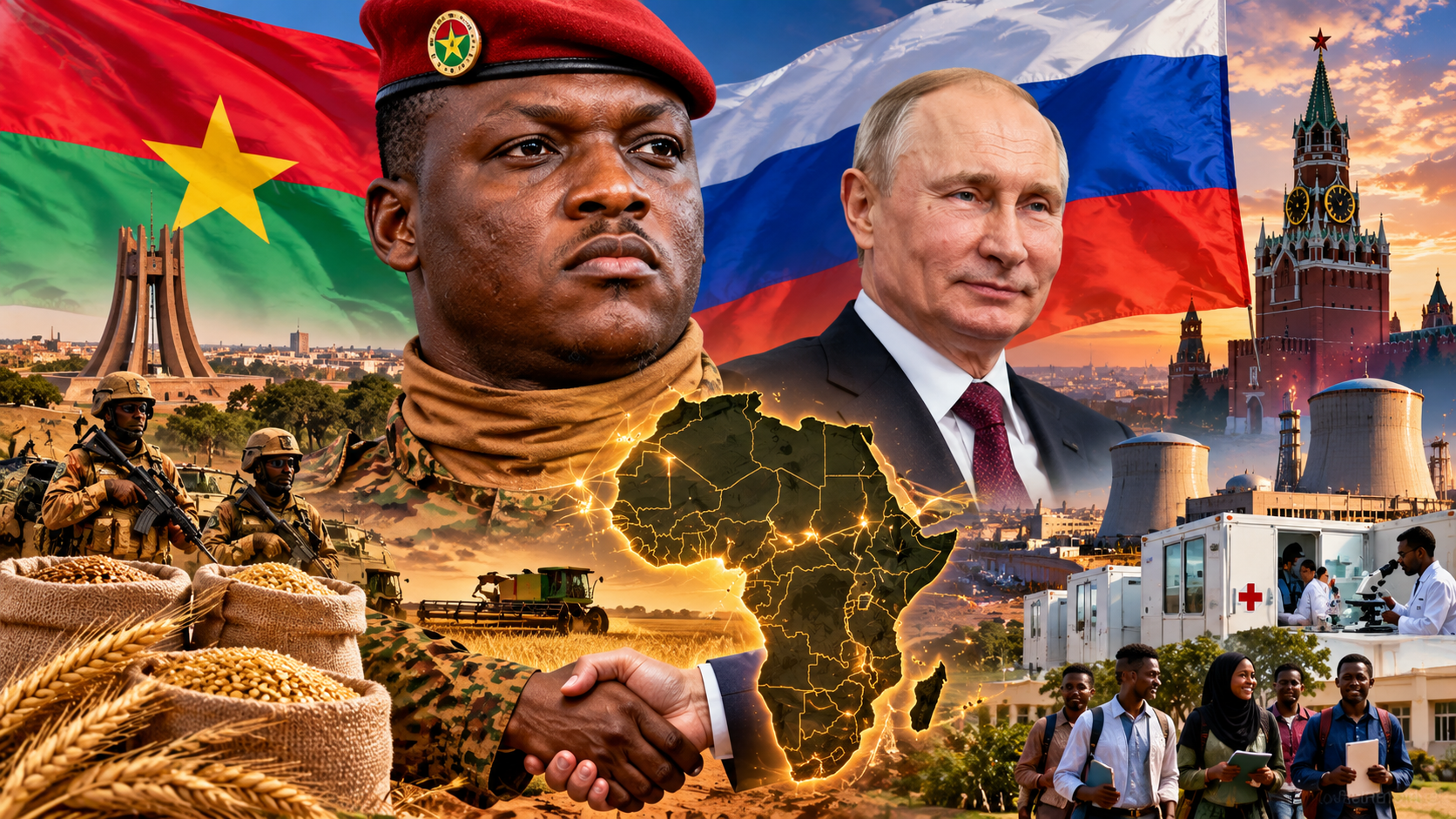
OUAGADOUGOU — Burkina Faso’s geopolitical realignment is becoming increasingly visible as Interim President Ibrahim Traoré prepares for another high-profile engagement with Russia, signaling that Ouagadougou intends to deepen its relationship with Moscow while reducing its dependence on traditional Western partnerships.
According to the Firstpost report, Traoré is expected to attend the third Russia-Africa Summit later this month. The visit would represent his third prominent trip to the Russian Federation in just over two years and comes as Burkina Faso continues to expand cooperation with Russia across security, food production, healthcare, education and potentially nuclear technology.
The relationship has developed against the backdrop of a broader transformation in Burkina Faso’s foreign policy under Traoré.
From Security Partnership to Strategic Partnership
Security remains central to the relationship.
Burkina Faso is confronting a prolonged jihadist insurgency across parts of the Sahel, and the government has increasingly sought alternatives to the military and security relationships that previously dominated the region.
Russia has reaffirmed its willingness to assist Burkina Faso in confronting terrorism and extremism, according to the report.
But the emerging relationship is extending beyond military cooperation.
For Traoré’s government, the larger question is whether external partnerships can contribute to building a more self-reliant state rather than simply replacing one security dependency with another.
That distinction is central to the Burkinabè leadership’s public rhetoric.
Traoré’s Sovereignty Message
At the 2023 Russia-Africa Summit, Traoré delivered one of the most striking speeches by a young African leader on the continent’s relationship with the outside world.
He criticized what he described as continuing forms of neo-colonial dependency and challenged African leaders to stop allowing their countries to remain dependent on external powers.
His message was blunt: African states should determine their own political and economic destinies.
That position has become a defining feature of his government’s international posture.
The growing relationship with Moscow is therefore being presented not simply as a change of geopolitical allegiance, but as part of a broader strategy of strategic autonomy.
For Ouagadougou, the objective is to establish relationships that provide Burkina Faso with access to technology, food, education, healthcare and security while strengthening the country’s ability to operate independently.
Food Security Becomes Geopolitical
One of the clearest examples is food security.
According to the report, Russia has supported Burkina Faso through grain shipments as the country attempts to strengthen its domestic food supply.
Food security is increasingly viewed across Africa as a strategic issue rather than simply an agricultural one.
A country that cannot reliably feed its population remains vulnerable to external economic pressure. For governments pursuing greater sovereignty, agricultural production, fertilizer access, grain supplies, irrigation and food-processing capacity therefore become components of national security.
The Russian relationship is being developed within this wider framework.
The question for Burkina Faso will ultimately be whether imported assistance can evolve into domestic productive capacity.
Healthcare and Scientific Capacity
The partnership is also moving into healthcare.
Russia has reportedly supported Burkina Faso through the transfer of advanced mobile laboratories designed to assist with disease control.
For a country confronting significant public-health challenges, mobile laboratory capacity can provide more than immediate medical assistance. It can also contribute to the development of scientific infrastructure and technical expertise.
This is particularly significant within Traoré’s broader emphasis on science and technical knowledge.
The underlying philosophy is that political independence without technological capacity remains incomplete.
A nation may control its territory politically while remaining dependent on foreign countries for the technologies necessary to manage its food systems, healthcare, energy and industrial development.
Education as an Investment in Sovereignty
Education represents another pillar of the expanding partnership.
The report states that Russia is doubling scholarships available to Burkinabè students.
Scholarship programs can have long-term geopolitical consequences because they create educational and professional networks that may influence a country’s future relationships for decades.
For Burkina Faso, sending students abroad to study science, engineering, medicine and other technical disciplines could help build a generation capable of contributing to domestic technological development.
This aligns closely with Traoré’s argument that African sovereignty requires mastery of science and technical expertise.
The strategic objective is therefore larger than sending students overseas.
It is about creating the human capital required to eventually build institutions, industries and infrastructure at home.
Civil Nuclear Cooperation
Perhaps the most consequential area under discussion is nuclear energy.
According to the Firstpost report, discussions are underway regarding civil nuclear cooperation between Burkina Faso and Russia.
If pursued, such cooperation could represent a major expansion of the relationship.
Reliable electricity is one of Africa’s most persistent structural challenges. Energy shortages constrain industrialization, manufacturing, healthcare, education and digital infrastructure.
Civil nuclear technology is complex and requires significant institutional, financial, scientific and regulatory capacity. For Burkina Faso, therefore, nuclear cooperation would represent not simply an energy project but potentially a long-term technological-development program.
It would also fit the government’s broader emphasis on mastering advanced technical capabilities.
A Wider Sahelian Transformation
Burkina Faso’s relationship with Russia cannot be separated from the wider geopolitical transformation taking place across the Sahel.
Governments in the region have increasingly questioned longstanding relationships with France and other Western powers while exploring alternative partnerships.
The result is a more competitive geopolitical environment in which African governments have greater opportunity to negotiate relationships with multiple external powers.
Russia is one of those powers.
China, Turkey, the Gulf states and other emerging partners are also increasingly important actors across Africa.
For African governments, this creates an opportunity to diversify relationships rather than remain locked into a single geopolitical bloc.
But diversification also creates new responsibilities.
Replacing one external dependency with another would not necessarily constitute sovereignty.
The deeper challenge is whether partnerships with Russia—or any other external power—can help African states develop domestic productive capacity, technological expertise and independent institutions.
The Real Test Is Self-Reliance
This is where Traoré’s message becomes particularly important.
The central question is not whether Burkina Faso chooses Russia over the West.
The more important question is whether Burkina Faso can use international partnerships to build capabilities that eventually reduce its dependence on external assistance altogether.
Grain shipments can address immediate food requirements.
But domestic agricultural productivity is the longer-term objective.
Foreign medical laboratories can strengthen healthcare.
But domestic scientific institutions and manufacturing capacity are the ultimate goal.
Scholarships can train students abroad.
But the strategic payoff comes when those students contribute to national development.
Nuclear cooperation could expand electricity generation.
But the deeper question is whether Burkina Faso develops the technical, regulatory and institutional capacity necessary to manage advanced energy systems.
This is the difference between geopolitical realignment and genuine strategic sovereignty.
Africa’s Emerging Geopolitical Choice
Traoré’s government is presenting its relationship with Moscow as part of a larger effort to reclaim African agency.
The approach reflects a growing sentiment among some African governments that the continent should no longer be required to choose between predetermined geopolitical camps.
Instead, African states should have the freedom to establish partnerships according to their own national interests.
For Burkina Faso, Russia currently represents an important partner in that strategy.
The relationship spans security, food, healthcare, education and potentially energy and nuclear technology.
Whether it ultimately delivers the self-reliance promised by Traoré’s rhetoric will depend on what Burkina Faso builds with that assistance.
The defining measure will not be the number of summits attended or agreements signed.
It will be whether the country emerges with stronger domestic institutions, greater productive capacity, deeper scientific expertise and a reduced dependence on foreign powers.
That is the real test of sovereignty.
Panafrican.email Intelligence Note
The Firstpost report frames Traoré’s upcoming Russia engagement as another step in Burkina Faso’s geopolitical realignment and highlights cooperation in security, food, healthcare, education and potential civil nuclear development.
The broader strategic question remains open: Can external partnerships become instruments of African self-reliance rather than new forms of dependency?
For Burkina Faso, that question may ultimately matter more than whether its closest partner is Moscow, Washington, Paris, Beijing—or any other capital.
Leave a Reply