
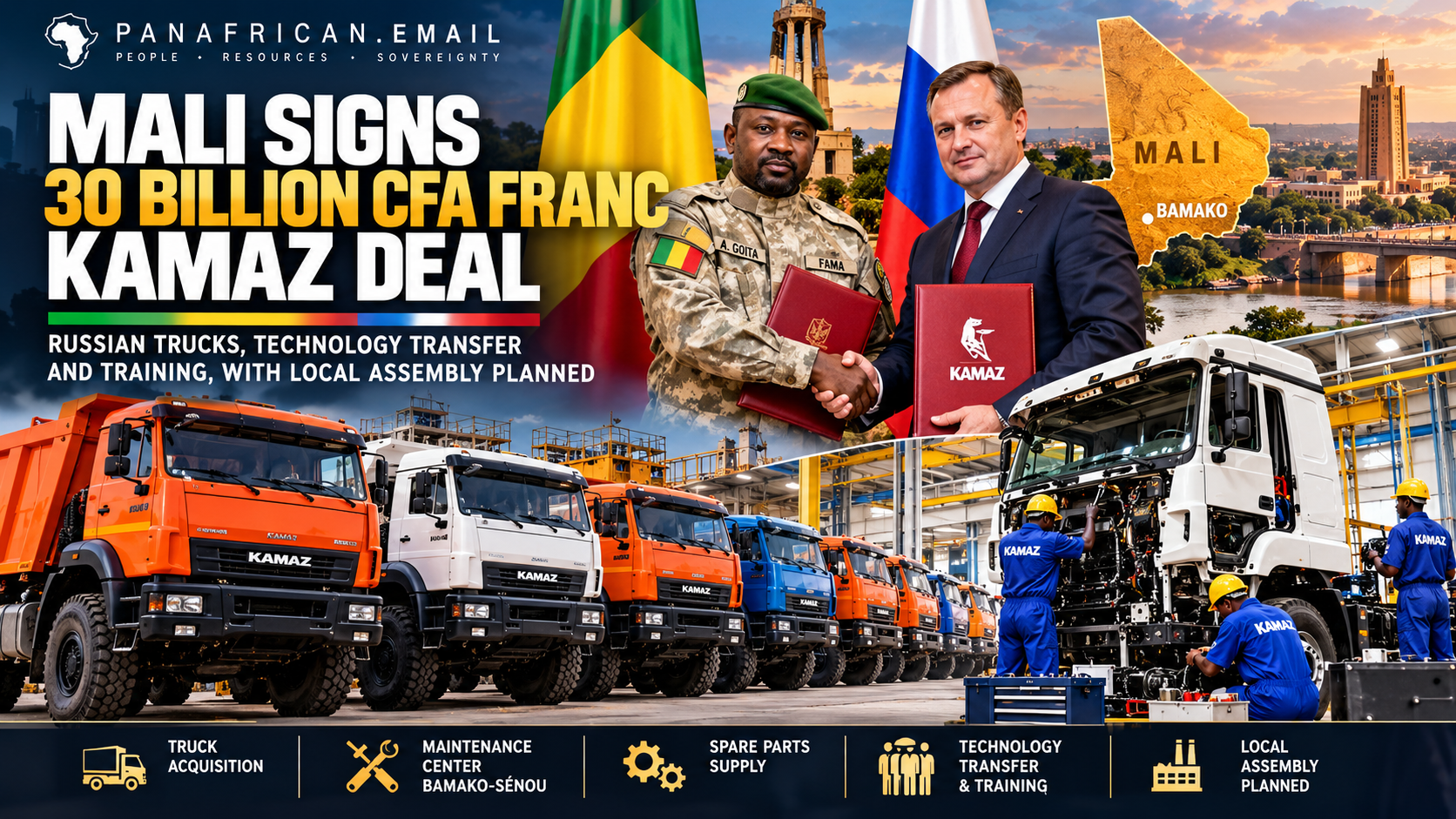
BAMAKO, Mali — Mali has signed a major transport and logistics agreement with Russian truck manufacturer KAMAZ worth more than 30 billion CFA francs, in a partnership that goes beyond the purchase of vehicles to include maintenance infrastructure, spare-parts supply, technology transfer and technical training.
The agreement, signed in Bamako on October 7, 2026, between the Société malienne de Transport et de Logistique (SMTL-SA) and KAMAZ, represents a significant step in Mali’s effort to strengthen its domestic logistics capabilities and reduce vulnerabilities in the movement of essential goods.
The Malian government says the contract is intended to expand national transport and logistics capacity and improve the country’s ability to meet its food, industrial and supply-chain requirements. (Government of Mali)
More Than a Truck Purchase
The headline figure of more than 30 billion FCFA, equivalent to roughly $51 million, initially draws attention because of the scale of the vehicle procurement. But the strategic significance of the agreement lies in what accompanies the trucks.
Under the partnership, Mali is expected to establish a dedicated maintenance and repair workshop in Bamako-Sénou, supported by KAMAZ. The agreement also provides for the supply of spare parts and technical support. (Government of Mali)
For a landlocked country whose economy depends heavily on reliable road transportation, maintaining a functioning commercial vehicle fleet is critical.
A truck that cannot be repaired locally can become a supply-chain liability. A truck supported by local technicians, spare-parts infrastructure and technical training becomes part of a broader logistics system.
That distinction is at the heart of Mali’s approach.
Training Malian Technicians in Russia
Another major component of the agreement is human-capital development.
Malian technical specialists are expected to receive training in Kazan, Russia, giving them the expertise required to service and maintain KAMAZ vehicles and eventually support the development of domestic technical capabilities.
The Russian and Malian sides have also discussed the transfer of technologies and expertise as part of the partnership. (Russian Transport Ministry)
This could become one of the most consequential aspects of the deal if training translates into a larger ecosystem of mechanics, engineers, technicians, parts suppliers and logistics specialists inside Mali.
Rather than treating imported equipment as an end product, the model creates the possibility of turning imported technology into domestic industrial knowledge.
From Imported Trucks to Local Assembly
The most ambitious element of the partnership is the possibility of assembling KAMAZ vehicles in Mali.
Malian officials have described plans for the eventual establishment of an assembly workshop and, over the longer term, a KAMAZ vehicle assembly or manufacturing facility in Bamako. KAMAZ has confirmed its willingness to support Mali in developing a local service center and, eventually, assembly capabilities. (Government of Mali)
It is important to distinguish this from the current contract itself: the immediate agreement is centered on vehicle acquisition and supporting infrastructure, while local assembly represents a longer-term development objective.
If realized, however, the implications could extend well beyond the transportation sector.
A local assembly operation could create demand for trained workers, engineering services, logistics providers, warehouses, parts distribution and other industrial support businesses.
The project could therefore become a foundation for a wider industrial ecosystem.
A New Direction for Mali’s Logistics Strategy
Mali’s decision comes as the country seeks greater control over critical supply chains.
As a large, landlocked West African country, Mali relies on transportation networks connecting its cities, agricultural regions, commercial centers and external markets. The ability to move food, fuel, industrial inputs, construction materials and other essential goods is therefore closely connected to economic security.
The Malian government has framed the KAMAZ agreement in precisely those terms, saying the partnership is intended to improve the country’s capacity to transport and supply essential goods. (Government of Mali)
The creation of SMTL-SA itself reflects this broader objective. The company is being positioned as an important instrument for strengthening national transport and logistics capacity.
The KAMAZ partnership consequently represents not simply the expansion of a vehicle fleet, but an attempt to build the infrastructure needed to operate and maintain that fleet inside Mali.
The Russia–Mali Economic Partnership
The KAMAZ agreement also fits within the expanding economic relationship between Mali and Russia.
According to the Russian Ministry of Transport, the contract was concluded within the framework of an intergovernmental agreement between Russia and Mali. The agreement follows earlier discussions between the two countries on transportation, logistics, technology and industrial cooperation. (Russian Transport Ministry)
A memorandum of understanding between Mali and KAMAZ was signed in May following the second meeting of the Russia–Mali Intergovernmental Commission in Kazan. The October contract represents a move from that framework toward a concrete commercial project. (African Initiative – news agency)
This progression—from memorandum, to procurement, to maintenance infrastructure and potentially local assembly—is significant.
For Mali, the objective is to capture more of the economic value generated by transportation infrastructure.
For Russia and KAMAZ, the partnership provides an opportunity to establish a deeper presence in a strategically important West African market.
What Local Assembly Could Mean
If the proposed assembly operation in Bamako eventually becomes reality, the economic impact could extend beyond the number of vehicles produced.
Industrial assembly requires more than a factory building. It requires technicians, electricians, welders, mechanics, quality-control personnel, logistics operators, warehouse workers, engineers and management specialists.
It also creates opportunities for local companies to participate in the surrounding supply chain.
Over time, a successful assembly operation could therefore help develop a cluster of industrial capabilities around transportation equipment.
That is precisely why technology transfer and training are important.

The real measure of industrial sovereignty is not simply whether a country owns imported equipment. It is whether its people increasingly possess the skills and infrastructure required to operate, repair, adapt and eventually produce the equipment themselves.
A Test of Industrial Policy
The KAMAZ partnership now faces an important test: whether the initial vehicle procurement can evolve into sustained local capacity.
The immediate priorities will be practical—getting vehicles into operation, establishing the Bamako-Sénou maintenance infrastructure, ensuring spare-parts availability and training technicians.
The longer-term challenge will be converting those foundations into an industrial base.
That will require investment, reliable electricity and infrastructure, technical education, efficient supply chains and a sufficiently large market to make local assembly economically viable.
If those pieces come together, the KAMAZ partnership could become an example of how a vehicle procurement agreement can be used as a starting point for industrial development.
If they do not, the agreement risks remaining primarily an import contract with supporting services.
The difference will depend on implementation.
Beyond the 30 Billion CFA Franc Figure
The most important story may therefore not be the 30 billion CFA franc price tag.
It may be what Mali attempts to build around it.
The immediate agreement brings Russian trucks and technical support into the country’s transportation system. The maintenance center would keep more servicing activity inside Mali. Training could build a national pool of technical expertise. Technology transfer could deepen local capabilities. And the proposed assembly operation could eventually move part of the value chain from importation toward production.
For Mali, that represents a potentially important shift in thinking: from purchasing equipment to developing the capacity to sustain and eventually produce it.
For West Africa, the project will be worth watching as a potential case study in industrial policy, logistics sovereignty and technology partnerships.
The first trucks are only the beginning.
The larger question is whether Bamako can turn a major vehicle contract into a lasting industrial capability built around Malian workers, Malian technical expertise and infrastructure located on Malian soil.
That will ultimately determine the significance of the KAMAZ agreement.
Leave a Reply