
By Panafrican.email | Film & Culture
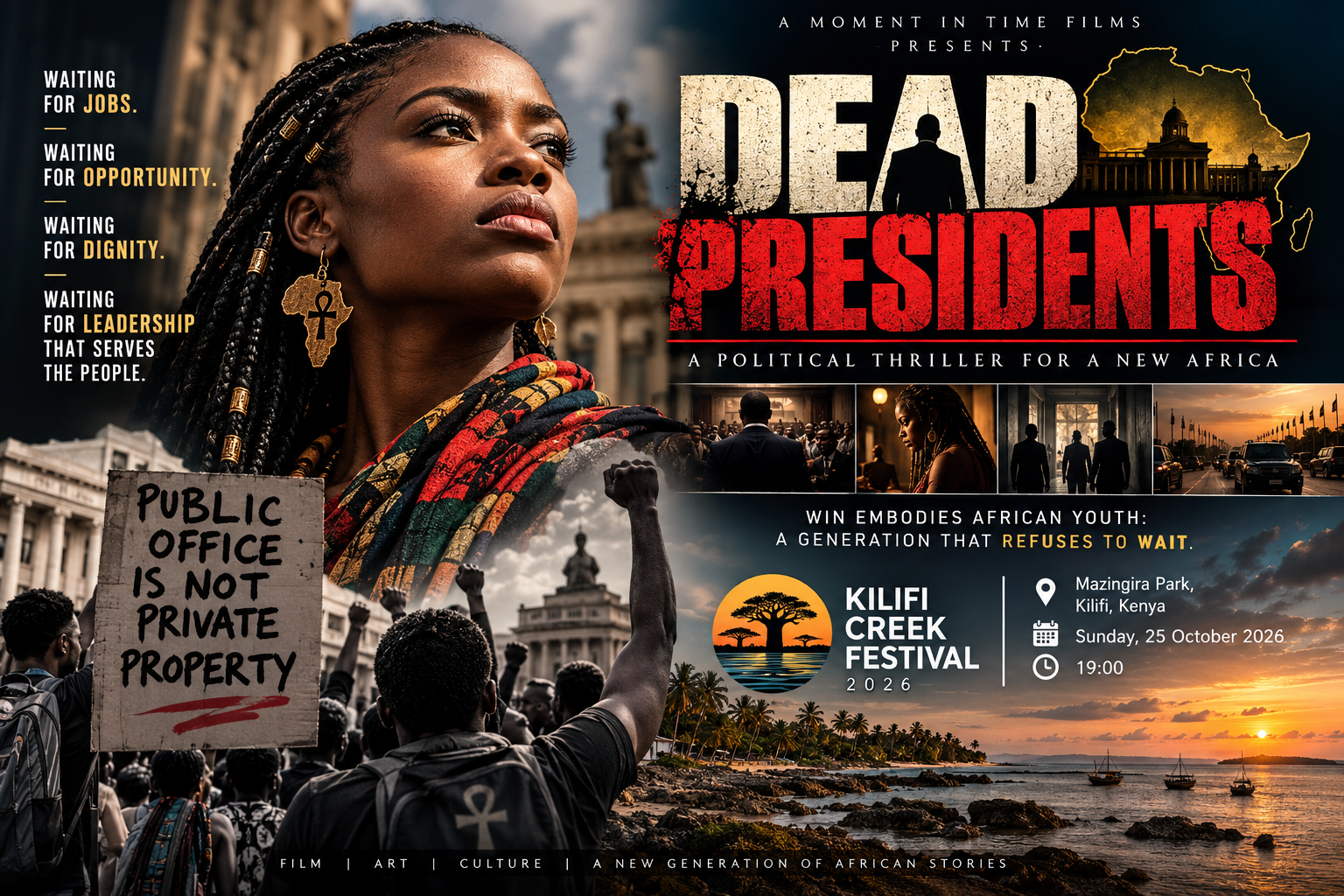
A new African political thriller titled Dead Presidents is turning its attention to one of the continent’s most urgent questions: what happens when a generation loses faith in the institutions that are supposed to create opportunity, dignity and a future?
According to a promotional announcement from A Moment In Time Films, the film centres on Win, a young African woman described as embodying a generation tired of waiting—for jobs, opportunity, dignity and leadership that serves the public rather than itself.
The filmmakers are presenting the project not simply as a political thriller, but as a confrontation with the frustrations facing Africa’s younger generation.
The film is scheduled to be screened in Kenya during the 2026 Kilifi Creek Festival, which runs from 23 to 31 October 2026 along Kenya’s coast. The festival has developed into an important platform for African and international cinema, bringing films, artists, workshops, exhibitions and industry discussions into the cultural landscape of Kilifi.
A story about a generation that is tired of waiting
The central character, Win, is presented as more than an individual protagonist.
She represents a generation confronting a familiar set of questions:
Where are the jobs?
Where are the opportunities?
Where is the economic independence?
Where is the political accountability?
And who is actually building the future?
The filmmakers’ description places these questions at the centre of Win’s journey.
She is described as being tired of waiting for employment, tired of waiting for opportunity and tired of waiting for dignity.
That framing gives Dead Presidents a distinctly contemporary African political dimension.
Across the continent, young people constitute a huge share of the population, while many economies continue to struggle with unemployment, underemployment, inequality and limited access to capital.
For young Africans attempting to establish independent lives, political decisions can have consequences that extend far beyond election cycles.
A government budget can determine whether a young person receives an education.
A corruption scandal can affect public services.
A failed infrastructure project can limit economic opportunity.
A weak employment market can push skilled graduates into informal work or migration.
And political instability can transform the question of finding a job into the question of simply finding somewhere safe to build a future.
Against that background, Win’s frustration becomes a broader political metaphor.
“Public office is not private property”
One of the strongest ideas presented in the film’s promotional statement is the assertion that public office is not private property.
That concept goes directly to the heart of democratic accountability.
Political office is supposed to represent a public trust.
Presidents, ministers, legislators, governors, mayors and other public officials exercise authority because institutions and citizens have entrusted them with that responsibility.
The film appears to ask what happens when that relationship becomes distorted.
What happens when political power is treated as personal wealth?
What happens when public resources are treated as political possessions?
What happens when access to opportunity depends on political connections rather than merit?
And what happens when an entire generation begins to believe that the political system was never designed for them?
These are questions that extend beyond one country.
They are part of a much larger African conversation about governance, accountability and the relationship between political elites and younger citizens.
The anger of Africa’s youth
The filmmakers describe Win as embodying the anger of a generation that has been ignored, exploited and left to inherit the consequences of decisions it never made.
That idea gives the film its strongest political charge.
Africa’s youth did not create many of the institutions they inherited.
They did not design colonial borders.
They did not establish many of the political systems that followed independence.
They did not negotiate the economic arrangements that shaped postcolonial states.
Yet they live with the consequences of those historical decisions.
They inherit national debt.
They inherit infrastructure deficits.
They inherit environmental damage.
They inherit unemployment.
They inherit political rivalries.
And they inherit institutions that are sometimes decades behind the technological and social realities of the population they serve.
The question increasingly being asked by young Africans is therefore not simply:
“What went wrong?”
It is:
“Why should our generation continue operating under systems that are no longer working?”
That is where a political thriller such as Dead Presidents can become more than entertainment.
It can become a vehicle for political imagination.
Why the title matters
The title Dead Presidents inevitably carries historical associations with political power and money.
The phrase has also been used in popular culture to refer to currency because of the portraits of deceased presidents printed on banknotes.
That symbolism is particularly relevant to a political story.
Presidents may leave office.
Governments change.
Political parties rise and fall.
But the institutions of power remain.
Money circulates.
Political influence changes hands.
And ordinary citizens continue to experience the consequences.
The title therefore creates an interesting intersection between political authority and economic power.
Who controls the money?
Who controls the institutions?
Who benefits from public resources?
And who is left waiting outside the gates?
These are questions that can make a political thriller resonate far beyond the fictional world of its characters.
Kilifi becomes the setting for the conversation
The film’s scheduled appearance at the Kilifi Creek Festival is particularly significant.
Kilifi Creek Festival is not simply a conventional urban film event.
The festival describes itself as an artist-led, community-rooted celebration of film, art and culture built around the natural environment and communities of Kenya’s coast. Its 2026 edition runs from 23–31 October.
The festival’s philosophy is built around the idea that cinema can exist outside traditional cultural capitals.
Its programme combines screenings with workshops, masterclasses, exhibitions, public conversations and industry events.
That environment is particularly appropriate for a film concerned with political and social questions.
Cinema becomes a meeting point.
A film raises a question.
An audience challenges it.
Filmmakers respond.
Young people debate it.
And communities interpret the story through their own experiences.
That is one of cinema’s most powerful functions.

Kilifi’s growing African cinema platform
The 2026 edition of Kilifi Creek Festival is considerably larger than its inaugural year.
Festival organisers say the 2025 edition featured 33 films from 15 countries, with 47 screenings across seven venues and more than 1,000 attendees.
For 2026, the festival received 260 film submissions from more than 50 countries.
The announced programme has expanded substantially, with reports describing 92 films across a broad programme of features, shorts, experimental works and immersive cinema.
The festival is also expanding its industry programme and awards structure, including the introduction of the African Film Press Critics Prize in East Africa.
That growth reflects a larger shift in African cinema.
Film culture is increasingly moving beyond the traditional centres of Johannesburg, Lagos, Nairobi, Accra and Cairo.
Smaller cities and coastal communities are becoming important places for filmmakers to meet audiences.
Kilifi is positioning itself within that movement.
Cinema as political conversation
Political cinema does not necessarily need to tell audiences what to think.
Its more powerful role can be to make audiences uncomfortable enough to ask better questions.
Dead Presidents appears to take that approach.
Rather than presenting its protagonist simply as a victim, the filmmakers place Win inside a broader political environment.
She is frustrated.
She is angry.
But she is also questioning.
And that distinction matters.
Anger without analysis can become destructive.
Analysis without action can become paralysis.
Political cinema can occupy the space between the two.
It can give audiences a fictional environment in which difficult questions can be examined without requiring viewers to agree on every answer.
The danger of political disillusionment
One of the most important themes suggested by the film’s description is the danger of political disillusionment.
When young citizens believe that legitimate avenues for advancement are closed, the consequences can be serious.
Some leave.
Some disengage.
Some turn toward protest.
Some become activists.
Some seek alternative political movements.
Others may simply stop believing that government has anything meaningful to offer them.
That erosion of trust can be more dangerous to a political system than a single election defeat.
Democracy requires more than voting.
It requires citizens to believe that institutions are capable of responding to them.
When that belief disappears, political legitimacy begins to weaken.
That appears to be one of the central tensions explored through Win.
From frustration to political agency
But there is another side to the story.
Young Africans are not simply waiting for governments to change.
Across the continent, younger generations are creating companies, cultural movements, technology platforms, media organisations, artistic communities and political campaigns.
They are building new institutions alongside the old ones.
They are using smartphones as newsrooms.
Social platforms have become political organising tools.
Independent filmmakers are creating stories outside traditional studio structures.
African musicians are reaching global audiences without waiting for conventional gatekeepers.
Technology entrepreneurs are building services for markets that were previously ignored.
The cultural sector itself has become a form of political expression.
In that sense, Win’s frustration can be interpreted not only as anger but as the beginning of agency.
A broader African question
The most important question raised by the film may ultimately be larger than any single president.
It is about the relationship between citizens and power.
What does leadership mean in the 21st-century African state?
Should political leadership be measured by speeches?
By infrastructure?
By employment?
By education?
By healthcare?
By transparency?
By economic growth?
Or by the ability of ordinary citizens to live with dignity?
These questions cannot be answered by one film.
But they can be placed into the public conversation by one film.
That is the potential power of Dead Presidents.
A film arriving at a critical moment
The timing is also significant.
The film arrives as African cinema itself is expanding internationally.
Kilifi Creek Festival’s 2026 programme includes films from across Africa and beyond, including works from Kenya, Nigeria, South Africa, Uganda, Angola and other countries.
The festival’s programme also demonstrates the increasing importance of African stories being told through different formats, including fiction, documentary and immersive media.
That environment gives Dead Presidents an opportunity to participate in a much larger conversation.
Not simply:
What is happening in this film?
But:
What is happening to Africa?
Not a call for violence
The promotional material for Dead Presidents explicitly states that no real presidents were harmed in the making of the film and says it is not suggesting that audiences harm political leaders.
That disclaimer is important.
The film’s provocative title and political subject matter should not be interpreted as an instruction toward violence.
Its central challenge appears to be political and intellectual:
Question the system.
Question leadership.
Question accountability.
Demand change.
But do so through civic engagement, political participation, journalism, art, organising and democratic institutions.
The distinction between challenging power and attacking people is critical.
The African youth question
Ultimately, Win’s story represents a question increasingly impossible for African political systems to ignore:
What happens when the largest and youngest generation in the continent’s history decides it will no longer wait?
That generation is connected.
It is digitally literate.
It is increasingly politically conscious.
It is culturally confident.
And it has access to information at a scale previous generations could not imagine.
Young Africans can compare their circumstances with those of their peers in other countries instantly.
They can see how other governments operate.
They can document corruption.
They can expose abuses.
They can organise demonstrations.
They can launch businesses.
They can produce films.
They can build media platforms.
And they can tell their own stories.
The political implications are enormous.
The screening at Kilifi
A promotional post from A Moment In Time Films states that Dead Presidents is scheduled for screening on Sunday, 25 October 2026 at 19:00 at Mazingira Park, Kilifi, Kenya.
However, the official Kilifi Creek Festival programme currently indicates that individual venue and screening-time details are still being confirmed.
Audiences should therefore verify the final festival schedule before travelling.
The wider festival itself runs from 23 to 31 October 2026.
Why Dead Presidents deserves attention
The significance of Dead Presidents may ultimately depend on what audiences do with the questions it raises.
A political thriller can entertain.
A political thriller can provoke.
But the most important political films make audiences leave the screening talking.
They ask:
Was Win right?
What created her anger?
Who failed her generation?
Can political systems change without a crisis?
What does accountable leadership actually look like?
And perhaps the most uncomfortable question:
How long can a generation be asked to wait before it stops waiting?
That is the question at the heart of the film’s message.
For African cinema, the emergence of stories like Dead Presidents represents something larger than another festival screening.
It represents a continent increasingly willing to put its own political anxieties, frustrations and ambitions onto the screen.
And for African youth, the message is even more direct:
The future is not something to wait for. It is something to participate in building.
Festival Information
Film: Dead Presidents
Production: A Moment In Time Films
Festival: Kilifi Creek Festival 2026
Location: Kilifi, Kenya
Festival dates: 23–31 October 2026
Advertised screening: Sunday, 25 October 2026, 19:00, Mazingira Park — subject to final festival programme confirmation.
Leave a Reply