
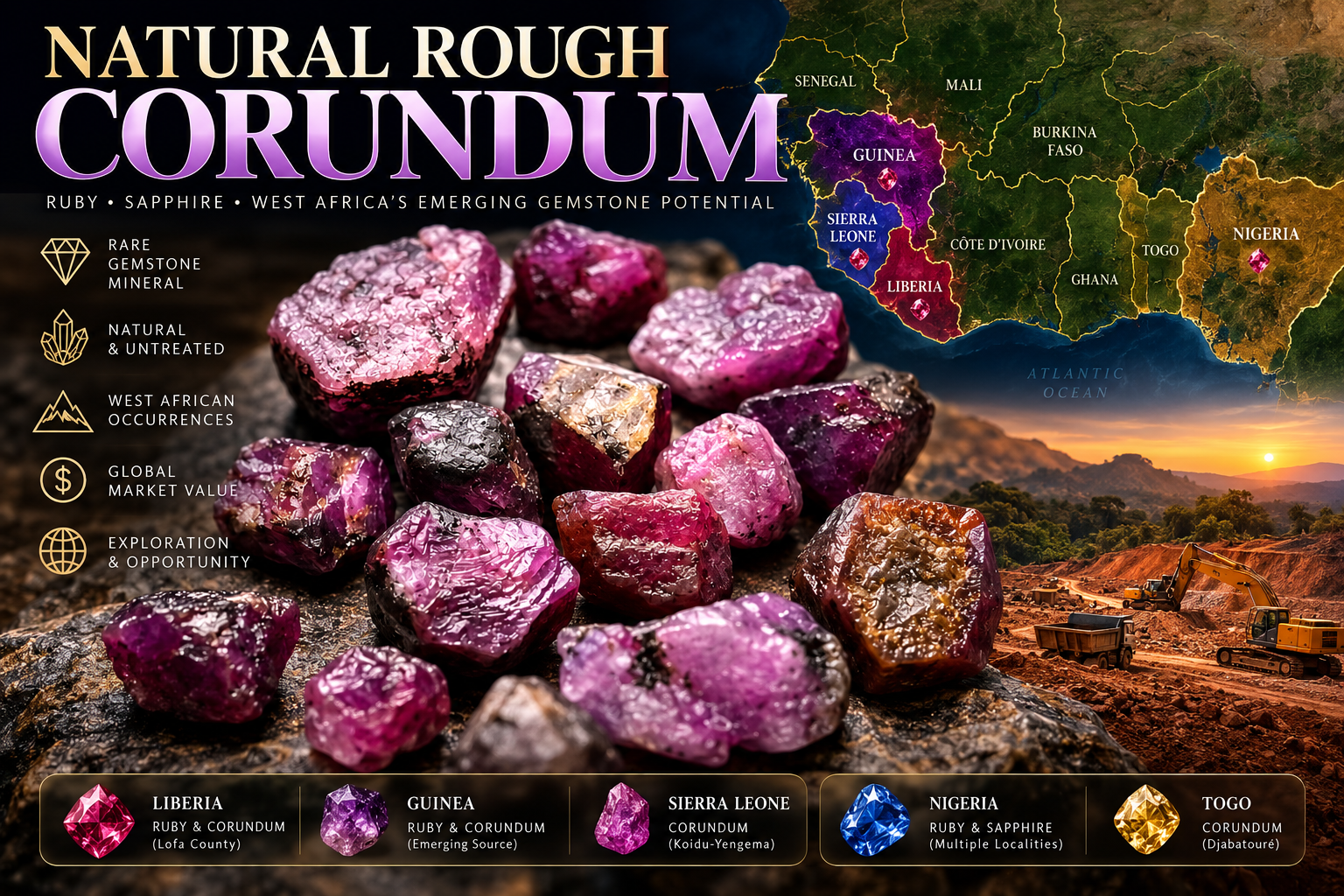
Mineral: Corundum
Chemical formula: Al₂O₃
Hardness: 9 on the Mohs scale
Varieties: Ruby and sapphire
Specimen shown: 68.70 carats of rough, predominantly pink, purple and reddish corundum
Claimed origin on label: Kashmir — requires independent laboratory verification
A mineral with two famous identities
The stones shown in this 68.70-carat parcel belong to one of the world’s most important gemstone minerals: corundum.
Corundum is crystalline aluminium oxide, Al₂O₃. In its chemically pure form it is essentially colorless, but small amounts of trace elements produce its spectacular range of colors. Chromium produces the red coloration associated with ruby, while iron and titanium are particularly important in blue sapphire. Other colors are classified as fancy sapphire. (gia)
The distinction is therefore relatively simple:
Red gem-quality corundum = ruby.
Blue gem-quality corundum = sapphire.
Other gem-quality colors = fancy sapphire.
But nature is not always so tidy. Corundum can occur in pink, purplish-red, violet, yellow, green, gray and other colors, and the boundary between ruby and pink sapphire can depend on the chemistry and color saturation of the individual crystal.
That makes a parcel such as the one pictured particularly interesting: the material appears to contain a mixture of pink, purple, reddish-purple and darker corundum rather than a uniform commercial ruby product.
Why corundum is so valuable
Corundum has a Mohs hardness of 9, surpassed naturally only by diamond. Its combination of hardness, durability, density and potential transparency makes it valuable both as an industrial mineral and as a gemstone. (Geoscience Australia)
Gem-quality corundum can become extremely valuable when several characteristics occur together:
- strong, attractive color
- good transparency
- large crystal size
- limited fracturing
- desirable inclusions
- natural, untreated status
- documented geographic origin
- good cutting yield
- exceptional optical phenomena such as asterism
This is why two pieces of rough corundum weighing exactly the same amount can have dramatically different values.
A 10-carat opaque corundum crystal and a 10-carat transparent ruby rough can be worth vastly different amounts.
The 68.70-carat parcel shown in the photograph
The specimen advertised in the photograph consists of multiple rough crystals with a combined stated weight of 68.70 carats.
Visually, the material appears predominantly:
- pink
- purplish pink
- purple
- reddish-purple
- dark red/purple
- gray-purple
Several pieces appear heavily included and fractured.
That appearance is important because weight alone does not establish gemstone value.
The commercial value of rough corundum depends heavily on whether individual pieces can actually yield facetable material after cutting.
For example, a 15-carat rough crystal might produce only a small faceted stone if it contains extensive fractures. Another 15-carat crystal could potentially yield a much more valuable gem if its color, transparency and internal structure are favorable.
Consequently, the photograph should be regarded as an identification and visual-reference photograph, not a valuation certificate.
Is it really Kashmir corundum?
This is the most important question surrounding the pictured material.
The label states:
“Natural Rough Kashmir Corundum — 68.70 Carat.”
But the geographic origin of a gemstone cannot normally be established simply by looking at a photograph.
Kashmir is one of the world’s legendary sapphire sources, particularly associated with extraordinary blue sapphires. GIA’s geological review identifies Kashmir among the world’s historically important sources of fine blue sapphire. (gia)
The photograph, however, shows predominantly pink-purple rough rather than the classic velvety blue Kashmir sapphire for which the region is famous.
That does not automatically prove the material is not from Kashmir. Corundum can occur in multiple colors, and locality claims require mineralogical and chemical evidence.
A serious commercial transaction should therefore ask for:
A laboratory identification report + treatment determination + geographic-origin opinion.
A major gemological laboratory can examine trace-element chemistry, inclusions and other characteristics to determine whether an origin determination is possible.
Without such documentation, “Kashmir” should be regarded as a claimed origin, not a proven origin.
West Africa: an overlooked corundum region

One of the most interesting aspects of this mineral is that West Africa has documented occurrences of corundum and ruby.
This is particularly important for countries such as Liberia, Guinea, Sierra Leone and Nigeria.
West Africa’s ancient geological terrains contain an extraordinary diversity of minerals. The region’s Precambrian rocks and associated metamorphic and igneous environments provide conditions in which corundum can occur.
Liberia
Liberia is particularly significant because modern gemological research has documented natural ruby and other corundum from the country.
GIA reported Liberian corundum from Weasua in Lofa County, including samples collected along the Lofa River. Researchers examined rough corundum showing purplish-red, pink, pale yellow and green colors, with some specimens falling into the sapphire range and a smaller number showing red ruby coloration. (gia)
Ruby has also been reported from diamond-mining areas along the Mano River and from Nimba Province, near the Guinean border. (gia)
This is particularly interesting because the geological area around Liberia, Guinea and Sierra Leone crosses major ancient geological structures of the West African Craton.
GIA has also noted similarities between some Liberian corundum and ruby material reported from Guinea, suggesting that geological conditions across the border may be related. (gia)
Liberia therefore deserves serious consideration as a source of West African corundum.
And importantly, Liberian material should not automatically be dismissed simply because it is not from one of the traditional Asian ruby-producing regions.
Guinea
Guinea is another documented source of ruby-colored corundum.
Mineralogical collections contain specimens identified as corundum var. ruby from Guinea, including strongly colored deep-fuchsia to purple material. (dynamicearthcollection.com)
Guinea’s significance becomes even more interesting when considered alongside the Liberian discoveries.
GIA has reported that low-quality ruby material from Guinea has entered the market, sometimes subjected to heat treatment and lead-glass filling. The organization also noted geological similarities between Guinean and Liberian material. (gia)
This is an important warning for buyers:
A rough stone described simply as “natural ruby” is not necessarily untreated ruby.
Treatment can dramatically affect its commercial value.
Sierra Leone
Sierra Leone also has documented corundum occurrences.
Mineralogical locality records identify corundum at Koidu-Yengema in Kono District, an area already internationally famous for its diamond resources. (Mindat.org)
This illustrates an important geological principle: regions known for one gemstone may contain additional mineral resources that have received far less commercial attention.
Sierra Leone therefore has potential significance for West African corundum exploration, although the existence of a mineral occurrence should not be confused with the existence of a large economically exploitable ruby deposit.
Nigeria
Nigeria has a much broader documented gemstone industry and is one of West Africa’s most important gemstone-producing countries.
Published geological reviews document both sapphire and ruby, with sapphire occurrences reported in areas including Taraba, Kaduna, Bauchi, Plateau, Yobe, Adamawa and other Nigerian localities. Ruby occurrences have been reported around:
- Jos-Bauchi
- Komu in Oyo State
- Ife-Ilesha in Osun State
These are documented as occurrences of red corundum/ruby. (ResearchGate)
Nigeria therefore represents one of the strongest West African countries to investigate when looking for commercially interesting corundum.
Other West African occurrences
Corundum is not restricted to the four countries above.
Mineralogical locality databases also record corundum occurrences in Togo, including the Djabatouré-Sotouboua Massif. (Mindat.org)
This demonstrates that the mineral has a wider West African geological distribution than the traditional international gemstone market might suggest.
However, there is a major distinction between:
“corundum has been scientifically reported here”
and
“this country has a commercially significant ruby or sapphire industry.”
The first is relatively common. The second is much rarer.
West African corundum map
The principal countries worth investigating are therefore:
Country
Corundum/ruby evidence
Commercial significance
Liberia
Ruby and pink/purplish corundum documented
Emerging / underexplored
Guinea
Ruby/corundum documented
Emerging / quality variable
Sierra Leone
Corundum documented around Koidu-Yengema
Underexplored
Nigeria
Ruby and sapphire documented at multiple localities
Most established West African gemstone sector
Togo
Corundum occurrence documented
Limited/underexplored
Ghana
Major mineral producer, but not an established major ruby source
Limited evidence for commercial ruby
Côte d’Ivoire
Highly mineralized West African terrain
No major documented ruby industry
Mali
Major mineral province
No major established ruby industry
Burkina Faso
Major mineral province
No major established ruby industry
Senegal
Mineralized geological terrain
No major established ruby industry
The strongest documented West African candidates for the specific ruby/corundum question are therefore Liberia, Guinea, Sierra Leone and Nigeria.
What could the 68.70 carats be worth?
This is where caution is essential.
There is no responsible way to assign a definitive dollar value to the pictured 68.70-carat parcel from the photograph alone.
Current ruby pricing demonstrates just how enormous the range can be.
In October 2026, Gemfields reported an average selling price of approximately US$564.54 per carat for 92,153 carats of mixed-quality rough ruby sold at auction. The total auction revenue was approximately US$52 million. (gemfieldsgroup.com)
But that figure is not a price that should simply be multiplied by 68.70 carats.
It represents a particular commercial auction consisting of material from Gemfields’ Montepuez ruby operation in Mozambique, with its own grading, sorting, provenance and buyer competition.
Nevertheless, it provides an important contemporary benchmark.
At that average:
68.70 × $564.54 ≈ $38,800
But this is only a mathematical comparison, not an appraisal of the pictured material.
The actual parcel could be worth substantially less—or potentially considerably more—depending upon what laboratory testing reveals.
A more realistic valuation framework
For rough corundum, I would divide the material into several commercial categories.
1. Specimen/low-grade corundum
Opaque, heavily fractured or weakly colored material may have relatively modest value.
Its market can be driven more by:
- crystal form
- locality
- collector interest
- color
- rarity
- size
than by faceting potential.
2. Commercial ruby/corundum rough
Material with attractive red or pink color but significant inclusions can have substantially higher value if buyers believe some portion can be cut or fashioned into cabochons.
3. Facetable natural ruby
This is where value can rise dramatically.
Strong red color, transparency and a favorable internal structure can transform a rough crystal into a much more valuable gemstone.
4. Fine untreated ruby
This is an entirely different market.
Natural, untreated ruby with exceptional color, clarity, size and documented origin can command thousands of dollars per carat—and exceptional stones can reach vastly higher levels.
Current market research shows enormous price dispersion between ordinary commercial ruby and exceptional untreated stones. (Ruby Glint)
Why the word “untreated” matters
The label on the photograph says:
“100% Natural”
and
“Untreated Gemstone.”
Those are two separate claims.
A stone can be natural but treated.
For example:
Natural + heated
means the original gemstone formed naturally but was subsequently heat treated.
Natural + glass filled
means the natural ruby has been modified to improve apparent clarity.
Natural + untreated
means no known treatment has been detected.
The distinction can have a major effect on value.
GIA has specifically documented treatment—including heat treatment and lead-glass filling—in some low-quality ruby material entering the market from Guinea. (gia)
Therefore, if this 68.70-carat parcel is being offered commercially, the statement “untreated” should ideally be supported by a recognized gemological laboratory.
Could this material be from Liberia?
This is an especially interesting possibility if similar material is encountered in West Africa.
GIA’s study of Liberian corundum found rough material from Weasua displaying purplish-red, pink, pale yellow and green colors, with some red material qualifying as ruby-colored corundum. (gia)
The photograph shown here contains several pieces with a broadly comparable pink-to-purple appearance.
But visual similarity is not proof of Liberian origin.
The same colors occur in corundum from numerous locations.
A genuine provenance investigation would require laboratory analysis.
How to authenticate a parcel like this
If someone actually owns the 68.70-carat material, the next step should not be selling it immediately.
The first step should be scientific identification.
A professional examination should establish:
1. Mineral identity
Confirm that the material is actually corundum.
2. Variety
Determine whether individual stones qualify as:
- ruby
- pink sapphire
- purple sapphire
- other fancy sapphire
- non-gem corundum
3. Treatment
Determine whether the stones have been:
- heated
- fracture filled
- glass filled
- diffused
- otherwise treated
4. Geographic origin
If the laboratory has sufficient evidence, it may be possible to determine whether material is consistent with:
- Kashmir
- Myanmar
- Sri Lanka
- Mozambique
- Madagascar
- West Africa
- another geological source
5. Cutting potential
A skilled lapidary should then examine the rough to determine potential yield.
That can be more important commercially than the headline weight.
The Kashmir problem
There is another reason this parcel deserves careful examination.
The name Kashmir carries enormous value in the sapphire market because historically exceptional blue sapphires came from the Kashmir region.
Consequently, “Kashmir” can dramatically affect the perceived value of a gemstone.
But a seller should never pay a Kashmir-origin premium solely because the packaging says “Kashmir.”
For a high-value transaction, the appropriate question is:
“Where is the laboratory report establishing origin?”
If the answer is that there is no report, the material should be priced according to its demonstrated gemological quality rather than an unsupported locality claim.
The opportunity for West Africa
There is a larger story behind these stones.
West Africa is already one of the world’s major mineral regions, particularly for gold, bauxite, iron ore, manganese, diamonds and other resources. Yet gemstone resources have historically received less systematic international attention.
The documented occurrence of ruby and corundum in Liberia, Guinea, Sierra Leone and Nigeria suggests an opportunity for more sophisticated gemstone exploration.
Liberia is particularly interesting because recent GIA work has brought scientifically documented Liberian ruby and corundum into greater visibility. (gia)
The opportunity is not necessarily to discover another “Kashmir.”
It is to determine whether West Africa possesses its own distinctive gemstone varieties that can be characterized, certified, cut and marketed according to their actual geological identity.
That could eventually create a recognizable West African ruby and sapphire provenance.
From rough stone to West African gemstone industry
The highest-value opportunity is not necessarily exporting rough stones.
A stronger value chain could look like:
Exploration → responsible extraction → sorting → laboratory identification → treatment disclosure → cutting → certification → jewelry manufacturing → international marketing
Instead of exporting an unidentified 20-carat rough crystal for a relatively small amount, a properly evaluated stone could potentially become:
West African rough → certified gemstone → precision cut → jewelry → branded African gemstone
The difference between those stages can be enormous.
This is the same basic principle that applies across mineral industries: the greatest value is often created after discovery rather than at the mine gate.
A note about “healing”
The packaging also advertises the stones for “healing.”
Corundum certainly has established physical and industrial properties, including exceptional hardness, but claims that ruby or sapphire can medically heal diseases or produce specific therapeutic effects are not established by modern scientific evidence.
Such descriptions are better treated as cultural, spiritual or metaphysical beliefs rather than medical claims.
Final assessment of the 68.70-carat parcel
The photograph shows a potentially interesting rough corundum collection, but the most important facts remain unverified.
What can reasonably be said from the photograph:
Mineral: visually consistent with corundum
Color: predominantly pink/purple/reddish-purple
Form: rough natural-looking crystals
Advertised weight: 68.70 carats
Advertised origin: Kashmir
Advertised treatment: untreated
Actual origin: unverified
Actual ruby percentage: unverified
Actual commercial value: unverified
The material should therefore not yet be valued simply as 68.70 carats of Kashmir ruby.
If laboratory testing confirms that a significant portion consists of natural, untreated, gem-quality ruby, the value could be substantially higher than ordinary rough corundum. Conversely, if most of the parcel is opaque, heavily fractured or low-saturation corundum, its value could be dramatically lower.
The contemporary rough-ruby market illustrates the point: Gemfields’ October 2026 auction averaged about $565/ct across mixed-quality rough ruby, while individual finished rubies can range from hundreds to many thousands of dollars per carat, with exceptional untreated stones reaching extraordinary prices. (gemfieldsgroup.com)
The real question, therefore, is not “What is 68.70 carats worth?”
It is:
How much of the 68.70 carats is natural gem-quality ruby or sapphire, what has happened to it since it formed, and where did it actually come from?
That is what determines the real market value.
For West Africa, the most compelling documented countries to investigate are Liberia, Guinea, Sierra Leone and Nigeria, with Liberia particularly notable for recent gemological documentation of natural ruby-bearing corundum from the Weasua/Lofa River area. (gia)
Leave a Reply