
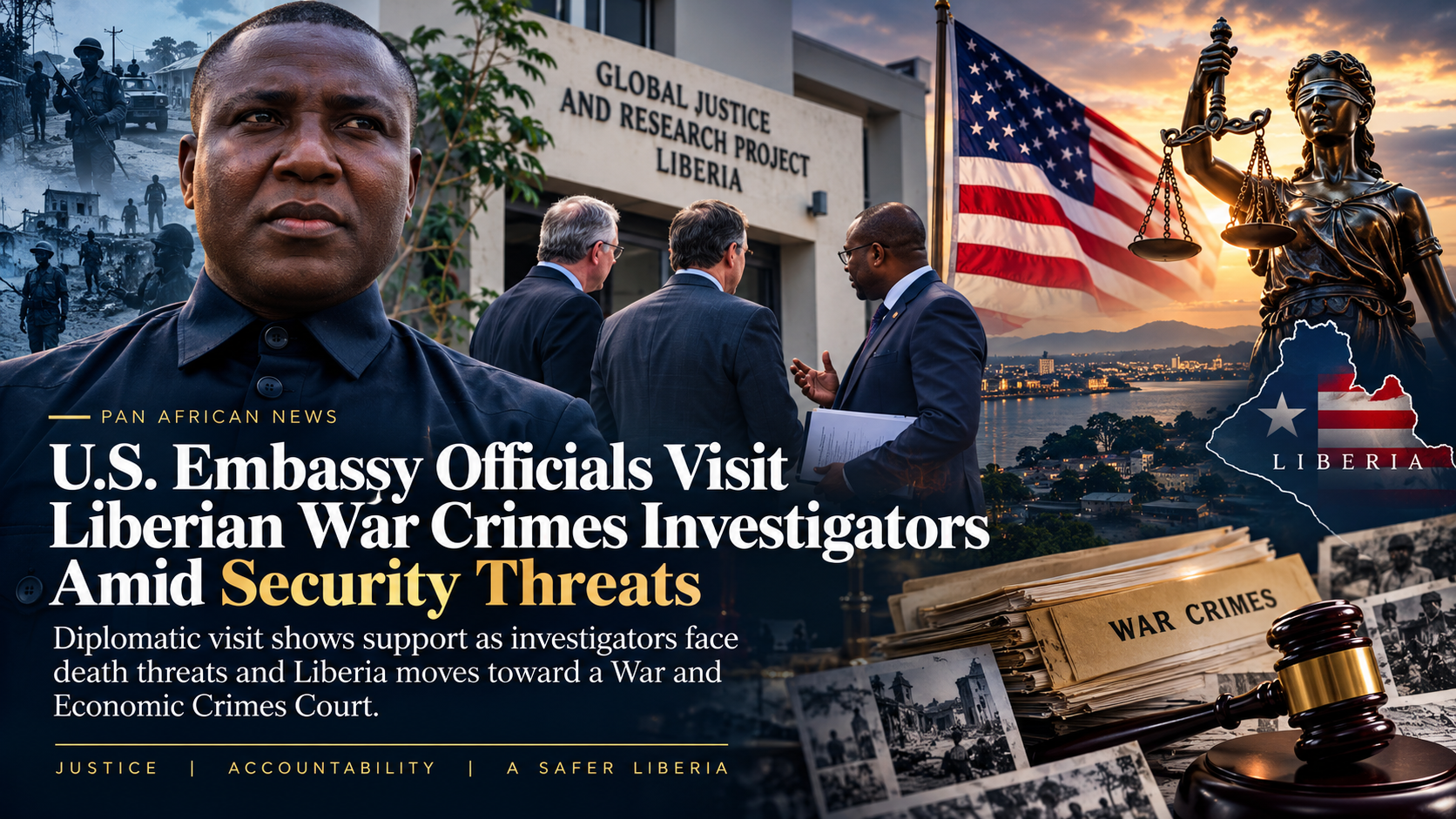
Monrovia, Liberia — Two officials from the United States Embassy in Liberia have visited the Global Justice and Research Project (GJRP), a leading Liberian organization investigating atrocities committed during the country’s civil wars, following renewed death threats against members of its investigative team.
The visit comes at a sensitive moment for Liberia’s long-running effort to establish a War and Economic Crimes Court. Investigators, survivors and human-rights advocates say the credibility of any future accountability process will depend not only on the quality of evidence collected, but also on whether witnesses, investigators and other participants can operate without intimidation.
According to a report by Anthony Stephens of New Narratives and FrontPage Africa, Christopher M. Hofmann, a political officer at the U.S. Embassy in Monrovia, and Thomas Quaye, a political and human-rights assistant, visited the GJRP earlier this month.
The embassy officials permitted the visit to be photographed but declined to comment publicly on the discussions. Hassan Bility, director of the Global Justice and Research Project, said the meeting focused on security concerns facing his organization.
Bility described the visit as a demonstration of American solidarity with investigators working to document Liberia’s wartime atrocities.
“The U.S. had come to listen to some of our security concerns.”
He said the presence of the embassy officials reassured his organization that its work continues to receive international attention and support. (FrontPageAfrica)
Death Threats Raise New Security Concerns
The diplomatic visit followed the relocation of the organization’s director of investigations after repeated death threats.
The latest threats reportedly involved an investigator working on cases concerning alleged wartime perpetrators, including former senior Liberian army commander Moses Wright.
Wright, 73, is accused by survivors of involvement in the 1990 St. Peter’s Lutheran Church massacre in Monrovia, where an estimated 600 civilians were killed. He has denied the allegations. He is also facing federal immigration fraud and perjury charges in Pennsylvania, where his trial has been postponed until February 2027. (FrontPageAfrica)
The threats have intensified concerns over the safety of investigators and witnesses as Liberia moves toward a domestic mechanism for prosecuting crimes committed during its civil conflicts.
Earlier this year, armed men reportedly broke into the GJRP’s Monrovia offices, assaulted a security guard and threatened Bility. The organization subsequently raised concerns about the lack of progress on complaints it had filed with the Liberian National Police. (FrontPageAfrica)
For investigators who have spent years gathering evidence and locating witnesses, the danger is not simply political. Their work can place them in direct contact with individuals accused of some of the most serious crimes committed during Liberia’s wars.
The Investigators Behind International War Crimes Cases
The Global Justice and Research Project, working with its Swiss partner Civitas Maxima, has spent years documenting atrocities committed during Liberia’s civil conflicts.
Their investigations have helped identify witnesses and assemble evidence used in criminal proceedings outside Liberia.
The organization’s work has been associated with several significant convictions.
In the United States, former rebel commander Mohammed Jabateh, popularly known as “Jungle Jabbah,” was sentenced to 30 years in prison for immigration fraud and perjury.
In Switzerland, former rebel commander Alieu Kosiah received a 20-year sentence for war crimes.
In France, Kunti Kamara was sentenced in 2022 to 30 years in prison for complicity in crimes against humanity, torture and acts of barbarism. (FrontPageAfrica)
These cases have demonstrated that Liberian war crimes can still reach courtrooms decades after the violence occurred, even when the alleged crimes were committed outside the jurisdiction where the suspects ultimately face trial.
The investigations have also attracted criticism from defendants and their supporters, including allegations of witness coaching and bribery. The investigators, prosecutors and organizations involved have rejected those allegations. (FrontPageAfrica)
Liberia’s War Crimes Court Faces a Critical Test
The security concerns come as Liberia continues its renewed effort to establish a War and Economic Crimes Court.
President Joseph Boakai’s administration has maintained that establishing accountability mechanisms for wartime crimes is part of Liberia’s broader effort to confront its history and strengthen the rule of law.
In May 2026, Boakai received draft legislation for a proposed War and Economic Crimes Court and a National Anti-Corruption Court after renewing the mandate of the government office responsible for establishing the tribunals. (fpa.news)
But the process has been complicated by disagreements over competing legislative proposals, institutional responsibilities and the precise structure of the proposed court.
Earlier in 2026, a transitional-justice conference in Monrovia highlighted divisions between government institutions and civil-society groups over how the court should be established. International experts called for broad consultation involving survivors, civil society, legal experts and other stakeholders. (fpa.news)
The security of investigators is therefore becoming an increasingly important part of the broader accountability debate.
A court cannot function effectively if witnesses are afraid to testify, investigators cannot safely collect evidence, or victims believe that participating in proceedings could expose them to retaliation.
Witness Protection Could Become Central to the Court
Liberia’s emerging accountability system also faces a major witness-protection challenge.
The country’s Witness Protection Agency has proposed a five-year plan estimated at US$20.54 million to establish safe houses, strengthen rapid-response capabilities and improve protection for victims, witnesses and whistleblowers. (liberianewsnetwork.com)
That requirement reflects the reality of Liberia’s war-crimes cases.
Much of the evidence surrounding atrocities committed during the civil wars is decades old. Investigators frequently depend on people who personally witnessed events or survived them.
Those witnesses may live in communities where alleged perpetrators or their supporters remain influential.
As a result, protection cannot be treated as an administrative detail. It could become one of the foundations on which Liberia’s accountability process succeeds or fails.
International human-rights officials have emphasized that victims and witnesses must remain at the center of Liberia’s transitional-justice process. (liberianewsnetwork.com)
A Long Shadow Over Liberia’s Past
Liberia’s civil wars left thousands dead and displaced millions of people. The conflict also produced allegations of massacres, torture, sexual violence, forced recruitment and other serious abuses.
For decades, Liberia struggled with the question of how to address those crimes without destabilizing a fragile peace.
The establishment of a domestic war-crimes court would represent a major shift.
Instead of leaving accountability largely to foreign jurisdictions, Liberia would have the opportunity to create a national judicial mechanism capable of hearing cases connected directly to the country’s own history.
But that opportunity carries significant risks.
A court that is perceived as politically selective could deepen divisions rather than heal them. A process without adequate resources could fail victims. And a system without effective witness and investigator protection could discourage crucial testimony.
The latest threats against war-crimes investigators therefore raise questions that go beyond the safety of one organization.
They test whether Liberia’s institutions are prepared to protect the people whose work is necessary to uncover the truth.
U.S. Support Sends a Significant Signal
The decision by U.S. Embassy officials to visit the Global Justice and Research Project carries symbolic importance even though the officials did not publicly comment on the substance of their discussions.
The United States has previously expressed support for efforts to pursue accountability for Liberia’s wartime crimes.
In 2021, then-U.S. Ambassador to Liberia Michael McCarthy visited the organization amid threats against its leadership. In 2022, Beth Van Schaack, then the U.S. ambassador-at-large for global criminal justice, also publicly praised the work of Bility and his organization. (FrontPageAfrica)
The latest visit consequently places the current security concerns within a longer history of international attention to Liberia’s pursuit of justice.
For Bility, the message appears straightforward: investigators should not have to face threats alone.
Justice, Security and Liberia’s Future
Liberia’s debate over a War and Economic Crimes Court is ultimately about more than punishment.
It is about whether a country emerging from a devastating history can establish institutions capable of confronting that history openly.
That process requires survivors to be heard, investigators to be protected, evidence to be preserved and accused persons to receive fair trials.
It also requires political leaders to resist the temptation to treat accountability as a weapon against opponents.
The visit by U.S. Embassy officials comes at a moment when those principles are being tested.
For Liberia, the challenge is now twofold: build a credible court and create the security architecture necessary for people to participate in it.
If investigators, witnesses and survivors cannot work safely, the historical record risks remaining incomplete.
And if Liberia wants its proposed court to command public confidence, protecting those who help establish the truth will have to be treated as seriously as the pursuit of the truth itself.
Source: Reporting by Anthony Stephens for FrontPage Africa/New Narratives, as part of the Investigating Liberia project. (FrontPageAfrica)
Leave a Reply