
By Panafrican.email | Business & Finance
A quiet transformation is taking place in global finance.
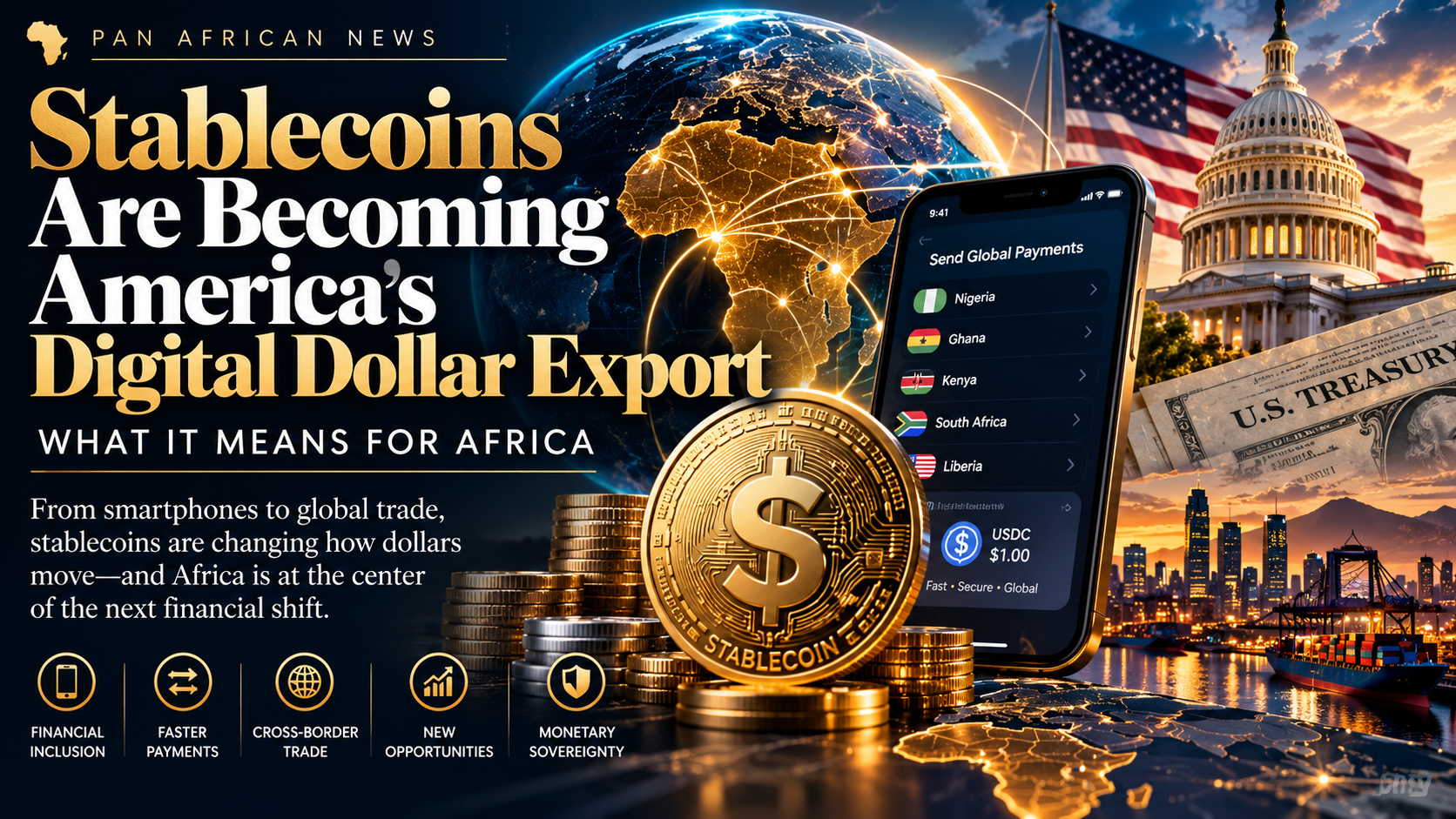
Dollar-backed stablecoins were once largely viewed as a cryptocurrency trading tool. Today, they are increasingly becoming something much larger: a digital distribution network for the U.S. dollar.
The argument has gained new force as the United States moves to formalize the stablecoin industry. Under the GENIUS Act, payment stablecoin issuers must maintain reserves on at least a one-to-one basis, with permitted reserve assets including U.S. dollars, bank deposits, short-term U.S. Treasury securities and other highly liquid government-backed assets. (Every CRS Report)
On October 21, 2026, the U.S. Office of the Comptroller of the Currency announced its final rule implementing major portions of the GENIUS Act. The rule is scheduled to take effect on January 18, 2027. (OCC.gov)
That development changes the strategic conversation.
The question is no longer simply whether people will use cryptocurrency.
The bigger question is:
What happens when the world’s most widely used reserve currency can be distributed globally through smartphones, digital wallets and blockchain networks without requiring a traditional bank branch?
For Africa, the question is particularly important.
The Digital Dollar Is Already Here
The central idea behind a dollar stablecoin is relatively simple.
A company issues a digital token designed to maintain a value of approximately one U.S. dollar. The issuer holds reserves intended to support the tokens in circulation.
Under the U.S. regulatory framework, those reserves are required to consist of specified liquid assets, including short-term Treasury securities and other approved assets. (Every CRS Report)
This creates a potentially powerful economic loop.
A person in Lagos, Accra, Nairobi or another emerging-market city can obtain a dollar-denominated digital asset using a smartphone.
The person does not necessarily need access to a U.S. bank account.
They do not need to physically hold U.S. currency.
And they can potentially transfer the digital dollar across borders within minutes.
At the other end of that transaction is an issuer whose reserve portfolio can contain U.S. government securities.
The result is a new pathway connecting global demand for dollars with the U.S. Treasury market.
That is why the stablecoin story is increasingly being discussed as a monetary and geopolitical story rather than simply a cryptocurrency story.
Global Crypto Markets
| # | Asset | Price | 24H | 7D | Market Cap |
|---|---|---|---|---|---|
| Loading market intelligence… | |||||
America Is Not Literally “Exporting Debt”
The phrase “America is exporting the dollar” is more accurate than saying America is literally exporting its debt.
A stablecoin transaction does not automatically mean that an African consumer is directly financing the U.S. government.
The mechanism is indirect.
When an issuer receives dollars or other eligible assets in exchange for issuing stablecoins, it can hold qualifying reserves. Under the GENIUS framework, those reserves can include short-term Treasury bills. That creates potential additional demand for U.S. government securities.
The U.S. Treasury Borrowing Advisory Committee has previously examined this relationship, noting that stablecoin reserve requirements could increase Treasury demand while concentrating that demand toward the short end of the yield curve. (U.S. Department of the Treasury)
Brookings researchers have similarly argued that the growth of dollar-backed stablecoins could increase demand for Treasury bills, although the ultimate effect depends on where new stablecoin demand comes from. (Brookings)
This is the important distinction.
Stablecoins don’t magically make U.S. debt disappear. They can create another global distribution channel for dollar-denominated financial assets.
The Treasury Connection
The numbers illustrate why policymakers and investors are paying attention.
The U.S. Treasury’s own analysis has estimated that stablecoin issuers held roughly $120 billion in Treasury bills in 2024, while examining scenarios in which stablecoin-related Treasury holdings could become substantially larger. (U.S. Department of the Treasury)
The mechanism is straightforward:
Global user demand → stablecoin issuance → reserve assets → Treasury bills and other permitted assets.
If stablecoin usage grows dramatically, the reserve pool can grow with it.
That potentially creates a new class of buyers for short-term U.S. government debt.
It is therefore possible to look at the stablecoin industry as part of a much broader architecture surrounding the dollar.
The United States already benefits from the dollar’s role in international trade, banking, commodities, reserves and financial markets.
Stablecoins add another layer:
programmable, portable and internet-native dollars.
Africa Is Already Testing the Model
Africa is not waiting for this transformation to arrive.
Nigeria provides one of the clearest examples.
According to the International Monetary Fund, Nigeria received approximately $59 billion in crypto-asset inflows between July 2023 and June 2024 and accounted for roughly 60% of stablecoin inflows into sub-Saharan Africa over the period covered by the IMF’s analysis. (International Monetary Fund)
Stablecoins have become particularly important for cross-border transactions.
The reasons are practical.
Businesses need foreign currency.
Families receive remittances.
Importers need to pay overseas suppliers.
Individuals want protection from domestic currency volatility.
And conventional international transfers can be slow and expensive.
The IMF says stablecoins can provide faster cross-border payments and can reduce reliance on traditional correspondent-banking networks. (International Monetary Fund)
That makes the African stablecoin phenomenon fundamentally different from the popular image of cryptocurrency speculation.
For many users, the attraction is not necessarily Bitcoin-style price appreciation.
It is the dollar.
Nigeria Shows the Monetary Trade-Off
There is, however, a deeper issue.
When Nigerians hold USDT or USDC, they are not simply holding cryptocurrency.
They are holding a digital representation of U.S.-dollar purchasing power.
That can provide protection against local currency volatility.
But at scale, it can also contribute to what economists describe as digital dollarization.
The IMF has warned that widespread use of U.S.-dollar stablecoins could reduce demand for the naira, weaken monetary-policy transmission and complicate capital-flow management. (IMF eLibrary)
This creates a difficult policy equation.
For the individual:
Dollar stability can be protection.
For the central bank:
Dollar substitution can be a loss of monetary control.
Both statements can be true simultaneously.
And This Is Where Africa’s Opportunity Begins
The debate should not simply be framed as:
Stablecoins — good or bad?
That is too simplistic.
The more important question for African policymakers is:
How can Africa capture the efficiency of digital-dollar infrastructure without surrendering monetary and financial sovereignty?
That requires building alternatives.
African economies need fast domestic payment systems, efficient foreign-exchange markets, interoperable regional payment networks and properly regulated digital-asset infrastructure.
The Pan-African Payment and Settlement System, or PAPSS, is one example of the continent’s attempt to reduce dependence on external currencies and correspondent banking for intra-African commerce.
Stablecoins represent another technological pathway.
The challenge is deciding where they fit.
The Rise of Local-Currency Digital Assets
Nigeria’s experience also demonstrates the difficulty of competing against the network effects of the U.S. dollar.
Nigeria launched a regulated naira-pegged stablecoin, cNGN, in 2025.
But the IMF reported that adoption remained extremely small compared with dollar-denominated stablecoins. (IMF eLibrary)
This is an important lesson.
Creating a digital version of a local currency does not automatically create demand.
Money is ultimately about trust, liquidity, purchasing power and network effects.
If users believe the dollar is a better store of value, merchants accept dollars more readily, international suppliers demand dollars and global financial markets are denominated in dollars, the digital version of the dollar inherits those advantages.
Africa therefore faces a much larger strategic question than simply whether to regulate cryptocurrency.
It must consider the future architecture of digital money itself.
The Smartphone Has Become a Financial Gateway
The most important feature of stablecoins may be their simplicity.
A smartphone can become the gateway.
There is no physical dollar note.
There is no branch.
There may be no conventional international wire.
There is simply a digital wallet connected to a blockchain network.
That architecture can be extremely powerful in markets where conventional financial infrastructure remains expensive or difficult to access.
The IMF notes that stablecoins can offer near-instant cross-border transfers and potentially lower transaction costs, particularly for remittances and smaller businesses. (International Monetary Fund)
This matters enormously for Africa.
The continent has a large population of mobile-first consumers and entrepreneurs.
In many markets, people adopted mobile money before they ever developed deep relationships with conventional banks.
Stablecoins could follow a similar trajectory.
From Remittances to Corporate Treasury
The next phase may be even more consequential.
Stablecoins are beginning to move beyond individual remittances into corporate treasury and cross-border settlement.
African companies operating in environments with foreign-exchange shortages have an obvious incentive to explore digital-dollar infrastructure.
A recent African technology-industry report described stablecoins increasingly moving toward corporate cross-border settlement as companies search for reliable access to dollars. (ITWeb Africa)
That changes the scale of the phenomenon.
A person sending $300 to family is one thing.
An African importer settling hundreds of thousands of dollars in international invoices through digital settlement infrastructure is another.
If stablecoins become embedded in corporate treasury operations, their relationship with international trade could become much more significant.
The Geopolitical Dimension
This is where the discussion becomes larger than cryptocurrency.
The dollar’s power has historically depended partly on its usefulness.
Oil contracts.
International trade.
Banking.
Foreign reserves.
Capital markets.
Government securities.
Cross-border payments.
Stablecoins can extend that ecosystem into the blockchain economy.
A dollar stablecoin is effectively a digital container for dollar-denominated value.
The more widely it is used, the more deeply the dollar can become embedded in digital commerce.
That does not mean every stablecoin user is consciously participating in U.S. monetary policy.
Most are not.
They are solving immediate problems.
But millions of individual decisions can produce macroeconomic consequences.
Africa’s Strategic Choice
African policymakers therefore have several choices.
They can attempt to prohibit stablecoins.
They can attempt to restrict them to licensed institutions.
They can create local-currency alternatives.
They can integrate regulated stablecoins into formal payment systems.
Or they can build regional digital-payment infrastructure capable of competing with or complementing dollar-based networks.
Each approach carries risks.
A prohibition may push activity into informal markets.
An unrestricted market could accelerate digital dollarization.
A poorly designed local stablecoin may fail to attract users.
And excessive regulation could prevent African financial institutions from participating in one of the most important technological changes in global payments.
The answer will probably not be found in a single policy.
The Question of African Monetary Sovereignty
The biggest issue is not whether Africans will use digital dollars.
They already are.
The question is whether African economies will build digital financial systems strong enough to give their own currencies comparable utility.
That means solving some very old problems with new technology:
- Expensive cross-border payments.
- Fragmented financial systems.
- Limited foreign-exchange liquidity.
- Weak interoperability.
- High remittance costs.
- Limited access to international settlement infrastructure.
- Currency instability.
- Lack of trust in financial institutions.
Technology can reduce some of these barriers.
Digital Asset Markets
Real-time cryptocurrency intelligence, market performance, digital-money developments and African stablecoin signals.
Top Digital Assets
| Asset | Price | 24H | 7D | Market Cap |
|---|---|---|---|---|
| Loading market data… | ||||
Bitcoin — 7 Day
Watch the Digital Money Shift
Africa’s Largest Economies Drive Stablecoin Adoption
A look at the growing use of dollar-linked digital assets in major African economies and what stablecoin adoption could mean for payments and financial infrastructure.
Nigeria & South Africa’s Stablecoin Payment Revolution
Examining how stablecoins are entering African payment ecosystems and the potential implications for banks, remittances, commerce and monetary sovereignty.
But technology cannot manufacture monetary credibility.
That remains the responsibility of economic policy.
The New Dollar Network
The stablecoin revolution therefore deserves to be watched through two lenses.
The first is technological.
Stablecoins can make money faster, more portable and more programmable.
The second is geopolitical.
A digital dollar can extend the reach of the existing U.S.-dollar system into places where traditional banking infrastructure has struggled to reach.
That is why the statement that stablecoins could become one of America’s most important financial “exports” deserves serious attention — even if it should not be interpreted literally as the export of U.S. government debt.
The United States is building a regulated framework around a private digital form of its national currency.
Africa is becoming one of the world’s most important laboratories for its use.
What Comes Next
The U.S. regulatory framework is now moving from legislation toward implementation.
The OCC’s final rule on payment stablecoins is scheduled to take effect on January 18, 2027, alongside the GENIUS Act’s broader framework. (OCC.gov)
That means the next stage will not simply be about crypto traders.
It will involve banks, fintech companies, payment processors, governments, central banks, multinational corporations and ordinary consumers.
For Africa, the strategic imperative is clear.
Do not simply ask what stablecoins will do to Africa.
Ask what Africa intends to do with stablecoins.
The continent has an opportunity to use the technology to reduce the cost of trade, improve remittances, expand financial inclusion and build faster settlement networks.
But it must simultaneously protect monetary stability, financial integrity and the ability of African states to conduct independent economic policy.
The future monetary system may not be entirely physical, entirely digital, or entirely national.
It may be a network in which dollars, naira, cedi, rand, shilling and other currencies move across blockchain rails alongside conventional banking systems.
The countries that understand that transition early will have an advantage.
Because the next great battle over money may not be about who prints the most currency.
It may be about whose currency becomes easiest to move.
Panafrican.email — Business | Finance
Leave a Reply