
By Panafrican.email Intelligence Desk
Guinea is entering a new phase of its mining history.
For decades, the West African country was known primarily for its extraordinary bauxite reserves. Today, however, Guinea is becoming something much larger: a strategic mining and infrastructure hub linking bauxite, iron ore, gold, railways, ports, industrial processing and global commodity markets.
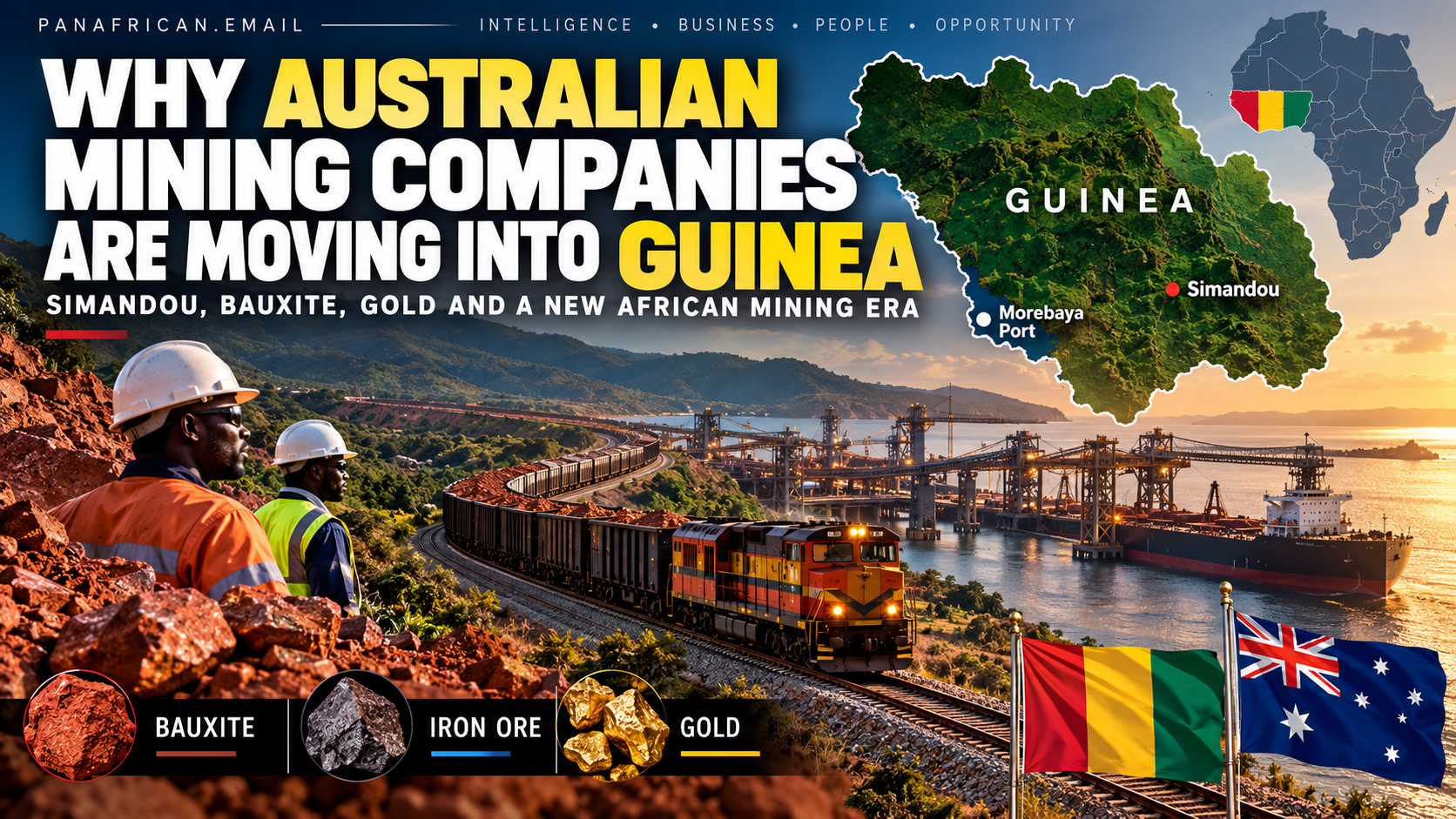
The transformation accelerated in December 2025 when the first iron ore shipment from the giant Simandou project left Guinea.
The development is attracting renewed attention from international mining companies—including Australian-listed explorers and producers—as companies position themselves around Guinea’s expanding mineral economy.
The question is no longer simply what minerals does Guinea have?
The bigger question is:
Who will participate in the next generation of Guinea’s mining economy—and what will Guinea capture from the value created by its resources?
Simandou Changes the Equation
Simandou is one of the most important mining developments in Africa.
The project is being developed through two major mining concessions involving Rio Tinto’s SimFer joint venture and Winning Consortium Simandou, alongside Chinese and Guinean partners.
The infrastructure is almost as important as the ore itself.
The wider Simandou development includes hundreds of kilometres of new railway infrastructure, port facilities and supporting logistics. Rio Tinto says the infrastructure is designed to eventually support exports of up to 120 million tonnes of iron ore per year from the two Simandou mining concessions. (Rio Tinto)
In December 2025, the first shipment officially left Guinea from the Moribaya port area.
SimFer subsequently reported that a full cargo followed in early February 2026 and arrived in China in March. (simfer-sa.com)
For Guinea, this is more than the opening of another mine.
It represents the creation of a new economic corridor.
Iron ore can now move from Guinea’s interior toward the Atlantic coast through a large-scale rail-and-port system that did not exist at this scale before the Simandou development.
That infrastructure potentially changes the economics of other mineral projects as well.
Guinea Was Already a Mining Giant
It is important not to look at Guinea only through the lens of Simandou.
Before Simandou began exporting iron ore, Guinea was already one of the world’s most important mineral exporters.
The country’s bauxite industry reached extraordinary levels in 2025.
According to official data reported by Reuters, Guinea exported approximately 182.8 million tonnes of bauxite in 2025, an increase of about 25% from the previous year. China accounted for approximately 74% of Guinea’s bauxite shipments. (Reuters)
That places Guinea at the centre of the global aluminium supply chain.
The significance is strategic.
Bauxite is the primary ore used to produce alumina, which is then processed into aluminium. Guinea therefore sits at the beginning of a supply chain connected to construction, transportation, packaging, electrical infrastructure, renewable energy and manufacturing around the world.
But Guinea’s government increasingly wants more than simply exporting ore.
The strategic objective is moving toward processing, refining and industrialisation inside Guinea.
That creates another category of opportunity for foreign investors.
Why Australian Mining Companies Are Watching
Australia has built one of the world’s most sophisticated mining industries.
Australian companies possess expertise in geological exploration, mine development, engineering, project finance, mineral processing and operating large-scale mines in difficult environments.
Guinea presents many of the geological characteristics that attract this expertise: enormous mineral endowment, relatively underexplored territories and deposits that could support large-scale operations.
Australian-listed companies are already active in Guinea.
One example is Resolute Mining, an ASX/LSE-listed gold producer.
In March 2026, Resolute and Guinea’s state-owned Nimba Mining Company signed a memorandum of understanding to evaluate potential gold projects in Guinea. The companies subsequently established Landaya Gold, a joint venture intended to advance those opportunities. (Nimba Mining Company)
Another example is Arrow Minerals.
The Australian-listed company had previously suspended Guinea activities because of uncertainty surrounding exploration permits. In April 2026, Arrow signed a memorandum of understanding with Guinea’s state mineral-rights manager, Soguipami, seeking greater clarity around permits connected to its bauxite and iron-ore interests. (Mining Weekly)
And PDI Gold, formerly Predictive Discovery, has positioned Guinea at the centre of its West African growth strategy.
The company says its portfolio includes the Kiniéro gold mine in Guinea, which began production in late 2025, as well as the Bankan Gold Project. (PDI Gold Limited)
These developments illustrate something important:
Australian participation in Guinea is not necessarily about one giant Australian mining company arriving to build another Simandou.
It is also happening through exploration companies, gold producers, joint ventures and partnerships with Guinean institutions.
Simandou Could Create a Mining Ecosystem
The most significant economic effect of Simandou may ultimately extend beyond iron ore.
Large mining projects require roads, railways, power, telecommunications, equipment, engineering, security, accommodation, food, logistics, environmental services, financial services and skilled labour.
That means a mine can become the anchor for an entire industrial ecosystem.
The Simandou infrastructure program includes more than 600 kilometres of new multi-use rail infrastructure and port facilities. (Rio Tinto)
Once that infrastructure is operational at scale, other mineral projects may be able to evaluate Guinea differently.
A mineral deposit that previously looked commercially difficult because of transportation constraints may become more interesting when a major rail network and export corridor are nearby.
This is one reason mining investors pay attention to infrastructure.
Ore deposits create potential. Infrastructure creates access.
Guinea’s Bauxite Sector Is Entering Another Phase
While Simandou attracts global headlines, Guinea’s bauxite sector is undergoing its own transformation.
The country’s government has increasingly emphasized domestic processing rather than relying entirely on exports of raw bauxite.
That means the next phase of competition may not simply be about who can extract the most tonnes.
It may be about who can help Guinea transform those tonnes into higher-value products.
In 2026, Guinea has been discussing plans to expand alumina refining and eventually develop additional industrial capacity. Reuters reported that the country is seeking investment in processing while also attempting to diversify its international partnerships. (Reuters)
The state-owned Nimba Mining Company illustrates this new direction.
Nimba Mining says it operates the Tinguilinta mine, railway corridor and port logistics around Kamsar and is developing plans for local processing. The company describes itself as Guinea’s first wholly state-owned mining company operating across an integrated extraction-to-export chain. (Nimba Mining Company)
In September 2026, Nimba Mining entered into a major bauxite offtake and pre-financing agreement with Glencore worth more than $300 million, covering the marketing of approximately 10–12 million tonnes of bauxite annually for five years. (Nimba Mining Company)
This is significant because it shows Guinea actively seeking multiple international commercial relationships rather than relying on a single external market.
China Remains Central
The growing Australian interest should not be interpreted as Guinea turning away from China.
China remains deeply embedded in Guinea’s mining economy.
In 2025, approximately three-quarters of Guinea’s bauxite exports went to China. Chinese-linked interests are also major participants in the Simandou development. (Reuters)
Simandou itself demonstrates the complexity of the modern African mining landscape.
Rio Tinto is a major participant, while the project also involves Chinalco-linked interests, Baowu, Winning Consortium and the Guinean state.
The result is not a simple competition between Australia and China.
It is a much more complicated network of African governments, Asian industrial groups, European commodity companies, Australian-listed explorers and multinational mining corporations.
Guinea is increasingly becoming a place where these interests intersect.
The New Competition Is About Value, Not Just Ore
For African countries, the most important question is not necessarily whether foreign companies invest.
Foreign capital can bring technology, infrastructure, jobs and access to global markets.
The deeper question is:
How much value remains in Africa after the mineral leaves the mine?
That question is becoming increasingly important across the continent.
Guinea has enormous resources, but resource wealth alone does not automatically produce broad-based prosperity.
The country needs reliable electricity, roads, railways, ports, industrial capacity, skilled workers, transparent contracts and competitive domestic businesses capable of supplying the mining industry.
This is why the next phase of Guinea’s mining story could be even more consequential than the first.
If Guinea can move from:
ore → export
toward:
ore → processing → manufacturing → regional supply chains → higher-skilled employment
then the economic impact could extend well beyond mining royalties.
The Australian Connection Could Go Deeper
Australian mining companies bring something Guinea may need: experience turning difficult geological opportunities into commercially viable mining operations.
But Guinea also has something Australia cannot manufacture:
the mineral deposits themselves.
That creates a potential partnership.
Australian geological expertise can meet Guinean mineral resources.
Australian capital can meet Guinean projects.
Australian mining technology can meet Guinean deposits.
And Guinean infrastructure can increasingly connect those projects to international markets.
The strongest partnerships, however, will likely be those that create benefits for both sides.
That means greater participation by Guinean companies and workers, local procurement, skills development, technology transfer and eventually more processing inside the country.
The African Investor Should Pay Attention Too
The conversation around Guinea is often dominated by multinational mining companies.
But African investors should also be watching.
A mining boom generates opportunities far beyond the mining concession.
There are potential markets for:
- Mining equipment
- Heavy transport
- Rail services
- Construction
- Engineering
- Industrial maintenance
- Security
- Food supply
- Housing
- Logistics
- Telecommunications
- Financial services
- Environmental services
- Geological surveying
- Data and mapping
- Workforce training
- Local manufacturing
The emergence of large-scale mining infrastructure can therefore create a much broader business environment.
For African entrepreneurs, the opportunity may not be to own the mine.
It may be to build the companies that serve the mine.
The Strategic Importance of Simandou
Simandou is frequently described as one of Africa’s largest mining projects.
But its significance goes beyond the volume of iron ore.
It represents a test of whether a major African mineral development can become an engine for national industrialisation.
The railway is important.
The port is important.
The ore is important.
But the most important infrastructure may ultimately be the economic relationships built around them.
If Guinea can use Simandou to stimulate manufacturing, logistics, energy development, skills and domestic enterprise, the project could become a foundation for a much larger transformation.
If the country remains primarily an exporter of raw materials, the opportunity will be much narrower.
That distinction matters across Africa.
What Comes Next?
The next few years will be closely watched.
Rio Tinto currently expects SimFer to ramp toward its full production capacity after the commissioning phase, with the company targeting full production rates later in the decade. Current project information indicates a planned capacity of approximately 60 million tonnes per year for SimFer, while the wider Simandou system is designed to support substantially larger combined exports. (SEC)
At the same time, Guinea is attempting to expand its bauxite industry, develop domestic processing and attract new investment into gold and other minerals.
Australian-listed companies are already appearing in that story.
So are Chinese companies.
So are European commodity groups.
And increasingly, Guinea itself is seeking to strengthen state participation.
The result is a new mining landscape in West Africa.
The Bottom Line
The question isn’t simply:
“Why are Australian mining companies moving into Guinea?”
The more accurate question is:
“Why is Guinea becoming one of the most strategically important mining jurisdictions in Africa at this moment?”
The answer is a combination of geology, infrastructure, global demand and political-economic strategy.
Guinea has world-class bauxite.
It has the Simandou iron-ore deposits.
It has major gold potential.
It is building rail and port infrastructure.
It is seeking domestic processing.
And it is attracting investors from Australia, China, Europe, the Middle East and elsewhere.
For Pan-African observers, Simandou should therefore be watched not simply as a mining project.
It should be watched as a continental economic signal.
The era of Guinea as simply a supplier of raw minerals may be approaching a turning point.
What comes next will depend on who controls the infrastructure, who finances the projects, who provides the technology—and most importantly, how much of the value created by Guinea’s minerals remains in Guinea and Africa.
Intelligence Note
The social-media post that prompted this analysis states that Guinea shipped approximately 183 million tonnes of bauxite in 2025 and that the first Simandou iron-ore cargo left the Moribaya/Morebaya port in December 2025. Those headline figures are broadly supported by independent reporting and project disclosures: Reuters reported 182.8 million tonnes of bauxite exports in 2025, while SimFer and Rio Tinto confirm the first Simandou shipment departed Guinea in December 2025. (Reuters)
The claim that Australian mining interest is increasing is also supported by recent developments involving ASX-listed companies including Resolute Mining, Arrow Minerals and PDI Gold. However, individual projects remain at different stages, ranging from production to exploration and preliminary partnership discussions. (Nimba Mining Company)
Panafrican.email Intelligence Classification: Strategic Mining / Infrastructure / Investment
Region: Guinea / West Africa
Key commodities: Iron ore, bauxite, gold, alumina
Assessment: High strategic significance
Status: Ongoing
Leave a Reply