
INTELLIGENCE ASSESSMENT
Event: Polish investor Virtus sets up shop in Canada to recover base metals from mine dumps
Assessment: LOW
Region: XXA
Category: Conflict / Critical Minerals
Status: Unverified
Source: Mining Weekly
Location: Canada / British Columbia
Executive Summary
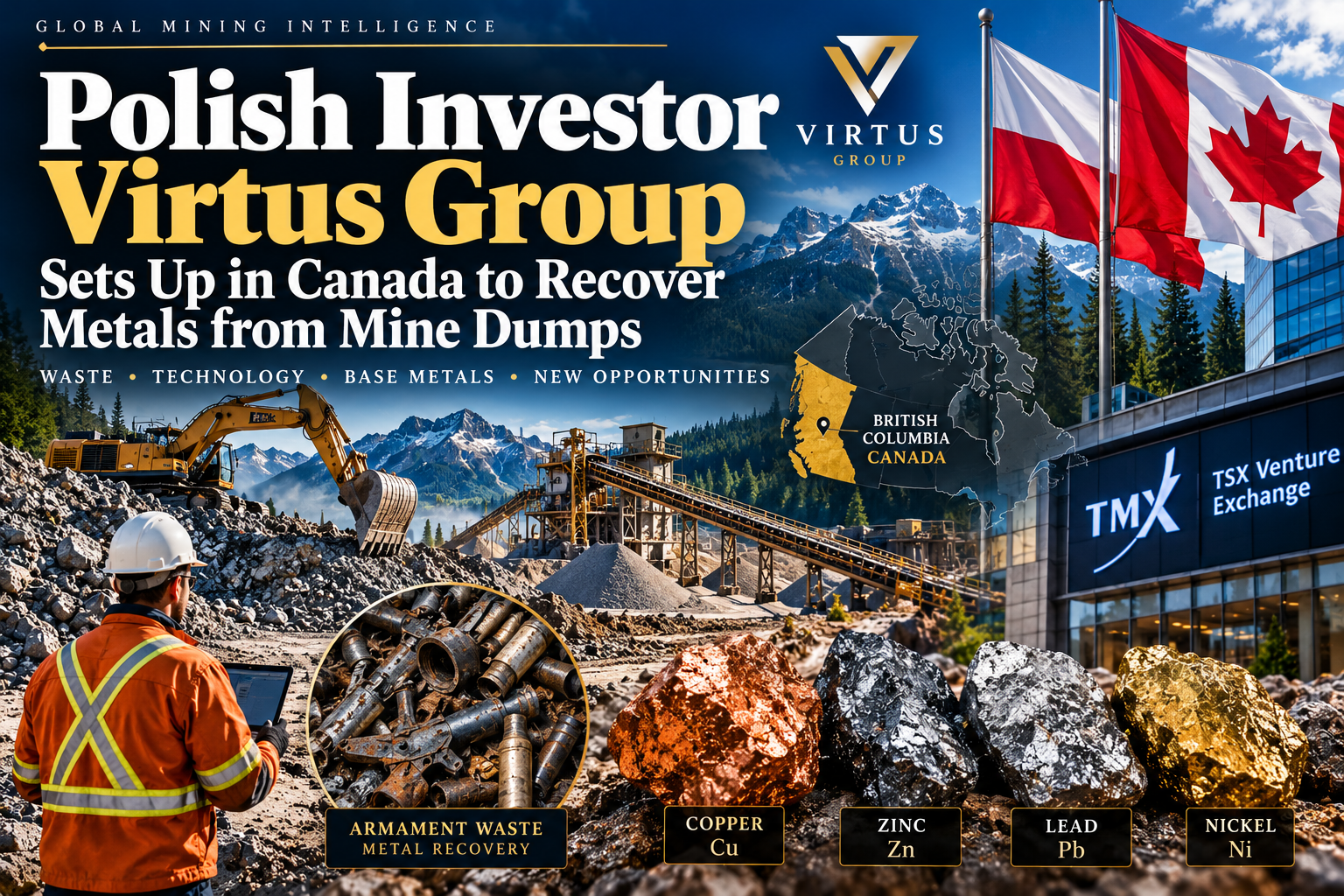
Warsaw-listed financial and investment company Virtus Group has established operations in British Columbia, Canada, with plans to develop projects focused on recovering base metals from post-mining waste and armament-related waste.
According to the intelligence report, the company intends to use a proprietary technology to extract value from materials left behind by mining and other industrial activities. Virtus is reportedly targeting the development of a portfolio of projects within six months, followed by a potential listing on the TSX Venture Exchange (TSX-V).
The move places Virtus at the intersection of two increasingly important markets: critical-mineral recovery and industrial waste remediation. Rather than relying exclusively on conventional mining, the company’s strategy seeks to turn existing waste deposits into potential sources of metals.
Because the underlying report is classified as unverified, the scale, technical performance and commercial viability of the proposed operations remain uncertain.
From Mine Waste to Mineral Assets
Mining operations generate enormous quantities of waste material. Tailings, waste rock, slag and other residues can retain economically significant quantities of metals that were not recovered during the original mining process.
Advances in processing technology have increasingly made these materials potential secondary mineral resources.
Virtus Group’s reported strategy is based on this concept. By establishing a presence in British Columbia, the company is positioning itself in a jurisdiction with a long mining history and substantial volumes of legacy mining material.
The strategy could allow the company to pursue mineral recovery without developing entirely new conventional mines, depending on the composition and accessibility of individual waste deposits.
The Armament-Waste Dimension
The intelligence report also identifies armament waste as part of Virtus’s target material.
This introduces a broader industrial-recovery component to the company’s strategy. Military and industrial waste streams can contain recoverable metals, although their composition, regulatory treatment and processing requirements can differ significantly from conventional mining waste.
If Virtus’s technology can economically process multiple categories of waste, the company could potentially build a diversified portfolio around secondary metal resources rather than relying on a single mine or commodity.
However, the reported technology has not been independently evaluated within this assessment. Questions concerning recovery rates, environmental performance, operating costs and scalability therefore remain open.
Why British Columbia Matters
British Columbia provides a potentially strategic base for this business model.
The province has an established mining industry, extensive historical mining activity and infrastructure associated with mineral exploration and processing. That creates a potential pool of legacy mine sites and waste materials that could be evaluated for secondary-resource recovery.
A Canadian operating base could also provide Virtus with access to North American capital markets and mining-sector expertise.
The reported intention to pursue a TSX-V listing is particularly significant. The TSX Venture Exchange is widely used by smaller and emerging resource companies seeking access to capital for exploration and development.
For Virtus, a Canadian listing could provide a mechanism for financing the acquisition, evaluation and development of its proposed waste-recovery portfolio.
Six-Month Portfolio Target
The company’s reported objective of building a portfolio of projects within six months represents an ambitious timetable.
The key intelligence question is whether Virtus will secure actual mineral-recovery assets or agreements within that period, and what stage those projects will have reached.
Monitoring should focus on:
- Acquisition or option agreements involving mine dumps or tailings facilities.
- Identification of specific sites and jurisdictions.
- Metallurgical test results.
- Demonstrated recovery rates for targeted metals.
- Environmental and permitting requirements.
- Capital commitments and financing arrangements.
- Partnerships with existing mining companies.
- The structure and timing of any TSX-V listing.
- Identification of the proprietary technology being deployed.
- Independent verification of the technology’s commercial performance.
These indicators will help distinguish an early-stage investment strategy from a commercially validated mineral-recovery operation.
Critical Minerals and the Secondary-Resource Economy
The move comes amid growing interest in recovering metals from unconventional sources.
Governments and mining companies are increasingly examining mine waste, industrial residues and recycled materials as potential components of future mineral supply chains.
Secondary-resource recovery can offer several potential advantages. Existing waste deposits may already have been extracted, transported and concentrated during previous mining operations, potentially reducing some of the costs associated with developing a conventional deposit.
At the same time, waste-recovery projects face their own challenges. Material grades can be inconsistent, processing technologies may require significant capital investment, and environmental liabilities can complicate project development.
The economic case therefore depends heavily on the specific waste stream and the technology used to process it.
Intelligence Assessment
Confidence: LOW
The reported establishment of Virtus Group operations in British Columbia and its intention to pursue metal recovery from post-mining and armament waste represent a potentially significant development in the emerging secondary mineral-resource sector.
However, the assessment remains unverified. There is insufficient information in the supplied intelligence to independently establish the identity and scale of targeted projects, the effectiveness of the company’s technology, expected metal volumes or the precise timetable for a TSX-V listing.
The most important indicator over the coming six months will be whether Virtus converts its stated strategy into identifiable projects, technical results, financing arrangements and regulatory filings.
If successful, Virtus could become part of a growing group of companies attempting to transform historical waste deposits into new mineral assets.
For investors and mining-sector observers, the story is therefore less about the quantity of metals currently sitting in mine dumps and more about whether technology can convert previously uneconomic material into commercially viable resources.
Until project-level evidence and independent technical data emerge, the development should be treated as an early-stage and unverified mineral-recovery initiative.
Source: Mining Weekly
Classification: LOW
Status: UNVERIFIED
Category: Conflict / Mining / Critical Minerals
Leave a Reply