
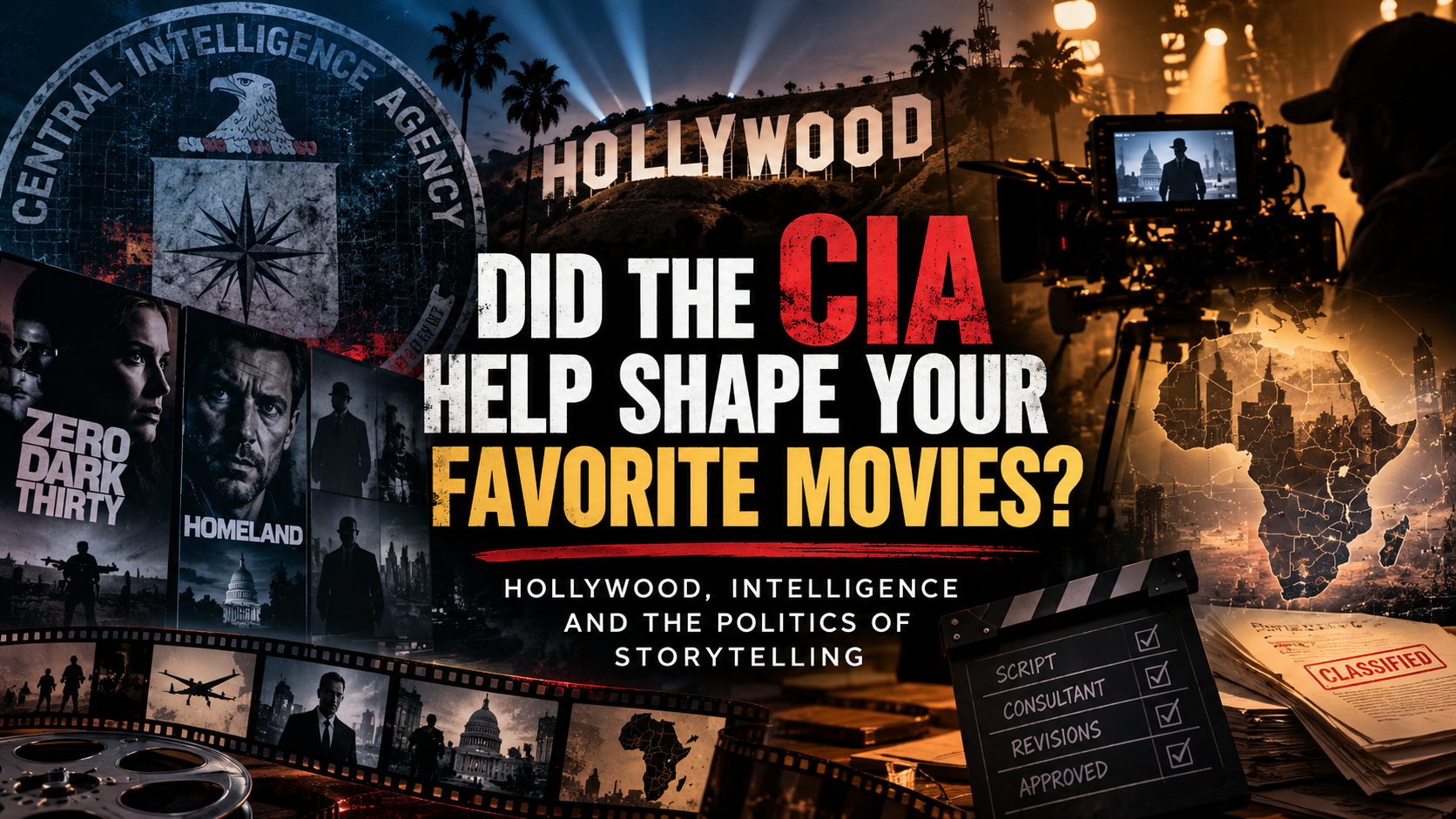
Hollywood, intelligence agencies and the hidden politics of the stories we watch
For generations, Hollywood has taught audiences how to imagine spies.
The mysterious agent with classified files. The heroic intelligence officer operating behind enemy lines. The terrorist threat that must be stopped before it reaches American soil. The interrogation room. The secret headquarters. The patriotic sacrifice.
But what happens when the real intelligence agencies being portrayed on screen become consultants to the people making the movies?
That question sits at the center of a complicated and largely under-discussed relationship between the U.S. intelligence establishment and the entertainment industry.
The relationship is not merely the stuff of conspiracy theories. The Central Intelligence Agency openly acknowledges that it works with filmmakers, television producers, actors and writers. The CIA’s Office of Public Affairs maintains an Entertainment Industry Liaison whose responsibilities include answering questions, arranging interviews, providing footage and, in some circumstances, coordinating filming at CIA facilities. (CIA)
The more controversial question is what happens when access, expertise and institutional cooperation begin influencing the stories themselves.
And that is where Hollywood becomes something more than entertainment.
From wartime propaganda to the modern intelligence thriller
The relationship between American intelligence and cinema predates the modern CIA.
During World War II, Hollywood filmmakers and technicians worked with the Office of Strategic Services—the OSS, America’s wartime intelligence organization and predecessor to the CIA.
According to the CIA’s own historical account, filmmakers including legendary director John Ford participated in OSS activities, while Hollywood professionals helped create training films and document intelligence operations. (CIA)
Film was already demonstrating its power as an instrument of persuasion.
Governments understood that moving images could do something government reports could not: they could make institutions feel human, make wars emotionally comprehensible and transform political objectives into personal stories.
After the war, that relationship did not disappear.
It evolved.
The CIA enters Hollywood
The CIA was established in 1947.
For decades, the agency generally kept its distance from Hollywood. But that changed significantly in the 1990s.
Author and scholar Tricia Jenkins has documented the development of the CIA’s entertainment-industry liaison program and its involvement with numerous film and television productions.
Her research describes an agency increasingly interested in correcting what it considered inaccurate or damaging portrayals of intelligence officers.
By the late 1990s and early 2000s, CIA-assisted productions included projects such as In the Company of Spies and The Agency, while other productions received varying forms of assistance or consultation. Jenkins’ research also identifies CIA involvement surrounding projects including Alias, The Sum of All Fears, The Recruit, Enemy of the State and others. (JSTOR)
The CIA itself does not describe this activity as propaganda.
Its stated purpose is accuracy.
The agency says filmmakers often approach it because they want to understand intelligence work, and that cooperation allows the CIA to correct myths while presenting what it considers a more realistic picture of its people and mission. (CIA)
That distinction matters.
Because influence does not necessarily require an intelligence officer sitting in an editing room.
Sometimes influence comes from deciding which doors open—and which remain closed.
Access can become influence
Hollywood productions need locations.
They need experts.
They need authentic uniforms, vehicles, equipment, technical information and sometimes access to people who have actually participated in the events being dramatized.
Government agencies can provide some of those things.
That creates a natural point of leverage.
Research into the CIA’s Hollywood relationship has documented a system in which filmmakers seeking assistance beyond simple consultation could face review of their projects before receiving additional cooperation. According to Jenkins’ research, script changes could sometimes be suggested when the agency believed particular portrayals were inaccurate or harmful to its image. (Default)
That does not mean every movie receiving CIA assistance becomes government propaganda.
It does mean that the relationship deserves scrutiny.
A filmmaker remains free to reject government advice.
But the agency can also decide whether it wants to provide access.
That is a fundamentally different relationship from an ordinary historical consultant.
The case that changed the conversation: Zero Dark Thirty
Few examples illustrate the problem better than Kathryn Bigelow’s 2012 film Zero Dark Thirty.
The film dramatized the decade-long hunt for Osama bin Laden and the 2011 U.S. raid in Abbottabad, Pakistan.
The filmmakers had extensive access to CIA officials and information while developing the movie.
That cooperation eventually became politically explosive.
One of the film’s most controversial elements was its portrayal of CIA interrogation techniques—including waterboarding and other coercive practices—and the apparent suggestion that information obtained through those methods helped lead investigators toward bin Laden.
The Senate Intelligence Committee strongly disputed that interpretation.
Senators Dianne Feinstein, Carl Levin and John McCain argued that the film’s depiction was inconsistent with the documentary record they had reviewed, including evidence that information concerning bin Laden’s courier had been obtained through means unrelated to the CIA detention and interrogation program. (The Washington Post)
The controversy became even more complicated when documents obtained through Freedom of Information Act processes revealed details about communications between the filmmakers and CIA officials.
A declassified CIA memo indicated that discussions with the filmmakers resulted in changes to scenes that agency officials considered inaccurate, including scenes involving interrogations and CIA personnel. (TheWrap)
The issue therefore wasn’t simply whether the CIA helped the production.
It clearly did.
The real question was whether that relationship affected the audience’s understanding of history.
When fiction becomes public memory
This is where the politics of entertainment become especially important.
Most people will never read a 6,000-page intelligence report.
Most people will never examine congressional testimony about classified operations.
Most people will never spend months studying the history of U.S. counterterrorism policy.
But millions of people will watch a two-hour movie.
That movie may become their mental picture of what happened.
That is precisely why the CIA itself acknowledges that popular culture matters.
In a 2025 article about its relationship with pop culture, the agency acknowledged that many Americans first encounter the CIA through movies, television or novels. It also openly described cooperation with productions including Argo and Jack Ryan. (CIA)
That admission is significant.
It means the agency understands entertainment not merely as entertainment.
It understands it as a powerful source of public perception.
Homeland and the post-9/11 imagination
Television’s influence may be even greater because serialized dramas allow audiences to spend dozens of hours inside an intelligence universe.
Homeland, which premiered in 2011, arrived during a period when the War on Terror had already transformed American political culture.
The series presented terrorism, surveillance, intelligence operations, psychological trauma and national security through an intensely personal drama.
But its significance goes beyond entertainment.
Shows like Homeland helped normalize a particular visual language for discussing terrorism and intelligence: hidden networks, sleeper agents, radicalization, surveillance, secret operations and extraordinary measures taken to prevent catastrophic attacks.
That doesn’t mean every narrative decision came from the CIA.
It means television helped establish the vocabulary through which an enormous audience encountered the War on Terror.
And once a narrative becomes familiar, it becomes easier to mistake familiarity for historical truth.
Hollywood doesn’t need to be ordered around
There is another important part of this story.
The relationship between government and Hollywood is not necessarily a simple master-and-servant arrangement.
Hollywood has its own interests.
Studios want access.
Producers want compelling stories.
Actors want realistic roles.
Directors want authenticity.
Government agencies want favorable—or at minimum less damaging—representations.
Sometimes those interests overlap.
Sometimes they collide.
And sometimes the government doesn’t have to censor anything because the entertainment industry already understands what kinds of stories sell.
That is why the most interesting question isn’t:
“Does the CIA control Hollywood?”
The available evidence does not establish such a sweeping claim.
A better question is:
“How does access to government institutions influence the stories Hollywood chooses to tell?”
That question is much harder to dismiss.
The Pentagon connection
The CIA isn’t the only U.S. institution with a long relationship with Hollywood.
The Department of Defense has operated a much larger entertainment liaison apparatus, providing military equipment, personnel, locations and technical assistance to productions.
This creates another form of influence.
A filmmaker making a movie about the U.S. military can potentially obtain extraordinary resources by cooperating with the Pentagon.
But government assistance comes with institutional interests.
The result can be a subtle feedback loop:
Hollywood wants realism.
The military provides realism.
The military wants its institution portrayed in a certain way.
Hollywood gains access by cooperating.
The final movie becomes both entertainment and a cultural representation of national power.
A look at some of Hollywood’s biggest CIA-associated and intelligence
films — and the commercial reach of the stories they helped put into
popular culture.
The Spy Story at the Box Office

Argo

The Sum of All Fears

American Made

Zero Dark Thirty

Charlie Wilson’s War

Body of Lies

The Recruit
The African question
For African audiences, this discussion has another dimension.
Hollywood has historically played an enormous role in shaping Western perceptions of Africa.
Africa has frequently been portrayed through familiar cinematic archetypes: the war zone, the corrupt government, the helpless victim, the exotic landscape, the terrorist haven or the backdrop for Western heroism.
Intelligence and national-security narratives can reinforce those patterns.
Consider how often African countries appear in international thrillers as locations for coups, arms trafficking, terrorism, espionage, civil war or political instability.
The continent becomes a stage.
Western protagonists become the actors.
African populations become background characters.
That matters because entertainment does not merely reflect geopolitics.
It can teach audiences how geopolitics supposedly works.
A viewer who repeatedly encounters Africa through the lens of Western security agencies may unconsciously begin to understand African political life primarily as a security problem.
That is a powerful narrative frame.
Who gets to tell the story?
The deeper issue is therefore not whether intelligence agencies literally write every Hollywood script.
They don’t.
The issue is who possesses the institutional power to define authenticity.
Who gets access?
Who gets interviewed?
Who provides the documents?
Who supplies the locations?
Who is considered an expert?
Whose version of events becomes the dramatic foundation?
And whose version never makes it onto the screen?
Those questions become particularly important when the subject is a war, intelligence operation or political crisis in another country.
The people who experienced the event may have one interpretation.
The government involved may have another.
The journalist may have another.
The filmmaker may create a fourth.
And the audience may remember the movie rather than any of the competing historical accounts.
Entertainment as soft power
This is where the concept of soft power becomes useful.
Military power can compel.
Economic power can incentivize.
Political power can legislate.
Cultural power can persuade.
A successful movie can make an institution appear competent, heroic, humane or necessary without ever explicitly telling the audience to support it.
That is the subtle power of narrative.
A spy agency doesn’t need to announce:
“This movie supports us.”
If the audience leaves the theater believing that the agency is indispensable, heroic and fundamentally trustworthy, the cultural effect may be considerably more powerful than a press release.
That does not prove deliberate propaganda.
But it demonstrates why governments care about their portrayal.
The line between accuracy and image management
The CIA’s stated argument is straightforward: intelligence agencies are frequently portrayed inaccurately, so the agency wants to help filmmakers understand what it actually does.
There is nothing inherently sinister about consulting an expert.
A filmmaker making a medical drama consults doctors.
A filmmaker making a courtroom drama consults lawyers.
A filmmaker making a spy thriller might reasonably consult intelligence officers.
The problem begins when the institution being portrayed becomes a gatekeeper for access to information about itself.
Then “accuracy” can become contested territory.
Accurate according to whom?
The agency?
A congressional investigation?
Former officers?
Journalists?
Historians?
Victims of intelligence operations?
Foreign governments?
Civilians affected by covert actions?
There may be no single answer.
The audience deserves to know the difference
The most responsible approach is not to dismiss Hollywood as propaganda.
Nor is it to believe every government-assisted production is an accurate historical record.
Instead, audiences should learn to recognize the difference between:
documentary evidence
official government accounts
journalistic investigations
historical scholarship
and
dramatic fiction.
A movie can be brilliant and still be historically misleading.
A television series can expose uncomfortable truths and still contain fictional characters and events.
And a production can receive government assistance without becoming a government production.
The categories matter.
So, did the CIA help shape your favorite movies?
In some documented cases, yes.
The CIA openly acknowledges its cooperation with filmmakers and maintains an entertainment-industry liaison. Researchers have documented the agency’s involvement with numerous productions. And Zero Dark Thirty provides particularly concrete evidence that CIA officials communicated with filmmakers about the depiction of events and characters, with some changes made following those discussions. (CIA)
But the evidence does not justify the blanket claim that the CIA secretly controls Hollywood or dictates what Americans watch.
The reality is more complicated—and arguably more interesting.
Government agencies possess information, access and institutional resources.
Hollywood possesses enormous cultural reach.
When those worlds cooperate, they create a space where entertainment, public relations, historical memory and national security can overlap.
And sometimes the most influential part of the relationship isn’t what appears on screen.
It is what never gets shown.
The Pan-African takeaway
For African audiences, the lesson extends far beyond Hollywood.
Africa is also fighting a battle over narrative sovereignty.
Who tells the story of the continent?
Who defines its conflicts?
Who determines which African leaders are portrayed as statesmen and which are reduced to dictators?
Who decides whether an armed movement is described as a liberation struggle, insurgency or terrorism?
Who gets to explain African resources, military interventions, elections and geopolitical alliances to the global public?
These aren’t merely questions for filmmakers.
They are questions of power.
In the age of streaming, social media and artificial intelligence, the battle over narrative is becoming even more consequential.
The next generation will not simply inherit historical events.
It will inherit the stories built around those events.
And the question every audience should ask is simple:
Who wrote the story—and who benefited from the way it was told?
Leave a Reply