
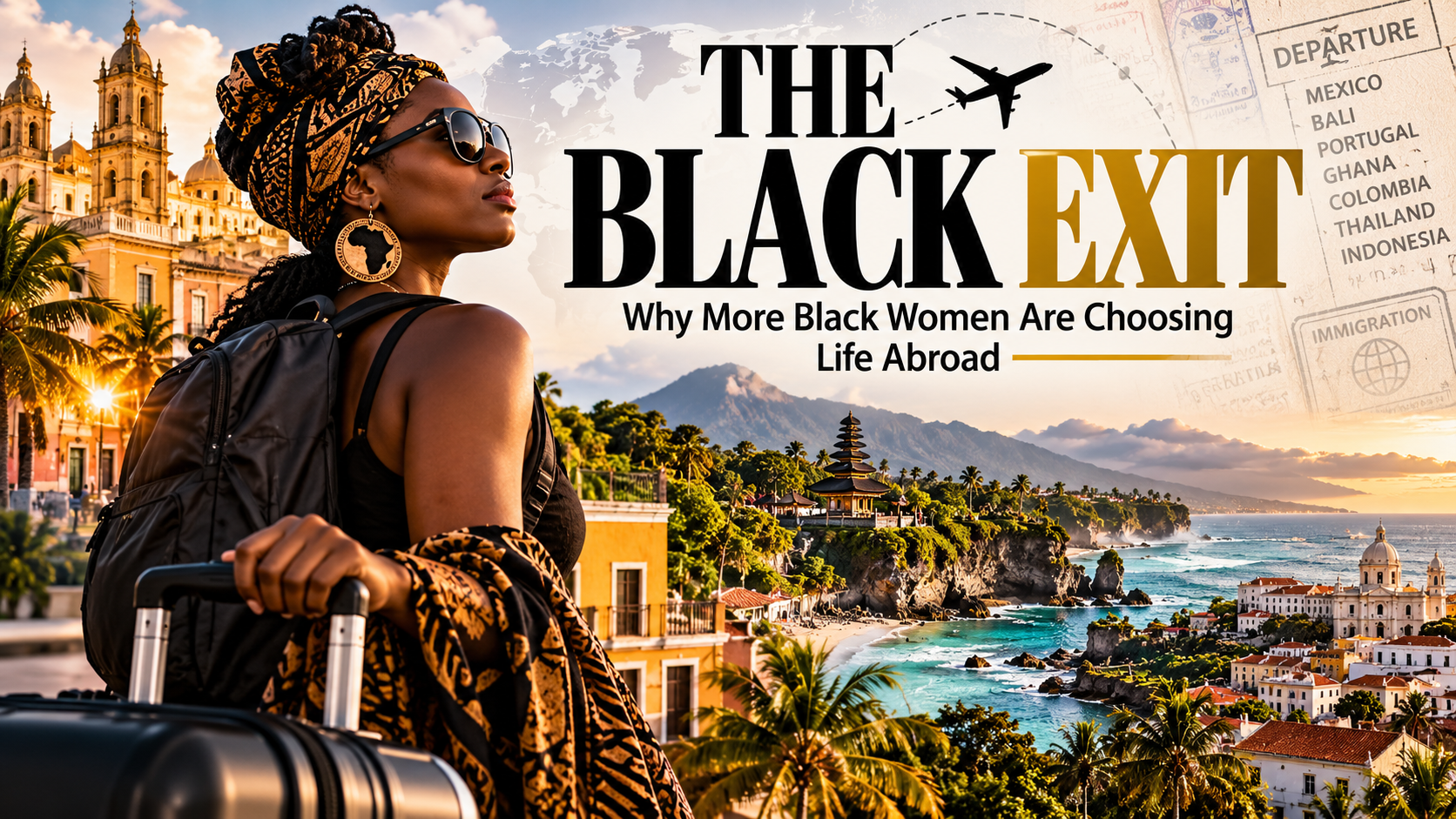
From Mexico to Bali, a growing number of Black American women are choosing to build their lives outside the United States
For generations, the American dream has been presented as a destination: work hard, buy a home, raise a family and build a better life.
But an increasing number of Black American women are asking a different question:
What if the better life is somewhere else?
Across social media communities, expatriate networks and international cities, Black women are increasingly exploring—and in some cases permanently choosing—life outside the United States.
The destinations vary. Mexico. Portugal. Colombia. Panama. Thailand. Indonesia. Ghana and other parts of Africa.
The motivations vary as well.
Some are looking for lower living costs. Others want greater flexibility, more time with their children, relief from professional burnout, cultural connection, safety or simply the experience of living somewhere where their identity does not dominate every interaction.
For some women, leaving America is not about rejecting their homeland.
It is about redefining what home can mean.
The economics of leaving
One of the most powerful forces behind the movement is economics.
For Americans earning income in U.S. dollars, relocating to countries with lower housing, domestic-service and everyday living costs can dramatically change the relationship between income and quality of life.
A salary that feels barely sufficient in an expensive American metropolitan area can provide considerably more purchasing power elsewhere.
That difference becomes especially significant for people who work remotely, operate online businesses, create digital content or have income that is not tied to a physical workplace.
One American family featured in recent reporting illustrates the calculation.
After years of demanding work schedules, Debrah Turnboe relocated with her family, first to Thailand and later to Bali. She described a lifestyle in Southeast Asia that provided her family with substantially more space and services for their money than they believed they could afford in the United States.
The appeal was not simply having a larger house.
It was having time.
Time with family.
Time away from exhausting work schedules.
Time to experience life.
That distinction is important.
The expatriate movement is not necessarily about becoming wealthy. For many people, it is about discovering whether the same income can purchase a different quality of life.
The search for peace
Money, however, only explains part of the story.
For many Black women, the decision to relocate is also deeply emotional.
Turnboe described her experience abroad as a feeling of peace and a sense that a weight had been lifted from her life.
That sentiment appears repeatedly in conversations among Black women considering life overseas.
The desire is sometimes described as wanting to “breathe.”
That word captures something larger than travel.
Travel is temporary.
Expatriation is about constructing an entirely different daily environment.
It means waking up somewhere else.
Shopping somewhere else.
Raising children somewhere else.
Building friendships somewhere else.
And, ultimately, asking whether a person’s surroundings can change the way they experience themselves.
Research and reporting on Black women living abroad has identified several recurring motivations, including work-life balance, cultural exploration, safety, affordability and the desire to escape environments where women feel constantly scrutinized or forced to navigate racial and professional pressures. (Sisters AARP)
Mexico becomes part of the conversation
Mexico has emerged as one of the most visible destinations in this broader movement.
For Black American women, Mexican cities offer a combination of geographic proximity to the United States, relatively accessible travel, established expatriate communities and a wide range of lifestyles.
Mexico City, in particular, has attracted Black American professionals, entrepreneurs, retirees and digital workers.
But the attraction is not merely financial.
Some women describe Mexico as a place where they can build a social life around food, culture, creativity and community without reproducing the exact pressures they experienced at home.
Bree Frye, another woman highlighted in recent reporting, moved to Mexico after struggling with the financial and emotional demands of life in the United States.
Her description was strikingly simple:
She wanted peace.
For Frye, working continuously while still struggling to maintain financial stability had become unsustainable.
Relocation offered the possibility of breaking that cycle.
But there is another side to the expatriate dream
There is an important contradiction at the center of this movement.
The same economic differences that make a country affordable to an American earning dollars can make that country increasingly expensive for people earning local wages.
When foreigners arrive with substantially greater purchasing power, they can contribute to rising rents, changing neighborhoods and increased demand for housing and services.
This is particularly visible in popular expatriate destinations.
What feels like liberation to one person can create economic pressure for another.
That means the Black expatriate movement cannot simply be understood as a story of individual freedom.
It is also a story about global inequality.
A U.S. dollar can stretch much further in certain parts of the world precisely because local wages are lower.
The challenge is determining how newcomers participate in those economies without becoming disconnected from the people who already live there.
The responsibility of the new expatriate
Some Black expatriates are consciously addressing that problem.
Frye has spoken about making an effort to rent from local residents and support local businesses rather than remaining inside an expatriate economic bubble.
That approach matters.
If international relocation becomes another mechanism through which wealthy outsiders consume desirable neighborhoods while local residents are pushed away, the movement risks reproducing the very economic inequalities that many expatriates hoped to escape.
A more responsible model would emphasize:
Live locally. Spend locally. Hire locally. Learn locally. Build relationships locally.
The goal should not be to recreate America overseas.
It should be to participate respectfully in another society.
The psychological dimension of the “Black exit”
There is also a deeper historical dimension.
Black Americans have long maintained relationships with countries and communities outside the United States.
Writers, artists, intellectuals and political figures have historically traveled or relocated abroad in search of creative freedom, political space and relief from racial restrictions.
The contemporary movement adds a new technological dimension.
Social media has made it possible for someone in Atlanta, Chicago, Los Angeles or Detroit to watch another Black woman living in Mexico, Portugal, Colombia, Ghana or Indonesia and immediately ask:
Could I do that too?
A generation ago, international relocation could seem like an inaccessible fantasy.
Today, smartphones have turned expatriate life into a constantly updated visual diary.
People can watch someone grocery shopping in Mexico City.
They can see an apartment in Accra.
They can follow a business owner operating from Medellín.
They can watch a family raise children in Bali.
And they can ask questions directly.
The psychological barrier to leaving has therefore become smaller.
The rise of the digital Black diaspora
This is where the movement intersects with something larger than American migration.
It is part of the development of a global Black middle class.
Black professionals, entrepreneurs, creatives and families increasingly possess the ability to operate across borders.
Technology makes it possible to earn money in one country, maintain clients in another and live in a third.
That creates a new form of geographic freedom.
It also creates new questions about identity.
What does it mean to be African American when your children grow up in Mexico?
What does Black identity mean when an American woman builds her business in Colombia?
What happens when African Americans begin developing permanent communities in African countries?
And what happens when those communities begin interacting with Africans on the continent in ways that go beyond tourism?
These questions are already emerging.

Africa is part of the conversation
For a Pan-African audience, perhaps the most significant question is why more Black Americans are looking abroad without necessarily looking toward Africa first.
Ghana, Senegal, Kenya, Rwanda and other African countries have all attracted African-American travelers, entrepreneurs and members of the wider diaspora.
Ghana’s “Year of Return” in 2019 dramatically increased international attention on the possibility of reconnecting African Americans with the continent.
But the contemporary movement is broader than symbolic return.
It is increasingly about economic participation.
Investment.
Property.
Entrepreneurship.
Education.
Retirement.
Creative industries.
Technology.
Agriculture.
Tourism.
Diaspora communities are beginning to think about Africa not simply as a place to visit but as a place where wealth, family and identity can potentially be rebuilt.
That is a fundamentally different proposition.
Leaving America does not mean escaping racism
There is also a necessary reality check.
Moving abroad does not eliminate racism.
Black people can encounter discrimination, stereotyping, colorism, xenophobia and other forms of prejudice anywhere in the world.
Nor does every expatriate destination offer political stability, affordable housing or reliable infrastructure.
Visas can be complicated.
Healthcare systems vary.
Tax obligations can become complicated.
Local laws matter.
Language barriers can be significant.
And the experience of an American with a U.S. passport and dollar-based income may be very different from that of a local resident.
The expatriate dream therefore requires research rather than romanticism.
A beautiful Instagram feed is not an immigration strategy.
A new definition of success
Perhaps the most important part of this story is not where Black women are moving.
It is why they are moving.
The traditional definition of success has emphasized accumulation:
More money.
More property.
More status.
More work.
More consumption.
The women choosing life abroad are increasingly describing another definition:
More time.
More autonomy.
More family.
More peace.
More cultural exploration.
More control over their environment.
That is a significant philosophical shift.
The question is no longer simply:
How much can I earn?
It becomes:
What kind of life can I build with what I earn?
That question has the potential to reshape how an entire generation thinks about geography, work and freedom.
The global Black future
The movement of Black Americans abroad should not be dismissed as a passing social-media trend.
Nor should it be romanticized as an effortless escape.
It is part of a larger transformation in the global Black experience.
Technology has reduced geographic barriers.
Remote work has separated income from location.
International travel has become more accessible.
Diaspora networks have become more organized.
And millions of people are reconsidering whether the place where they were born must also be the place where they spend the rest of their lives.
For some Black American women, the answer is increasingly no.
They are packing their belongings.
They are taking their children.
They are starting businesses.
They are renting homes.
They are learning new languages.
They are forming new communities.
And they are discovering that the American dream may not necessarily require remaining in America.
The deeper question now is what happens when an increasingly mobile Black population begins treating the entire world as part of its economic, cultural and social geography.
That is where the story becomes bigger than expatriation.
It becomes a story about the future of the African diaspora.
And perhaps the most radical idea is not that Black women are leaving America.
It is that they are beginning to believe they have the right to choose where their lives should happen.
Leave a Reply