
By Panafrican.email News Desk
October 29, 2026
Deportees say they were transported thousands of miles from the United States without knowing their final destination, arriving in Bangui without identification, phones or adequate access to basic necessities.
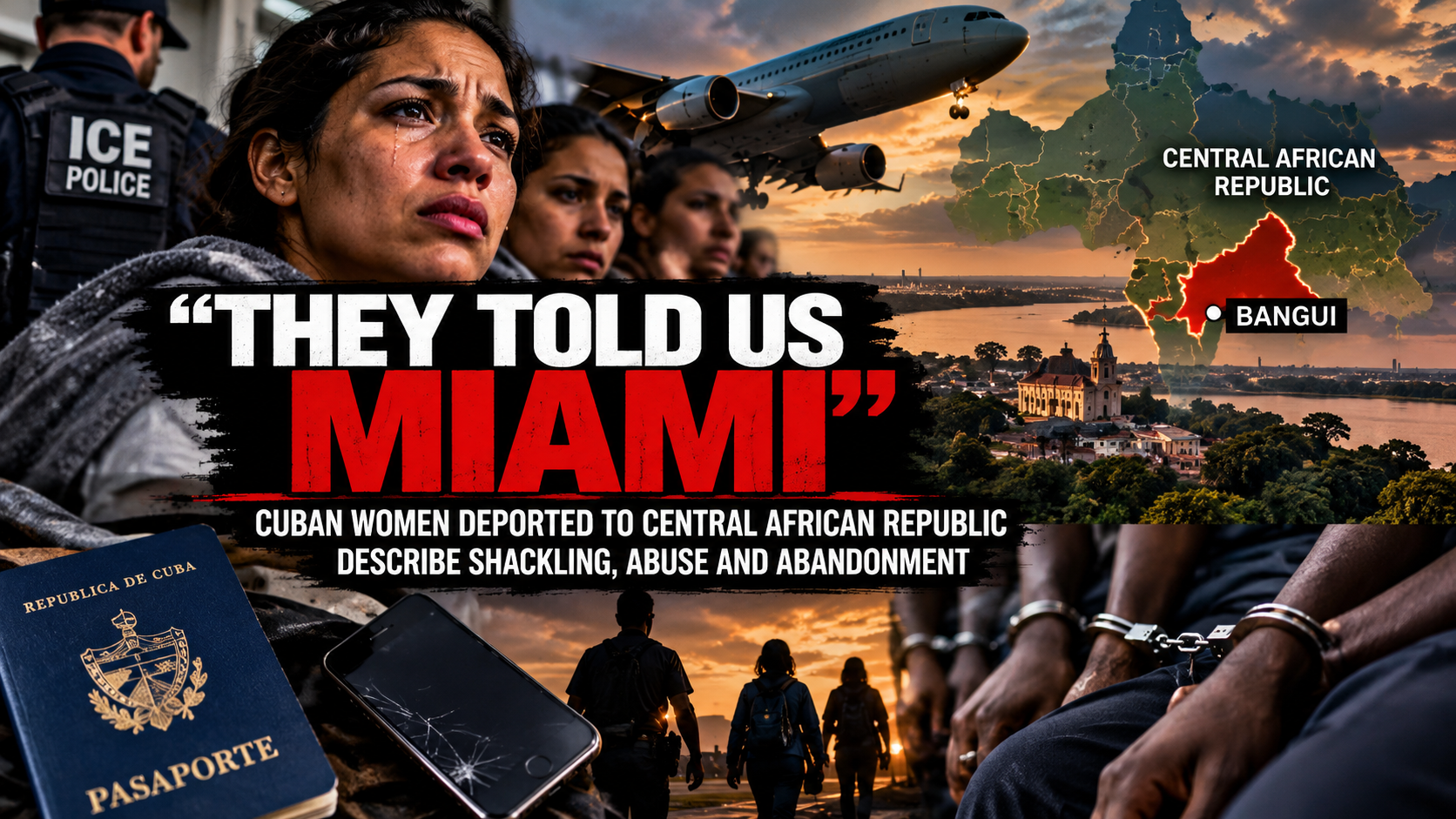
A group of Cuban, Peruvian and Venezuelan women deported from the United States say they were subjected to harsh treatment during their removal and then left in an unfamiliar African country without the documents and resources they needed to navigate their new circumstances.
The women arrived in Bangui, the capital of the Central African Republic (CAR), amid a growing U.S. policy of sending migrants to countries other than their countries of origin.
Their accounts, circulated through videos from Cuban deportee and humanitarian advocate Yasmany Moreno de Armas and subsequently reported by Spanish-language media, describe a frightening journey in which some women say they did not know they were being taken to Central Africa until the flight was underway.
One woman summarized the experience bluntly: they said they had been told they were going to Miami, then Mexico, before ultimately finding themselves in Africa. The accounts have generated renewed questions about transparency, due process and the treatment of migrants during U.S. deportation operations. (CiberCuba)
A destination they say they never expected
The Central African Republic is thousands of miles from the United States and has no obvious connection to many of the migrants being transferred there.
Human Rights Watch has documented the broader expansion of U.S. “third-country” deportations, in which people are removed to nations that are neither their countries of origin nor places where they necessarily have meaningful personal or legal ties.
According to Human Rights Watch, the United States transferred more than 500 people to African countries that were not their countries of origin between January 2025 and August 2026. The organization says people transferred to African countries have reported abusive treatment during flights, including prolonged shackling and inadequate information about their destinations. (Human Rights Watch)
The Central African Republic has become one of those destinations.
Human Rights Watch reports that a flight arriving in CAR on July 31 carried people from Afghanistan, Cuba, Ecuador, Honduras, Vietnam and other countries. Another flight arrived in late August with dozens more deportees. (Human Rights Watch)
The policy has already produced a population of migrants in Bangui who have little or no connection to the country.
Women describe a 25-hour journey in restraints
One of the women, identified as Yari, said she had lived in Las Vegas for four years before being deported.
According to her account, she resisted during the removal process and says several male immigration agents hit her, pulled her hair and forced her onto the aircraft.
She also says she remained shackled by her hands and feet for more than 25 hours.
The Human Impact Project, which tracks reported immigration-enforcement incidents, recorded her allegations on October 26, citing CiberCuba, Diario de Cuba and social-media footage. (HIProject)
Other women reportedly arrived with swollen feet after prolonged restraint.
These allegations are serious. However, the available reporting does not independently establish every detail of the women’s accounts or determine individual responsibility for the alleged assaults. They remain allegations made by the deportees and reported through interviews and social-media documentation.
That distinction matters, particularly when reporting allegations involving federal law-enforcement personnel.
Passports and phones
Another central issue is what happened to the women’s identification documents and communications devices.
Several women said their passports and phones were taken from them during the deportation process.
Without passports or other identification, migrants can face enormous difficulties proving their identity, traveling legally, accessing money and communicating with relatives.
For people arriving in a country where they have no established family network, employment history or community infrastructure, the loss of a telephone can also mean the loss of their primary connection to the outside world.
CiberCuba reported that women arriving in Bangui described being without documents, phones and meaningful legal protection. (CiberCuba)
A humanitarian problem after the plane lands
The crisis does not necessarily end when a deportation flight reaches its destination.
Recent accounts from Bangui describe migrants struggling with basic necessities, including documentation, money, hygiene and medication.
The Human Impact Project reported on October 28 that several Cuban women who arrived among a group of roughly 80 migrants said they lacked documentation and money and were experiencing poor living conditions. One woman reportedly said she had gone two days without bathing. Another said she had medical conditions and had been unable to obtain her medication. (HIProject)
The arrival of the migrants therefore raises a broader question:
What obligations exist after the United States removes someone to a third country?
If a person has no passport, no money, no family in the receiving country and no established immigration status, deportation can create a second layer of vulnerability after the physical journey is over.
Bangui is not a conventional migration destination
The Central African Republic is also facing its own serious security and humanitarian challenges.
The U.S. State Department has maintained its highest travel advisory for the country, citing risks associated with armed conflict, crime, kidnapping, terrorism and civil unrest.
That context is particularly important when evaluating the vulnerability of migrants arriving without established support networks.
Earlier deportees interviewed by CBS described being unable to move freely after arriving in CAR. One Cuban deportee told CBS that he learned he was being sent to Africa only after the flight was underway. (CBS News)
The Associated Press also reported the case of Daniela Fuentes, a Cuban transgender woman deported to CAR, who said she now disguises herself for safety, cannot work and spends most of her time inside a compound in Bangui. AP reported that she had no passport or other identification after arriving. (ABC News)
Her case illustrates how the consequences of third-country deportation can vary dramatically depending on a person’s identity and circumstances.
The numbers are growing
The Cuban women’s experience is part of a much larger expansion.
Human Rights Watch says U.S. third-country deportations increased dramatically during the period it examined. Between January 20, 2025 and August 5, 2026, ICE data showed 27,943 people deported to third countries, compared with 8,563 during the comparable period a year earlier.
Transfers to African countries increased from 103 to 536 during those comparison periods, according to the organization. (Human Rights Watch)
CBS News similarly reported that the Trump administration sent more than 100 deportees from Afghanistan, Cuba, Nicaragua and other countries to eight African nations during a 10-day period in 2026. (CBS News)
The Central African Republic is therefore not an isolated case.
It is part of a broader system in which African countries have increasingly become destinations for migrants removed from the United States.
Who is responsible for what happens next?

Alexandria, Louisiana → Dakar, Senegal → Malabo, Equatorial Guinea → Bujumbura, Burundi → Bangui, Central African Republic.
That question is becoming increasingly important.
A deportation order may determine that someone must leave the United States. But when that person is sent to a third country, another set of questions emerges.
Who guarantees that the receiving country will recognize the person’s legal status?
Who replaces lost identification?
Who provides medical care?
Who ensures that people are not arbitrarily detained?
Who protects women who arrive without documentation?
And what happens when the receiving country itself does not want—or cannot safely accommodate—the people being transferred?
Human Rights Watch argues that third-country removals can place people at risk of arbitrary detention, ill-treatment and onward removal to places where they may face persecution or torture. (Human Rights Watch)
Africans should be paying attention
For African audiences, this story should not be reduced to a dispute over American immigration policy.
The Central African Republic is being asked to become part of an international deportation infrastructure involving people from countries across the world.
That raises questions about sovereignty.
What does it mean for an African government to accept deportees from a powerful foreign government?
What protections are negotiated before those people arrive?
Who pays for their accommodation and medical care?
And how much authority does the receiving country actually exercise over their future?
These questions extend beyond Cuba.
African states from West Africa to Central Africa have increasingly appeared in discussions surrounding third-country removals. Human Rights Watch has documented transfers involving multiple African countries and warned about the consequences for people who arrive without meaningful ties to the receiving state. (Human Rights Watch)
Beyond immigration statistics
The women now in Bangui are more than numbers in a deportation database.
They are mothers, daughters, workers and family members who say they suddenly found themselves thousands of miles from the lives they had built.
Some say they were unable to contact their families.
Some say they arrived without documents.
Some say they experienced violence during the journey.
And some are now trying to understand what legal options remain available to them.
In the middle of that uncertainty, Yasmany Moreno has emerged as an informal source of assistance for newly arrived deportees. CiberCuba reported that he used donations to purchase five phones for women who had arrived without working devices, allowing them to reconnect with relatives. (CiberCuba)
It is a small intervention against a much larger problem.
A telephone cannot replace a passport.
A humanitarian donation cannot replace legal status.
And an apartment cannot resolve the question of where someone ultimately belongs.
The bigger question
The controversy surrounding these deportations ultimately forces a question that extends beyond the United States and Cuba:
When a country removes a person to a third country, what responsibility does it retain for that person’s safety and dignity after the plane lands?
That question is becoming increasingly urgent as African nations become destinations in an expanding global deportation system.
For the women now in Bangui, the immediate concerns are painfully practical: documentation, medication, communication, security and a path forward.
For governments across Africa, the issue is larger.
It concerns sovereignty, humanitarian responsibility and whether Africa becomes merely a destination for unwanted migrants—or an active participant in deciding what happens to the people arriving on its soil.
The women say they were told they were going somewhere else.
Now they are in Bangui.
And they are asking the world to listen.
Leave a Reply