
By Panafrican.email News Desk
October 29, 2026
For years, the creator economy has operated in an unusual space between entertainment, media, advertising and entrepreneurship.
A person with a camera, podcast microphone, YouTube channel, production studio, newsletter, gaming platform or social-media audience could generate substantial revenue while operating outside the traditional categories that banks and government agencies have historically used to define businesses.
That is beginning to change.
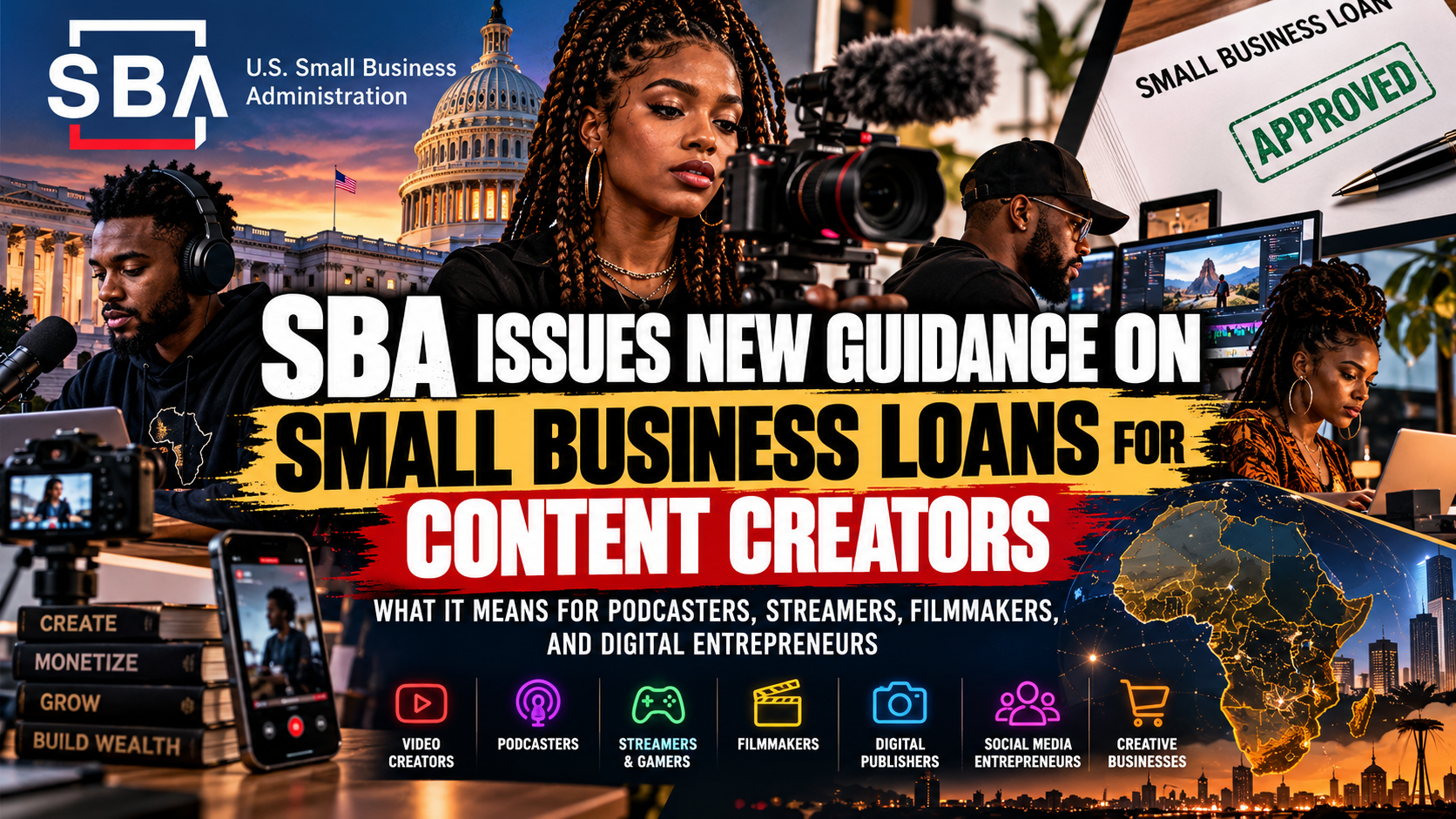
The U.S. Small Business Administration (SBA) has issued new guidance explicitly clarifying how qualifying content-creator businesses should be classified within its small-business framework.
The move could have significant consequences for creators seeking financing, government contracting opportunities and recognition as legitimate operating businesses rather than simply individuals producing content online.
The SBA announced October 15 that qualifying creator-led businesses should begin with NAICS 5121 — Motion Picture and Video Industries when determining the appropriate classification for SBA program eligibility. The agency says the classification is intended to better reflect the modern business models used by filmmakers, video producers, podcasters, streamers, gamers, digital publishers, social-media entrepreneurs, creative agencies and other businesses producing and distributing original audiovisual content. (Small Business Administration)
The creator is now being treated more like an entrepreneur
The significance of the announcement goes beyond a government classification code.
The creator economy has evolved into a sophisticated commercial ecosystem involving advertising, subscriptions, sponsorships, merchandise, licensing, digital products, consulting, events, intellectual property and direct-to-consumer sales.
A successful creator may simultaneously function as:
- A media company
- A production studio
- A marketing agency
- A publisher
- An entertainment company
- An e-commerce business
- A technology company
- A licensing operation
Traditional business classifications do not always capture that complexity.
The SBA acknowledged that problem in its announcement, noting that modern creators frequently produce, edit, distribute, market and monetize original audiovisual content across multiple platforms and revenue streams. (Small Business Administration)
The new guidance is therefore an attempt to make the government’s classification system better match the way these businesses actually operate.
What is NAICS 5121?
NAICS stands for the North American Industry Classification System.
It is used by government agencies to categorize businesses according to their primary economic activity.
The SBA’s new guidance places qualifying creator businesses within NAICS 5121, Motion Picture and Video Industries, while instructing businesses to identify the specific six-digit classification that best corresponds to their primary activity. (Small Business Administration)
That distinction matters.
A YouTuber who primarily produces original video programming may have a different appropriate classification from a marketing agency producing branded campaigns, for example.
The SBA is not saying that every person who posts content online automatically becomes eligible for every SBA program.
Instead, the agency is providing a clearer starting point for businesses whose principal activity involves producing and distributing original audiovisual content.
Who could benefit?
The SBA specifically identifies a broad range of creator-led businesses.
That includes:
Podcasters
Creators producing original audio and video programming may now have a clearer path toward identifying the appropriate industry classification.
Streamers and gamers
Businesses built around livestreaming, gaming content and digital entertainment can potentially fall within the creator economy framework.
Video producers
Independent production companies and individuals operating professional video businesses can use the classification guidance when determining their SBA eligibility.
Digital publishers
Online publishers producing original audiovisual programming represent another category affected by the modernization.
Social-media entrepreneurs
Creators who have transformed their audience into an actual business operation are increasingly being treated as entrepreneurs rather than merely social-media personalities.
Creative agencies
Businesses producing original media and audiovisual campaigns may also fall within the framework.
The SBA says the broader creator economy includes 27 million creator-led businesses, illustrating how significant the sector has become. (Small Business Administration)
The modern creator economy extends far beyond influencers. From filmmaking
and podcasting to gaming, publishing and digital commerce, creative skills
can become scalable businesses with employees, intellectual property,
equipment and multiple revenue streams.
Produce films, documentaries, branded video, television and digital programming. Build audio and video shows around advertising, memberships, sponsorships and licensing. Create live entertainment, commentary, education and community-driven programming. Build audiences through gameplay, esports, reviews, livestreams and gaming media. Turn short-form and long-form content into sponsorship, advertising and commerce businesses. Operate newsletters, independent media brands, websites and specialized publications. Create recordings, soundtracks, podcasts, commercial audio and licensed intellectual property. Build commercial photography, editorial, portrait, fashion and visual-media businesses. Produce branding, animation, digital graphics, campaigns and visual identities. Provide video editing, color, sound, animation and post-production services. Build media careers around interviews, news, entertainment, education and commentary. Turn creative production skills into full-service advertising, media and production companies. Transform audiences into customers through merchandise, products, subscriptions and stores. Create courses, memberships, educational media and professional learning products. Build businesses around African culture, history, diaspora storytelling and cultural education.
The biggest opportunity isn’t simply gaining followers. It is converting
attention into intellectual property, products, services, jobs and
sustainable companies.
Panafrican.email | Creator Economy Intelligence
Creative Careers That Can Become Businesses
Filmmakers & Video Producers
Podcasters
Streamers
Gaming Creators
Social Media Creators
Digital Publishers
Music & Audio Producers
Photographers
Graphic & Motion Designers
Editors & Post-Production
Hosts & Presenters
Creative Agencies
Creator-Commerce
Online Educators
Cultural Media Creators
From Audience → Enterprise
But this does NOT mean automatic SBA loans
This is perhaps the most important distinction for creators reading the headline.
The SBA’s announcement does not mean that every influencer, YouTuber or podcaster can automatically receive a government-backed loan.
The agency is clarifying classification and eligibility—not guaranteeing financing.
Existing SBA programs continue to have their own requirements.
The SBA states that eligibility generally depends on factors including what the business does, ownership, where it operates, whether it meets applicable size standards and whether it can demonstrate an ability to repay financing. (Small Business Administration)
That means a creator still needs to operate like a business.
A lender may examine:
- Revenue
- Cash flow
- Business expenses
- Creditworthiness
- Tax records
- Business structure
- Debt obligations
- Collateral where applicable
- Ability to repay
- Business purpose
- Ownership eligibility
The new classification can make it easier to identify where a creator belongs within the system, but it does not eliminate underwriting.
What SBA financing could look like
Depending on eligibility, creator-led companies could potentially explore existing SBA-backed financing programs.
The SBA’s 7(a) program can provide loans of up to $5 million for qualifying businesses, with permitted uses including working capital, equipment, supplies, inventory, business acquisition and certain real-estate-related expenses. (Small Business Administration)
For smaller businesses, the Microloan program provides loans of up to $50,000 through nonprofit intermediary lenders. The SBA says the average microloan is approximately $13,000. (Small Business Administration)
The 504 program is designed primarily around major fixed assets such as real estate and equipment. (Small Business Administration)
For a creator, that distinction could become important.
A production company might need cameras, lighting, editing systems and studio equipment.
A podcast network could require recording facilities and production infrastructure.
A digital publisher might need servers, production equipment and working capital.
A creator-focused merchandise company could require inventory and fulfillment infrastructure.
The creator economy increasingly has the same capital requirements as conventional businesses.
The rise of the creator as a media company
The traditional image of a content creator is rapidly becoming outdated.
Consider a creator with:
500,000 followers
That number alone does not constitute a business.
But suppose that creator also operates:
- A production company
- A paid membership
- A newsletter
- A merchandise line
- Sponsored programming
- Digital courses
- Licensing agreements
- A podcast
- A YouTube channel
- A website
At that point, the operation looks considerably more like a diversified media company.
The SBA’s guidance recognizes this reality.
The government is essentially acknowledging that the modern small business does not necessarily need a storefront, warehouse or traditional office.
Its primary asset may be intellectual property and an audience.
Why this matters for Black and African creators
For Black creators and African diaspora entrepreneurs, the change could be particularly significant.
Across the United States and Africa, creators have increasingly become independent publishers capable of reaching audiences without traditional media gatekeepers.
A smartphone can now function as:
Camera + newsroom + television station + radio station + publishing platform + advertising channel.
That technological shift has lowered the barriers to entry while simultaneously creating new challenges.
Creators may have audiences worth millions of dollars in potential commercial value while still struggling to obtain conventional business financing.
Banks traditionally understand businesses through financial statements, collateral and established commercial structures.
The creator economy introduces another asset:
audience.
But an audience isn’t necessarily recognized as collateral.
That creates a financing gap.
Africa’s creator economy is also expanding
The SBA’s announcement is specifically about U.S. businesses, but the underlying economic transformation is global.
Across Africa, creators are building businesses around music, film, fashion, sports, gaming, journalism, education, comedy and cultural storytelling.
Platforms such as YouTube, TikTok, Instagram and streaming services have allowed African creators to bypass traditional distribution systems and reach global audiences directly.
A Nigerian filmmaker can reach viewers in London.
A Ghanaian podcaster can build an audience in Atlanta.
A Liberian journalist can publish directly to readers in California.
A South African gaming creator can monetize viewers across several continents.
The geography of media is changing.
And governments are beginning to catch up.
From influencer to institution
One of the biggest consequences of this development could be a cultural shift in how entrepreneurs see themselves.
The word “influencer” often suggests an individual whose primary product is personal visibility.
The term “creator business” suggests something different.
It implies an organization capable of generating intellectual property, employing people, producing products and building long-term commercial value.
That distinction matters when approaching lenders and investors.
A creator who says:
“I have 200,000 followers”
is presenting an audience statistic.
A creator who says:
“My media company generated $180,000 in revenue last year across advertising, subscriptions, licensing and merchandise”
is presenting a business.
The second statement gives a lender something substantially more concrete to evaluate.
The government is recognizing an economic reality that platforms already understood
Social platforms have spent years building sophisticated monetization systems around creators.
Creators can earn through:
- Advertising
- Subscriptions
- Tips
- Sponsorships
- Affiliate commerce
- Digital products
- Licensing
- Merchandise
- Paid communities
- Brand partnerships
The platforms already understand that creators generate economic activity.
The SBA’s move represents government infrastructure beginning to reflect that reality.
The agency described the change as part of an effort to modernize government programs and reduce unnecessary regulatory complexity for entrepreneurs. (Small Business Administration)
There is still a major catch
Creators should not interpret the announcement as a guarantee of financing.
The SBA’s own lending information emphasizes that businesses must satisfy program-specific eligibility requirements and demonstrate a sound business purpose and ability to repay. (Small Business Administration)
Furthermore, SBA eligibility rules can include requirements concerning ownership and residency.
Earlier in 2026, the SBA announced restrictions concerning foreign nationals and SBA-backed lending, including requirements relating to U.S. citizenship or nationality and principal residence in the United States. (Small Business Administration)
That means international creators and creators operating across borders need to examine the rules carefully rather than assuming that the new creator classification applies equally to every business.
The opportunity is bigger than a loan
Perhaps the most important consequence of the announcement isn’t the possibility of borrowing money.
It is institutional recognition.
For years, entrepreneurs in the creator economy have had to explain themselves to traditional institutions.
Now the federal government is explicitly acknowledging that creator-led companies belong within the small-business ecosystem.
That could affect how creators think about:
Accounting.
Business formation.
Tax planning.
Intellectual property.
Employees and contractors.
Equipment financing.
Commercial leases.
Government contracts.
Business credit.
Capital raising.
Long-term succession and ownership.
The creator who treats their operation as a hobby will remain dependent on platform income.
The creator who builds an actual company can potentially create something much more durable.
The next phase of the creator economy
The first era of social media was about gaining attention.
The second was about monetizing that attention.
The next phase may be about building institutions around it.
A creator with an audience can become a publisher.
A publisher can become a media company.
A media company can create jobs.
A media company can own intellectual property.
That intellectual property can generate revenue across multiple markets.
And that business can eventually require serious capital.
The SBA’s new guidance recognizes that progression.
For creators, the message is straightforward:
Your audience can be the beginning of a business—but it cannot be the entire business.
The real opportunity comes from turning attention into intellectual property, intellectual property into products and products into durable companies.
That is where the creator economy starts looking less like social media—and more like the next generation of small business.
What creators should do next
Creators considering SBA financing should begin by treating their operation as a formal business.
1. Identify the primary business activity.
Determine whether your main operation is video production, podcasting, publishing, streaming, creative services or another activity.
2. Review the appropriate NAICS classification.
The SBA says qualifying creator-led businesses should begin with NAICS 5121 and identify the appropriate six-digit code based on their principal activity. (Small Business Administration)
3. Separate personal and business finances.
Use dedicated business banking and maintain accurate financial records.
4. Document revenue.
Keep records of advertising, sponsorships, subscriptions, merchandise, licensing and other income.
5. Build business credit responsibly.
A lender needs evidence that the business can manage financial obligations.
6. Create a capital plan.
Know exactly what the money would fund—equipment, working capital, inventory, production facilities, employees or expansion.
7. Speak with an SBA-approved lender or intermediary.
Different programs have different requirements, so eligibility should be confirmed before making financing decisions. (Small Business Administration)
The bottom line
The creator economy has become too large for government agencies to treat it as an internet novelty.
The SBA’s October guidance is an acknowledgment that creators can be legitimate small-business owners, employers, producers and entrepreneurs.
But recognition is only the first step.
The creators who benefit most may be those who move beyond chasing views and begin building companies that can survive without any single platform.
For America’s creator economy—and increasingly for Africa’s emerging digital entrepreneurs—the next battle is no longer simply for attention.
It is for ownership, capital and institutional power.
Leave a Reply