
Russia-Africa Summit | Geopolitics | Debt | Ukraine | African Sovereignty
Putin’s Message to Africa: The West Is Keeping You in Debt
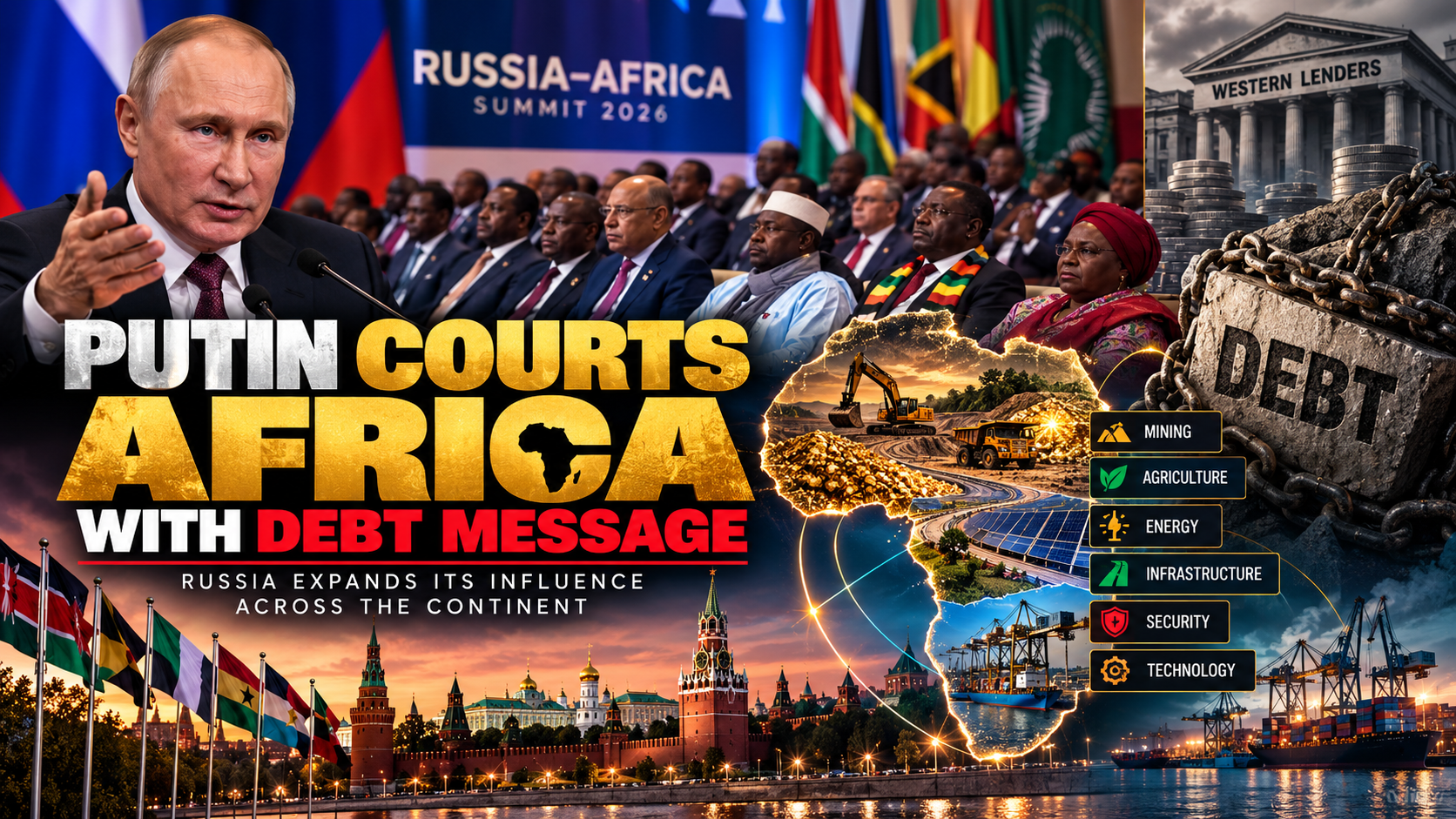
At the third Russia-Africa Summit in Moscow, Russian President Vladimir Putin delivered a message designed to resonate with a continent increasingly frustrated by the terms of its relationship with traditional Western powers.
Putin accused Western countries of attempting to keep African nations dependent on debt and argued that unfavorable financial arrangements can constrain long-term development.
He presented Russia as a different kind of partner—one willing to share technology, localize production, support infrastructure development and expand agricultural and fertilizer supplies.
The summit brought together delegations from 48 African countries, including 22 represented by national leaders, making it one of Moscow’s most important diplomatic gatherings with the continent. (Reuters)
But the significance of the summit goes beyond Putin’s speech.
It raises a much larger question about Africa’s place in the emerging global order.
Who gets to define Africa’s development model?
The Image Going Viral
A video circulating on social media shows African leaders seated during the summit while a CNN-style chyron reads:
“PUTIN: WEST USING DEBT TO HAMPER AFRICAN GROWTH”
The accompanying commentary by journalist Larry Madowo argues that African leaders frequently criticize being summoned by individual foreign powers but continue to attend such meetings.
The post also raises a more uncomfortable issue: the reported recruitment of Africans into Russia’s war in Ukraine.
That criticism deserves attention—but it is important to distinguish the social-media commentary from what has actually been documented about the summit.
Africanews, citing AFP, reported that African nationals being recruited into Russian military structures has become a significant concern. Nigeria, Kenya and South Africa have publicly expressed alarm over citizens being recruited by Moscow, while Amnesty International urged African governments attending the summit to demand that Russia end what it described as forced and deceptive recruitment. (Africanews)
That makes the absence—or prominence—of the issue in diplomatic discussions an important subject for African public debate.
Russia’s Africa Strategy Is Bigger Than Putin’s Speech
Moscow’s renewed African engagement isn’t simply about speeches.
Russia is attempting to construct a broad relationship spanning:
- military and security cooperation
- mining
- energy
- agriculture
- fertilizer
- nuclear technology
- infrastructure
- education
- digital technology
- pharmaceuticals
- transportation
- diplomatic cooperation
Putin told African representatives that Russia was prepared to share technological capabilities, localize manufacturing and help create jobs and tax revenues inside African economies.
He also promoted greater African representation in institutions including the International Monetary Fund and World Bank. (Reuters)
Russia is also seeking to expand agricultural exports, with Putin saying Moscow was prepared to increase the geographical reach of its grain and other agricultural shipments.
Africanews reported that Russia also intends to localize production of medicines and vaccines on the continent. (Africanews)
This is therefore not merely a geopolitical summit.
It is an attempt to build an economic ecosystem.
The Ukraine Question Cannot Be Separated From Russia’s Africa Policy
There is another reality behind the Moscow summit.
Russia is fighting a major war in Ukraine while facing extensive Western sanctions.
Its outreach to Africa therefore has strategic value.
Africa represents 54 countries and one of the largest voting blocs in the United Nations system. Building stronger relationships with African governments gives Moscow diplomatic relationships at a time when Russia is seeking to counter Western pressure. (AP News)
This doesn’t mean African governments are simply acting as Russian proxies.
Far from it.
African governments have their own interests.
They want:
food security.
energy.
infrastructure.
security.
investment.
technology.
access to markets.
And increasingly, they want the ability to negotiate with multiple global powers rather than depend overwhelmingly on one geopolitical bloc.
That is where the idea of a multipolar Africa becomes important.
Africa Is Becoming the Negotiating Ground of a Multipolar World
For decades, African states were frequently forced to navigate a world dominated by competing Western and Soviet blocs.
Today the environment is different.
The United States remains a major power.
The European Union remains deeply connected to Africa.
China has become one of the continent’s largest economic partners.
Russia is expanding its security and diplomatic footprint.
India, Turkey, the Gulf states, Brazil and other emerging powers are also increasing engagement.
African governments therefore have something their predecessors often lacked:
choice.
But choice only becomes leverage when African governments coordinate their interests.
Otherwise, competition between external powers can simply become another mechanism through which African resources and strategic positions are negotiated externally.
The Debt Question Is Real—But It Cannot Be Reduced to East Versus West
Putin’s criticism of Western debt practices is politically powerful.
But Africa’s debt crisis cannot be understood through a simple Russia-versus-West framework.
African countries borrow from multiple sources.
These include:
- commercial markets
- multilateral institutions
- bilateral governments
- Chinese lenders
- private creditors
- development banks
- domestic financial institutions
Debt itself is not automatically exploitation.
Borrowing can finance infrastructure, energy, transportation, education and industrialization.
The problem emerges when debt-financed projects fail to generate sufficient economic returns—or when governments borrow under terms that leave them with little fiscal room to invest in their own populations.
The real question for Africa should therefore be:
What does the continent receive in exchange for the debt?
If $1 billion is borrowed and produces productive infrastructure, industrial capacity and millions of dollars in new economic activity, the equation is different from borrowing $1 billion simply to cover recurring expenditure.
African governments need to evaluate the economic architecture behind the loan, not merely the nationality of the lender.
The Resource Question
There is another issue sitting beneath almost every major foreign-power engagement with Africa:
natural resources.
Africa possesses enormous deposits of gold, copper, cobalt, lithium, uranium, manganese, bauxite, iron ore, oil and natural gas.
Russia is no exception to the international competition for access to these resources.
Russian companies and Russian-linked interests have pursued opportunities in areas ranging from mining to energy, while Western, Chinese, Gulf and other international companies compete for similar assets. (Reuters)
This creates an enormous opportunity.
But it also creates a danger.
Africa can become the world’s resource warehouse without becoming the world’s manufacturing center.
That is the historical problem.
The Real Test: Localization
One of the more significant promises Putin made at the summit was that Russia was prepared to help localize production rather than simply purchase African raw materials. (Reuters)
That is exactly the proposition African policymakers should interrogate.
If Russia wants African minerals, what happens next?
Does Africa export raw ore?
Or does Africa develop:
- refining capacity
- processing plants
- component manufacturing
- engineering expertise
- research institutions
- industrial supply chains
- skilled employment
- African-owned companies?
The same question should be asked of China.
The United States.
Europe.
India.
The Gulf.
Everyone.
The nationality of the foreign investor is less important than the structure of the transaction.
Africa Corps and the Security Dimension
Russia’s growing relationship with Africa also has a security component.
In parts of the Sahel, governments that have broken with traditional Western partners have developed closer relationships with Moscow.
The Wagner Group’s former footprint has increasingly been associated with Russia’s Africa Corps, which operates under the Russian Defense Ministry.
The United States and other Western governments have accused Russian forces and associated networks of supporting military governments and expanding Moscow’s geopolitical influence.
Russia rejects those accusations. (Reuters)
This creates a difficult dilemma for African governments.
Security partnerships can provide immediate military assistance.
But governments must also ask:
What are the long-term political and economic consequences of outsourcing security?
And perhaps more importantly:
What happens when the foreign security partner becomes economically or politically indispensable?
The African Recruits Issue
This may be the most uncomfortable part of the current relationship.
African nationals have reportedly been recruited into Russian military structures, including people who were allegedly deceived about the nature of their employment.
Africanews reported that governments including Nigeria, Kenya and South Africa have raised concerns about their citizens being recruited by Moscow. Amnesty International separately called on African leaders attending the summit to press Russia to stop forced and deceptive recruitment. (Africanews)
That issue deserves independent investigation and sustained diplomatic attention.
African citizens should not become disposable manpower for wars being fought thousands of kilometres from home.
And African governments have a responsibility to know where their citizens are, how they were recruited and under what legal conditions they are serving.
Why African Leaders Still Attend
This is where the social-media criticism requires nuance.
The fact that African leaders attend a Russian summit does not necessarily mean they endorse everything Russia does.
African governments attend American summits.
Chinese summits.
European summits.
Arab summits.
Indian summits.
Turkish summits.
And increasingly, meetings hosted by other emerging powers.
Diplomacy requires showing up.
The more important question is what African leaders demand when they arrive.
Do they negotiate hard?
Do they bring continental priorities?
Do they coordinate positions?
Do they demand local processing?
Do they negotiate technology transfers?
Do they protect African workers?
Do they secure market access?
Do they insist on transparent contracts?
Do they protect sovereignty?
Those questions matter more than the photograph of African leaders sitting in an auditorium.
Putin’s Ice Cream Moment
One of the more memorable images surrounding the summit was Putin’s highly publicized gesture of handing out ice cream to African leaders.
It may look trivial.
But political symbolism matters.
Diplomatic summits are increasingly designed not only around agreements but around images.
A leader offering food, shaking hands, standing beside African heads of state or emphasizing shared opposition to colonialism is communicating something deeper:
Russia wants to be remembered as a partner rather than a former imperial power.
That messaging is particularly significant in countries where anti-colonial sentiment remains politically powerful.
The New Scramble Is Not Just for Africa
The emerging competition should not be described simply as another “scramble for Africa.”
There is something different happening.
African governments are increasingly attempting to use competition between major powers to their advantage.
The continent can negotiate with Washington and Moscow.
Beijing and Brussels.
Delhi and Riyadh.
Ankara and Tokyo.
The objective should not be choosing a new master.
It should be eliminating the need for one.
What Africa Should Demand From Every Foreign Partner
Whether the partner is Russia, China, America, France, Britain, India or the Gulf states, African governments should establish a common negotiating framework.
1. Local value creation
Natural resources should increasingly be processed locally.
2. Technology transfer
Investment should create African technical capacity rather than permanent dependence.
3. African employment
Projects should generate skilled African jobs.
4. Infrastructure
Mining and resource deals should contribute to roads, ports, electricity, water and digital infrastructure.
5. Transparent financing
Loan agreements should be understandable to citizens and legislatures.
6. Sovereignty
Security cooperation must not compromise national decision-making.
7. Citizen protection
African governments must protect their citizens working abroad—including citizens recruited into foreign military structures.
8. Long-term industrialization
The objective should be manufacturing and productive capacity—not simply exporting commodities.
The Bigger Question
The most important question coming out of Moscow isn’t whether Putin is right about Western debt.
Nor is it whether Russia is better for Africa than Europe, America or China.
The question is:
Can Africa turn geopolitical competition into African power?
That requires a fundamental change in negotiating psychology.
Instead of asking:
“Who will invest in us?”
African governments should increasingly ask:
“What capabilities will this investment create for us?”
Instead of asking:
“Who will buy our minerals?”
Ask:
“What can we manufacture from them?”
Instead of asking:
“Who will provide security?”
Ask:
“How do we build sustainable African security institutions?”
Instead of asking:
“Who will lend us money?”
Ask:
“What economic engine will repay the loan?”
That is the difference between dependency and leverage.
Africa’s Moment
Putin’s appearance in Moscow is part of a much larger transformation.
The global system is becoming more competitive, fragmented and multipolar.
For Africa, that creates enormous risks.
But it also creates enormous opportunity.
The continent possesses the population growth, natural resources, strategic geography and emerging consumer markets that every major power wants access to.
Africa therefore has something extremely valuable:
negotiating leverage.
But leverage only matters when it is organized.
The challenge for African leaders is not to choose between Moscow, Washington, Beijing or Brussels.
The challenge is to build an Africa powerful enough to negotiate with all of them.
No permanent enemies. No permanent patrons.
Permanent African interests.
That may ultimately be the most important message emerging from the Russia-Africa Summit.
Panafrican Intelligence Brief
EVENT: Russia-Africa Summit 2026
LOCATION: Moscow, Russia
AFRICAN DELEGATIONS: 48 countries
LEADERS REPRESENTED: 22
CORE THEMES: Trade, security, agriculture, infrastructure, technology, debt, diplomacy and multipolarity
KEY RISK: Foreign competition over African resources and strategic influence
KEY OPPORTUNITY: Using geopolitical competition to accelerate African industrialization and strategic autonomy
INTELLIGENCE QUESTION: Can African governments convert external competition into domestic economic power?
Panafrican.email Intelligence Assessment:
SIGNIFICANCE — HIGH
TREND — MULTIPOLAR COMPETITION
AFRICAN LEVERAGE — RISING
STRATEGIC RISK — HIGH
OPPORTUNITY — HIGH
This article distinguishes between verified reporting about the 2026 Russia-Africa Summit and commentary contained in the social-media post that prompted this analysis. Claims concerning recruitment of African citizens into Russian military structures remain a subject of ongoing reporting and governmental concern. (Africanews)
Leave a Reply