
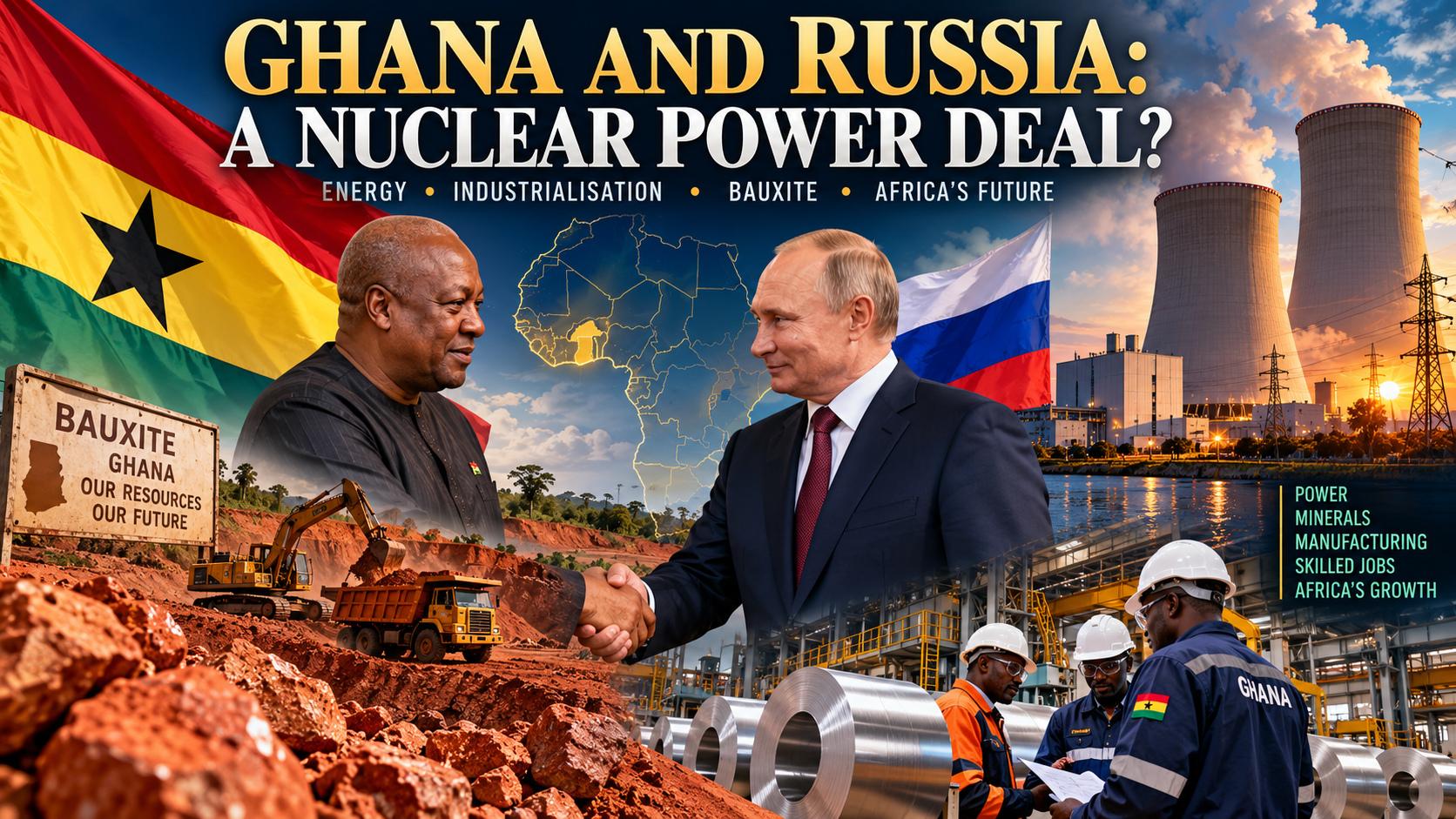
President Mahama’s renewed engagement with Moscow places energy, industrialisation and Ghana’s mineral wealth at the center of a potentially transformative relationship. But the nuclear question is about much more than building a power station.
A Nuclear Question Has Entered Ghana’s Russia Strategy
President John Dramani Mahama’s engagement with Russia has moved beyond conventional diplomacy and trade.
During the Third Russia–Africa Summit in Moscow, Mahama announced that Ghana had initiated discussions with Russia’s state-owned nuclear corporation, Rosatom, over establishing Ghana’s first nuclear power station. (Ghana News Agency)
The announcement is significant because Ghana has discussed nuclear energy for years, but the country has never built a commercial nuclear power plant.
Mahama has presented nuclear energy as part of a broader strategy to provide the reliable and affordable electricity required for industrialisation.
The logic is straightforward: Ghana wants to stop exporting so much of its mineral wealth in raw form and instead process more of it domestically.
But processing gold, bauxite and manganese requires enormous amounts of reliable electricity.
That makes the nuclear question inseparable from Ghana’s larger economic transformation agenda.
The question facing Accra is therefore not simply:
Can Russia build Ghana a nuclear power station?
The more important question is:
Can Ghana use a Russian partnership to build greater economic independence without creating a new form of strategic dependence?
Mahama’s Industrialisation Argument
Mahama has repeatedly connected Ghana’s nuclear ambitions to industrialisation.
Speaking at the Russian University of Transport earlier this week, the president argued that Ghana needs substantially more electricity if it is going to process its natural resources domestically and create jobs for its young population. (Information Services Department)
Ghana is already a major producer of gold and has substantial deposits of bauxite and manganese.
But exporting raw or semi-processed resources limits the amount of economic value retained inside the country.
The industrialisation model Mahama is describing is different.
Instead of:
Extract → Export → Import finished products
Ghana wants to move toward:
Extract → Process → Manufacture → Export higher-value products
That transition requires infrastructure.
It requires railways.
It requires ports.
It requires factories.
And above all, it requires dependable electricity.
This is where nuclear power enters the conversation.
Ghana’s Electricity Challenge
Electricity is not simply another infrastructure issue for an industrial economy.
It is foundational.
A refinery cannot operate competitively if electricity supply is unreliable. An aluminium industry cannot function efficiently without enormous quantities of dependable power. Manufacturing plants cannot plan production around unpredictable electricity availability.
Ghana’s existing electricity system relies heavily on thermal generation and hydropower, with renewables playing a growing but comparatively smaller role.
That creates both an opportunity and a vulnerability.
Hydropower provides relatively low-carbon electricity, but its performance can be affected by water availability.
Thermal generation provides flexibility but exposes Ghana to fuel costs and supply risks.
Solar power has significant potential, but large-scale industrial operations require electricity beyond daylight hours unless substantial storage capacity is available.
Nuclear energy offers something different: continuous large-scale generation.
That does not mean nuclear should replace renewables, hydro or thermal generation.
It means nuclear could potentially become another component of a diversified national energy system.
Mahama has explicitly described Ghana’s strategy as a diversified energy mix that includes renewables while advancing the peaceful use of nuclear energy. (Ghana News Agency)
Ghana’s nuclear ambitions involve a potentially multi-billion-dollar,
multi-year infrastructure programme. The numbers below are indicative
estimates from Ghanaian nuclear planning and reporting — not a finalized
Russia–Ghana construction contract.
What Could Ghana’s Russia Partnership Cost — and How Long Could It Take?
Large Nuclear Plant
Construction
National Programme
Illustrative Nuclear Development Timeline
The Bigger Investment Equation
Russia’s Nuclear Advantage
Russia has spent decades developing nuclear technology and has become one of the world’s most aggressive exporters of nuclear infrastructure.
Rosatom is involved in nuclear projects across multiple countries, including the major El Dabaa nuclear project in Egypt.
For Ghana, Russian involvement could potentially bring together reactor technology, engineering expertise, financing structures, training and long-term technical support.
That could be attractive to a country trying to establish an entirely new nuclear industry.
But nuclear cooperation is fundamentally different from buying ordinary infrastructure.
A nuclear power station creates relationships that can last for decades.
The supplier may remain involved in fuel supply, maintenance, technical services, training and reactor support.
That means the original construction agreement can become the foundation for a much broader strategic relationship.
Ghana therefore has to negotiate beyond the price of construction.
The Bauxite Connection Changes the Equation
The nuclear announcement becomes even more interesting because it comes at almost exactly the same moment that Russia is expanding its involvement in Ghana’s bauxite industry.
Russian aluminium giant RUSAL and Ghana’s state-owned Ghana Integrated Aluminium Development Corporation, or GIADEC, have agreed to jointly develop bauxite mining and alumina refining projects connected to the Nyinahin deposit. (Reuters)
The proposed project could involve annual bauxite production of up to 5 million tonnes and an alumina refinery with capacity of approximately 1.2 million tonnes per year.
The Nyinahin deposit is estimated to contain more than 100 million tonnes of bauxite. (Rusal)
That creates a potentially powerful connection:
Russian capital → Ghanaian bauxite → alumina refining → aluminium value chain → electricity demand
And that last component matters enormously.
Aluminium is an energy-intensive industry.
If Ghana wants to develop an integrated aluminium industry rather than simply export bauxite, reliable electricity becomes one of the country’s most important competitive advantages.
Suddenly, the nuclear conversation is no longer only about electricity for households.
It becomes part of a possible industrial ecosystem.
Could Energy and Minerals Become One Strategy?
This may ultimately be the most important question arising from Mahama’s Moscow visit.
Ghana has historically exported significant quantities of natural resources while importing many higher-value manufactured products.
The industrialisation strategy now being discussed attempts to reverse that equation.
Consider the potential chain:
Bauxite
↓
Domestic mining
↓
Alumina refining
↓
Aluminium production
↓
Manufacturing
↓
Export
Every stage requires infrastructure.
Every stage creates jobs.
And every stage increases electricity requirements.
The same principle applies to other minerals.
Gold refining requires energy.
Manganese processing requires energy.
Steel and manufacturing require energy.
Industrial agriculture requires energy.
Digital infrastructure requires energy.
Artificial intelligence and data centers require energy.
The future African economy will therefore be increasingly shaped by the availability of reliable electricity.
But Nuclear Power Is Not Cheap
This is where the excitement surrounding the announcement must be balanced by hard economic analysis.
A nuclear power plant is a multi-billion-dollar infrastructure project.
It can take years to develop, finance, license and construct.
The country must also establish or strengthen regulatory institutions, emergency-response systems, trained personnel, nuclear-security capabilities and long-term waste-management systems.
The investment does not end when the reactor begins producing electricity.
The country must operate and maintain the facility for decades.
Eventually, it must also deal with decommissioning.
This creates an important distinction between energy access and energy affordability.
A country can technically have a large nuclear power plant and still face expensive electricity if the project’s financing arrangements are unfavorable.
For Ghana, therefore, the question should not be:
“How quickly can we build a nuclear plant?”
It should be:
“What structure gives Ghana the lowest sustainable cost of electricity while maximizing domestic ownership and technological capability?”
Who Pays?
Financing could become one of the most important elements of the negotiations.
Nuclear projects require enormous upfront capital, which means the financial structure can be as important as the reactor technology itself.
Ghana will need to examine questions including:
- Who finances construction?
- What interest rate applies?
- Who carries construction risk?
- What currency are repayments denominated in?
- Who owns the plant?
- Who operates it?
- Who supplies nuclear fuel?
- How long is the operating agreement?
- What happens if electricity demand does not grow as projected?
- What happens if construction costs increase?
- How much technology transfer is guaranteed?
- How many Ghanaian engineers will eventually operate the system?
These are not technical footnotes.
They determine whether the project strengthens Ghana’s economic sovereignty or creates a long-term financial obligation.
The Currency Question
Mahama has also advocated stronger use of local currencies and digital payment systems in Africa-Russia trade.
That could become particularly interesting if Ghana and Russia move toward large infrastructure agreements.
Large international infrastructure projects traditionally involve hard currencies and international financial institutions.
But Ghana’s currency strategy, Russia’s experience with sanctions and alternative payment systems, and the broader African push toward greater monetary sovereignty could create new possibilities.
At the same time, Ghana must remain extremely careful about foreign-exchange risk.
A project financed in dollars, euros or another foreign currency can create a substantial repayment burden if the Ghanaian cedi depreciates.
That means the financing architecture deserves as much attention as the reactor itself.
Technology Transfer Must Be a Core Requirement
If Ghana enters a nuclear partnership, simply receiving a completed facility should not be enough.
The country should seek a genuine domestic capability.
That means training Ghanaian engineers, scientists, technicians and regulators.
It means developing local maintenance capacity.
It means strengthening Ghanaian universities and research institutions.
It means creating pathways for Ghanaian companies to participate in the nuclear supply chain wherever safety standards allow.
The ultimate objective should be:
not merely a Russian-built nuclear plant in Ghana, but a Ghanaian nuclear industry capable of understanding, operating and eventually managing its own infrastructure.
That distinction could determine the long-term value of the partnership.
The Safety Question Cannot Be Negotiated Away
Nuclear energy carries enormous potential, but it also demands extraordinary institutional discipline.
Ghana would need independent regulatory oversight, strong safety culture, emergency preparedness and transparent public communication.
Political administrations change.
Nuclear facilities remain.
That means the regulatory architecture must be designed to survive political transitions.
The public should also have access to meaningful information about safety standards, environmental assessments, emergency planning and radioactive waste management.
The nuclear debate should therefore not be reduced to a choice between being “pro-Russia” or “anti-Russia.”
The real issue is whether Ghana can establish a system where the technology is subject to Ghanaian law, internationally recognized safety standards and strong independent oversight.
Russia Is Not Ghana’s Only Option
Another important consideration is competition.
Ghana’s nuclear programme has attracted interest from multiple international partners and technologies.
That creates an opportunity for Accra.
Instead of treating one country as the inevitable supplier, Ghana can use competition to negotiate better terms.
If Russia wants to participate, it should compete on:
- Price
- Financing
- Technology
- Safety
- Training
- Local content
- Technology transfer
- Operating costs
- Fuel security
- Waste management
- Decommissioning
- Ghanaian ownership
Competition between potential partners could ultimately improve Ghana’s negotiating position.
The RUSAL Question
The simultaneous expansion of Russian interest in Ghana’s bauxite sector deserves particular attention.
The RUSAL-GIADEC agreement targets the development of the Nyinahin bauxite deposit and an alumina refinery. (Reuters)
That could bring investment, jobs, infrastructure and industrial capacity.
But Ghana should examine the entire value chain.
If Ghana provides the mineral resource while foreign companies capture most of the downstream value, the country could simply reproduce the traditional extractive model under a new partnership.
The objective should instead be to maximize Ghanaian participation.
That means asking:
How much of the value chain remains in Ghana?
How much tax revenue is generated?
How many Ghanaian companies participate?
How many skilled jobs are created?
What infrastructure remains under Ghanaian control?
What technology is transferred?
What environmental obligations apply?
These questions matter just as much as the headline investment figure.
The African Question
There is also a broader continental dimension.
Ghana hosts the Secretariat of the African Continental Free Trade Area.
That gives Accra an unusual strategic position.
If Ghana successfully combines energy expansion with mineral processing and manufacturing, it could potentially become an industrial platform serving markets across Africa.
Imagine an economy where:
Ghanaian bauxite becomes Ghanaian alumina.
Ghanaian energy powers Ghanaian manufacturing.
Ghanaian factories produce higher-value goods.
Those goods enter African markets through AfCFTA.
That is a very different economic model from exporting raw materials and importing finished products.
The ultimate opportunity is therefore bigger than a nuclear reactor.
It is the possibility of building an integrated African industrial economy.
But Ghana Must Avoid a New Dependency
This is perhaps the most important warning.
Economic partnerships become problematic when one country becomes excessively dependent on another for critical infrastructure.
Ghana should therefore avoid creating a situation where one external partner controls too many strategic components simultaneously:
energy + minerals + infrastructure + finance + technology.
Diversification should remain a central principle.
Russia can be a partner.
China can be a partner.
The United States can be a partner.
Europe can be a partner.
African institutions can be partners.
But Ghana’s development strategy must remain Ghanaian.
The objective should be to use international competition to build domestic capability—not to replace one dependency with another.
What Should Ghana Prioritise in Negotiations?
If discussions with Rosatom progress, Ghana should enter negotiations with a clearly defined national-interest framework.
1. Affordable electricity
The ultimate measure should be the delivered cost of electricity—not the size of the reactor or the value of the construction contract.
2. Ghanaian ownership
Ghana should negotiate meaningful ownership and governance arrangements.
3. Technology transfer
Training and technical capability should be embedded into the agreement from the beginning.
4. Local content
Ghanaian companies should participate wherever technically and safely possible.
5. Independent regulation
The nuclear regulator must have the authority and resources to operate independently.
6. Long-term financing transparency
The public should understand the financial obligations created by the project.
7. Fuel security
Ghana should understand the full lifetime fuel-supply arrangement.
8. Waste and decommissioning
These costs should be incorporated into the original economic model rather than postponed.
9. Environmental protection
Mining, construction, cooling-water requirements and radioactive waste must all be independently assessed.
10. Industrial integration
The nuclear programme should support Ghana’s wider industrial strategy rather than become an isolated megaproject.
A Strategic Opportunity—If Ghana Negotiates From Strength
President Mahama’s Moscow initiative could become one of the most consequential economic partnerships of his administration.
Ghana is simultaneously seeking greater energy security, domestic mineral processing, industrialisation, technology investment and expanded international trade.
Russia is offering expertise and capital in several of those areas.
The emerging relationship therefore has real potential.
But opportunity and dependence can look remarkably similar at the beginning of a major infrastructure project.
The difference is determined by the contract.
It is determined by ownership.
It is determined by financing.
It is determined by technology transfer.
And ultimately, it is determined by whether Ghana develops the capacity to control the economic systems it is building.
The Pan-African Intelligence View
Ghana’s nuclear conversation should be watched as part of a much larger shift in African economic strategy.
Across the continent, governments are increasingly asking whether Africa can move beyond the role of raw-material supplier.
The old model was built around extraction.
The emerging model is increasingly about processing, manufacturing, energy security and technological sovereignty.
Ghana’s potential nuclear partnership with Russia sits directly inside that transition.
If reliable electricity enables Ghana to process its bauxite, refine its minerals, manufacture products and create skilled employment, the impact could extend far beyond the energy sector.
But if the country accumulates unsustainable debt, imports almost all of the technology, exports the majority of the value and becomes locked into a single foreign supplier, the outcome could be very different.
That is why the most important story coming out of Moscow is not that Ghana may build a Russian nuclear power station.
It is that Ghana is attempting to decide who will control the energy foundation of its next industrial era.
The opportunity is enormous.
So are the stakes.
For Ghana, the measure of a successful Russia partnership should ultimately be simple:
More electricity. More Ghanaian ownership. More processing. More skilled jobs. More technology. More industrial capacity. And greater—not weaker—economic independence.
Leave a Reply