
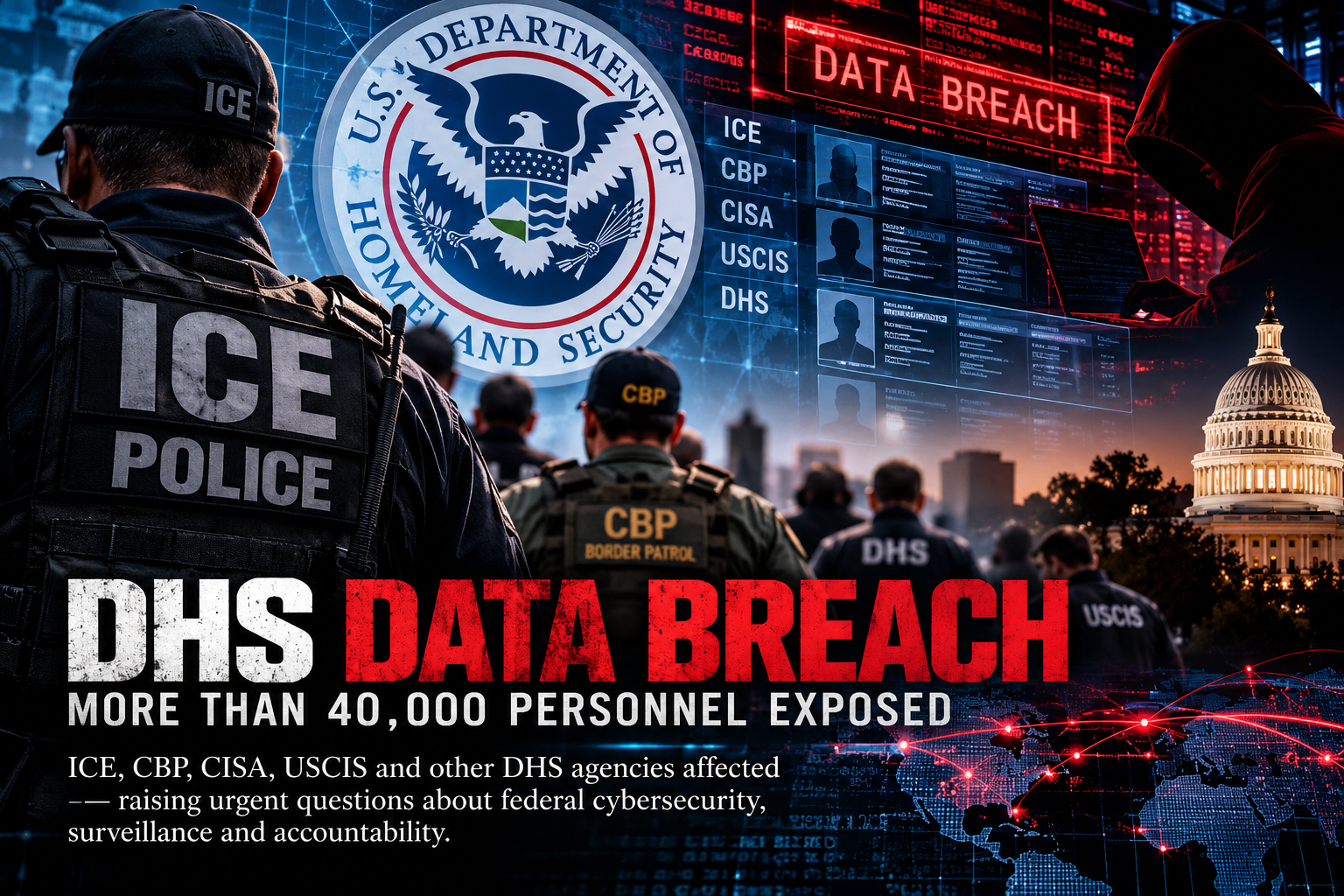
DHS Confronts Massive Data Leak
The U.S. Department of Homeland Security is facing a major cybersecurity crisis after information relating to more than 40,000 employees and contractors was released online, including personnel connected to Immigration and Customs Enforcement (ICE), Customs and Border Protection (CBP), the Cybersecurity and Infrastructure Security Agency (CISA) and other DHS components.
The incident has quickly moved beyond the category of an ordinary employee-directory leak. Reporting indicates that the exposed material contains names, job titles, work contact information, organizational relationships and other details that could reveal how sensitive government operations are structured.
Wired reported that the dataset, referred to as “Icepick,” contains records involving more than 41,000 DHS employees and contractors. The material reportedly includes information associated with undercover personnel, surveillance-related activities, investigative functions and internal access groups.
DHS has acknowledged that it is investigating a potential breach and says it is working to protect affected personnel.
The department’s response has also included efforts to restrict access to the leaked information.
According to Reuters, DHS sought assistance from Icelandic hosting provider FlokiNET to remove or restrict access to the leaked database, warning that the information could expose more than 40,000 identifiable people to harassment, stalking and physical harm.
The controversy places two competing principles directly against each other: the public’s interest in understanding powerful government agencies and the right of individual employees to remain protected from unnecessary exposure.
What Was Exposed?
The reported dataset contains considerably more than a simple list of names.
Reports indicate that records include combinations of:
- Names
- Job titles
- Work email addresses
- Work telephone numbers
- Office locations
- Supervisory relationships
- Internal organizational information
- Access groups
- Agency affiliations
Some records reportedly provide indications of sensitive responsibilities, including surveillance and undercover work.
The scope is particularly significant because DHS is not a single law-enforcement agency. It is a sprawling federal department responsible for border security, immigration enforcement, cybersecurity, emergency management and numerous intelligence and investigative functions.
The affected organizations reportedly include ICE, CBP, CISA, USCIS and Homeland Security Investigations, among others.
That makes the incident potentially useful to anyone attempting to map relationships inside the department.
A list of employees can reveal more than individual identities. When combined with job titles, reporting structures, locations and technology access, seemingly ordinary information can become a map of an institution.
The ICE and Border Patrol Dimension
The exposure of personnel associated with immigration enforcement is particularly sensitive.
ICE and CBP officers have become highly visible targets of political controversy during the Trump administration’s aggressive immigration-enforcement campaign. At the same time, the agencies argue that their personnel face serious security threats because of the nature of their work.
The White House’s border czar, Tom Homan, condemned the publication of the information and argued that exposing officers’ identities could endanger them and their families. The Justice Department is also investigating the incident, according to reporting from The Washington Post.
The security concern is straightforward: information that allows someone to identify an investigator, locate an office or establish professional relationships can potentially facilitate harassment, intimidation, impersonation or attempts to compromise an investigation.
Reuters reported that DHS specifically cited risks of harassment, stalking and physical harm in its effort to restrict access to the leaked information.
But the incident also raises a more difficult question.
Where does legitimate transparency end and dangerous exposure begin?
The Hacktivist Justification
A group calling itself “Department of Peace” has claimed responsibility for obtaining the information.
The group has attempted to frame the release as a form of political accountability, arguing that DHS employees participate in systems that collect information about members of the public and therefore should not expect complete anonymity.
The group’s justification does not, however, resolve the central security question.
There is an important distinction between investigating government power and publishing identifying information about individual employees.
Journalists, researchers and civil-society organizations can scrutinize government policies, procurement systems, surveillance technologies, immigration databases and enforcement practices without necessarily publishing sensitive personal information about individual workers.
That distinction is becoming increasingly important as governments accumulate enormous quantities of personal data.
The Bigger Cybersecurity Question
The most important issue may ultimately be less about the leaked names and more about how the information became accessible in the first place.
The reporting around the incident has raised questions about systems associated with identity and access management. The leaked records have reportedly been connected to DHS’s Okta environment, although Okta has said it has no evidence that its own systems or data were compromised.
That distinction matters.
A breach involving an identity provider, a government application, stolen credentials, an improperly secured database or an authorized user would represent very different technical failures.
Until investigators establish the precise intrusion path, it would be premature to conclude exactly how the attackers obtained the information.
The incident nevertheless demonstrates a broader cybersecurity reality:
A government does not have to lose classified documents for a breach to become strategically dangerous.
Personnel records can themselves become intelligence.
From Names to Network Maps
Modern cybersecurity increasingly recognizes that metadata can be as valuable as the underlying documents.
Suppose an attacker knows:
- who supervises a particular unit;
- where that unit operates;
- which employees belong to a particular access group;
- which investigators work on specific programs;
- which contractors support a particular system;
- which offices communicate with one another.
The attacker may be able to reconstruct portions of an organization’s internal structure without ever obtaining a classified report.
That is why seemingly mundane employee information can become valuable when aggregated.
The reported DHS leak illustrates this problem vividly.
Surveillance Infrastructure Also Enters the Story
One of the more consequential aspects of the reported dataset is the apparent presence of references to surveillance and investigative technologies.
Wired reported that the material contains references to surveillance tools, wiretapping-related systems, immigration databases and other technology used within DHS-related operations.
That raises questions extending far beyond employee privacy.
The public debate surrounding government surveillance has traditionally focused on the legal authority to collect information.
But there is another question:
Can governments securely protect the infrastructure and personnel associated with that surveillance?
If sensitive organizational information can be extracted and published at scale, the cybersecurity of surveillance systems becomes part of the civil-liberties debate itself.
Transparency Versus Privacy
There is a legitimate public interest in understanding how DHS operates.
ICE and CBP exercise enormous government authority. Their activities affect immigration, detention, deportation, border security and the lives of millions of people.
Citizens therefore have a legitimate interest in examining:
- agency policies;
- enforcement practices;
- surveillance technologies;
- government contracts;
- spending;
- databases;
- accountability mechanisms;
- civil-rights complaints;
- relationships between federal agencies.
But transparency does not automatically require publishing every employee’s personal identifying information.
That distinction becomes particularly important for lower-level employees who may have little influence over agency policy.
A democratic society needs mechanisms for holding powerful institutions accountable without transforming every employee database into a public targeting list.
Why This Matters Beyond the United States
For African governments, technology companies and civil-society organizations across the continent, the DHS breach offers another warning.
African governments are rapidly digitizing:
- national identity systems;
- immigration databases;
- tax systems;
- biometric databases;
- health records;
- financial systems;
- border-management platforms;
- law-enforcement databases.
The more centralized these systems become, the more attractive they become to attackers.
The lesson from the DHS incident is therefore not simply that governments should protect employee directories.
It is that institutional metadata is itself a strategic asset.
A compromised employee database can provide an attacker with the first layer of an organizational map.
Africa’s Digital Security Challenge
Across Africa, governments are increasingly investing in digital public infrastructure while cybersecurity capacity remains uneven.
That creates a dangerous imbalance.
Digitization can make government services faster and more accessible. But it can also concentrate enormous amounts of sensitive information into systems that become high-value targets.
The DHS incident demonstrates what happens when a large institution’s information ecosystem becomes exposed.
For African governments building digital identity, customs, immigration and intelligence systems, cybersecurity cannot be treated as a final-stage technical upgrade.
It has to be part of the architecture from the beginning.
That means:
Zero-trust access controls.
Strong identity verification.
Multi-factor authentication.
Continuous monitoring.
Least-privilege access.
Segmentation of sensitive systems.
Comprehensive audit logs.
Rapid credential revocation.
And critically, the ability to determine exactly who accessed what information and when.
A New Era of Government Data Risk
The DHS incident also reflects a changing cybersecurity environment.
Government agencies increasingly operate interconnected digital ecosystems involving employees, contractors, cloud providers, identity platforms, software vendors and third-party service providers.
Every additional connection creates another potential attack surface.
A modern breach may therefore involve no dramatic penetration of a classified network.
It may begin with an identity.
A credential.
An API.
A third-party platform.
An improperly configured database.
Or an account with more privileges than it actually needs.
That is why cybersecurity professionals increasingly describe identity as the new perimeter.
The Accountability Question
There is another uncomfortable question at the center of this story.
If governments possess enormous amounts of personal information about citizens, what obligations do they have to protect that information?
And if that information is leaked, who is accountable?
The answer cannot simply be that hackers are criminals.
The attackers may be responsible for the intrusion, but institutions remain responsible for designing systems that minimize the consequences when an account is compromised.
The same principle applies to private corporations, banks, telecommunications companies and African governments.
Cybersecurity is ultimately about more than protecting computers.
It is about protecting people.
What Happens Next?
The investigation is still developing.
DHS has said it is aware of a potential breach and is working to address it, while efforts have been made to restrict access to the published information.
The precise method used to obtain the records, the full scope of compromised information and the identities of everyone affected remain matters for investigators.
Meanwhile, the publication of the data has created a second security problem: once information has been copied and distributed across the internet, removing the original database does not necessarily eliminate the exposure.
That is the fundamental challenge of the digital age.
You can take down a server. You cannot easily take down information that has already been copied.
The Pan-African Intelligence View
The DHS breach should be understood as both a U.S. national-security story and a global lesson in digital power.
Governments are becoming data institutions.
Their power increasingly depends on their ability to collect, connect, analyze and act on information.
That creates enormous opportunities — but also enormous vulnerabilities.
For African nations building the next generation of digital infrastructure, the message is clear:
Data security is national security.
A government database is not merely a technical asset.
It can be a map of the state itself.
And when that map falls into the wrong hands, the consequences can extend far beyond the screen.
Intelligence Brief
EVENT: DHS personnel data breach
STATUS: Under investigation
REPORTED SCALE: More than 40,000 personnel records
AGENCIES REPORTEDLY AFFECTED: DHS, ICE, CBP, CISA, USCIS and others
DATA REPORTEDLY EXPOSED: Names, work contact information, organizational details and other employment information
SECURITY CONCERN: Potential harassment, stalking, impersonation and operational exposure
ATTRIBUTION: A group calling itself “Department of Peace” has claimed responsibility; the precise intrusion method remains under investigation
LIVE RISK: The publication of identifying information can continue creating exposure even if individual websites or databases are removed.
Pan African Brief: The DHS incident is a warning for every government digitizing identity, immigration, financial, health or security infrastructure: the database is only as secure as the identities, access controls and organizations surrounding it.
no
Leave a Reply