
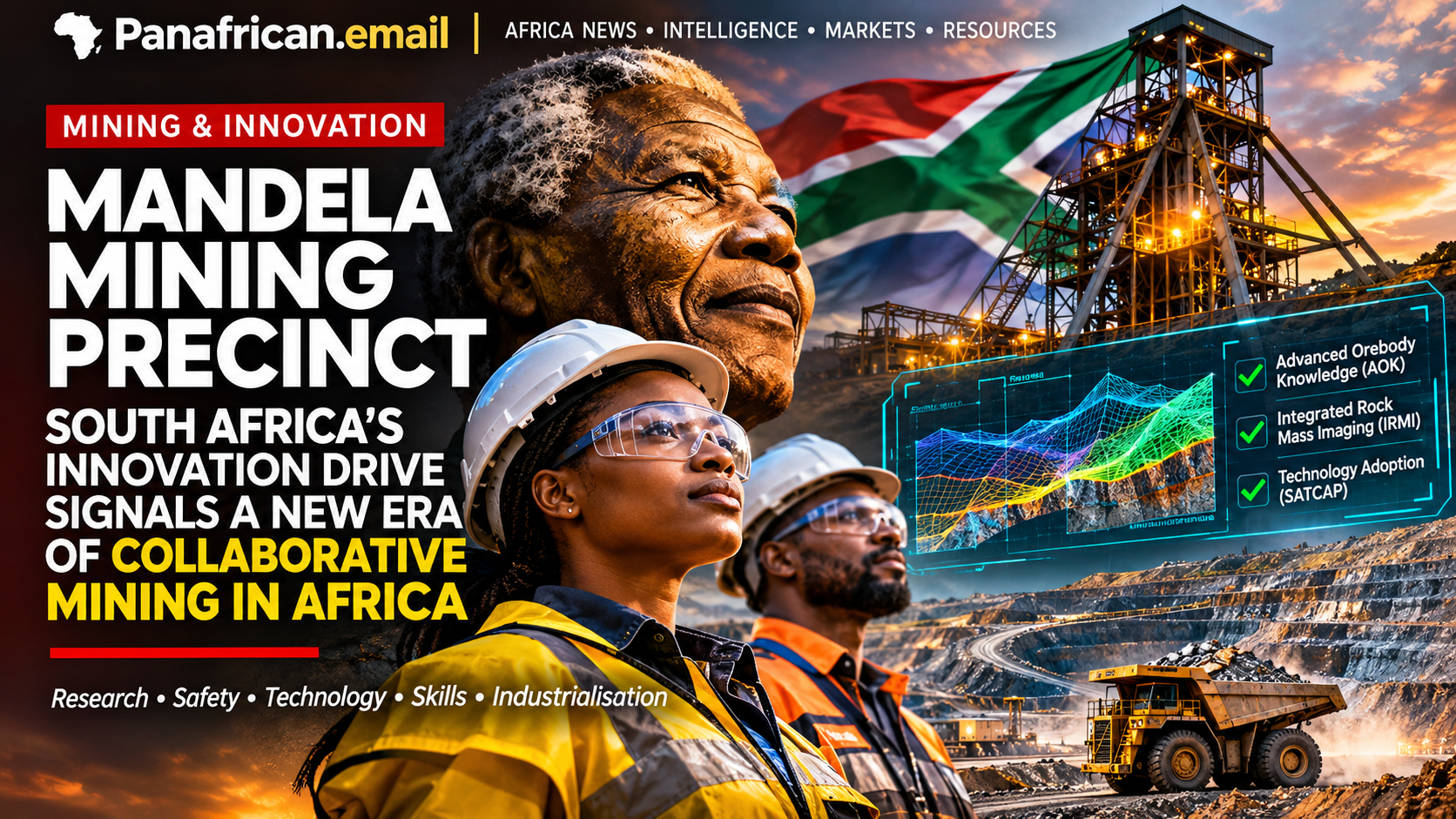
Mandela Mining Precinct: A New Blueprint for Collaborative Mining in Africa
South Africa’s showcase of geological intelligence, mining-safety research and technology adoption raises a wider question: can Africa turn mineral wealth into technological capability and industrial independence?
Africa stands at a critical crossroads in the global minerals economy. The continent holds some of the world’s most strategically important mineral resources, yet the economic benefits remain unevenly distributed. The next stage of development will depend not only on what Africa extracts, but on the knowledge, technology and industrial capacity it builds around those resources.
Against this backdrop, South Africa’s Mandela Mining Precinct (MMP) hosted its second Biennial Showcase at the Council for Scientific and Industrial Research (CSIR) International Convention Centre in Pretoria. The event brought together researchers, mining companies, technology developers and industry stakeholders to examine emerging solutions for the country’s evolving mining sector.
Under the theme “Collaborative Innovation for a Future-Ready Mining Sector,” the showcase presented research developments and practical technologies addressing the mining industry’s changing needs. Its message extends beyond South Africa: resource-rich countries need to become centres of research, engineering, technological development and production—not merely suppliers of raw materials.
Collaboration as an industrial strategy
MMP executive director Julie Courtnage emphasised that meaningful collaboration requires more than organisations agreeing to participate in joint projects. She called for “collaboration as a verb”, pointing to the need for institutions with different mandates, priorities, funding arrangements and risk appetites to work together in practical ways.
Mining companies, universities, research institutions, governments and technology developers often operate in separate institutional structures. Their expertise may be substantial, but fragmented research can slow the movement of innovation from laboratories into operating mines.
For African economies seeking to expand mineral processing, improve geological knowledge and attract investment into advanced manufacturing, cooperation is not simply a matter of networking. It is an industrial strategy.
Mine safety: the human cost of industrial risk
One of the most consequential discussions concerned the safety of mineworkers. Zamaswazi Nkosi, representing the Mine Health and Safety Council’s research delivery specialisation, presented figures showing that South Africa had recorded 53 mineworker fatalities by 19 October 2026, compared with 37 during the corresponding period in 2025.
Reported mineworker fatalities
Figures presented at the showcase; 2026 data reported as at 19 October. The chart compares the reported totals, not full-year results.
Fatal accidents also increased from 32 to 45. Reported injuries declined from 1,594 to 1,441, but the rise in fatalities underlines the continuing dangers of mining operations.
The presentation also identified emerging concerns involving fire and heat-related incidents. Fire signals increased from zero to ten, while heat signals rose from three to thirteen. As mines adopt diesel, battery-powered and electrified equipment, new hazards require appropriate engineering controls, monitoring and emergency-response capabilities.
The real measure of innovation is not whether a mine purchases advanced equipment. It is whether that equipment and the systems around it reduce exposure to danger and prevent injuries and fatalities.
Advanced Orebody Knowledge: seeing danger before extraction
Advanced Orebody Knowledge (AOK) is intended to improve geological and rock-mass understanding before mining advances into potentially hazardous areas. Traditional operations rely on drilling, mapping and underground observations, but incomplete information about rock structures can expose workers and equipment to risk.
The initiative brings together information such as geological scanning and rock imagery, drilling observations, radar and acoustic technologies, positioning data and geological structure identification. Combining these sources can give operators a more comprehensive picture of the rock mass ahead of the mining face.
The intended benefits include earlier identification of geological hazards, improved planning, safer extraction practices and more informed operational decisions. As mining extends deeper underground and more complex deposits are developed, geological intelligence becomes an essential part of safety and productivity.
Integrated Rock Mass Imaging: understanding what lies beneath
Integrated Rock Mass Imaging (IRMI) focuses on understanding rock formations beyond what can be observed directly from exposed underground surfaces. By integrating different forms of geological information, the initiative seeks to produce a more detailed three-dimensional interpretation of underground structures.
Better underground imaging can support decisions about excavation, ground stability and operational planning. It also creates opportunities for African engineering and technology firms to develop specialised solutions for mines across the continent.
Technology adoption requires people and institutional readiness
The showcase also addressed the gap between developing technology and successfully introducing it into operating environments. South Africa’s SATCAP initiative—Successful Application of Technology Centred Around People—focuses on assessing readiness for technological adoption.
The programme considers three connected dimensions:
- Technical readiness: whether a technology is suitable for the operational environment.
- Human readiness: whether workers and management have the knowledge and skills to use it.
- Change management: whether organisations can adapt their processes and working practices.
The initiative includes an exemplar learning management system designed to train industry assessors and support structured readiness assessments. It was piloted at selected sites during 2026, with further refinement and a planned handover to the Mining Qualifications Authority in 2027.
This recognises that industrial transformation cannot be achieved through equipment procurement alone. Workers need training, management systems need adaptation, and organisations need the capacity to integrate technology into daily operations.
From research to measurable industrial results
Minerals Council South Africa CEO Mzila Mthenjane welcomed progress in mining safety and technology development, while emphasising that research must demonstrate its value in operating environments. The challenge is to move beyond reports, prototypes and demonstrations: technologies must reach mines, solve identifiable problems and deliver measurable improvements.
CSIR Business Excellence and Integration group executive Dr Kavin Naidoo recognised the progress made by the Mandela Mining Precinct and the investment provided by government and private-sector stakeholders. He called for further participation, accountability and clear measurement of research impact. He also highlighted the importance of South Africa identifying its strategic priorities when engaging with international partners.
For Africa, the principle is significant. International partnerships matter, but African institutions must be able to participate as knowledge producers and technology developers—not only as recipients of imported solutions.
The Pan-African opportunity: from extraction to technological sovereignty
The showcase invites a wider question: what would a coordinated African mining innovation ecosystem look like?
The continent’s mineral wealth is distributed across countries with different geological conditions, regulatory systems, industrial capabilities and infrastructure. South Africa has established research and mining-engineering capabilities; Ghana is a major gold producer; the Democratic Republic of Congo is central to global cobalt and copper supply chains; Zambia is an important copper producer; and Guinea has significant bauxite and iron ore resources. Namibia, Zimbabwe, Tanzania and other countries also play important roles in the continent’s minerals landscape.
Such cooperation could help reposition Africa in the global minerals economy. Rather than competing solely on the volume of minerals extracted, African economies could increasingly compete through technical expertise, industrial capacity and specialised mining technologies.
Where the showcase took place
The Biennial Showcase was hosted at the CSIR International Convention Centre in Pretoria, South Africa.
Map is an area locator for the CSIR campus in Pretoria; confirm the venue’s exact entrance and event logistics with the organiser before travelling.
Watch and explore: related video research
Use these topic-specific video searches to find public footage, institutional explainers and mining-technology demonstrations. Search results may change over time; select and verify the individual video before embedding it in a published page.
The next frontier is what Africa can build from its minerals
The Mandela Mining Precinct’s second Biennial Showcase has placed an important industrial principle back on the agenda: innovation becomes transformative when collaboration produces practical results.
For Africa’s mining economies, this could help define the next stage of development—one in which mineral wealth becomes a catalyst for technological capability, safer workplaces and industrial independence.
The question is no longer simply how much mineral wealth Africa can extract. It is how much knowledge, industrial capacity and long-term prosperity Africa can build from it.
Source and attribution: Reporting by Tasneem Bulbulia, Mining Weekly, 3 November 2026. The mining-safety statistics and project descriptions are attributed to presentations and information reported at the showcase. This feature expands the source report with Pan-African editorial analysis.
Leave a Reply