
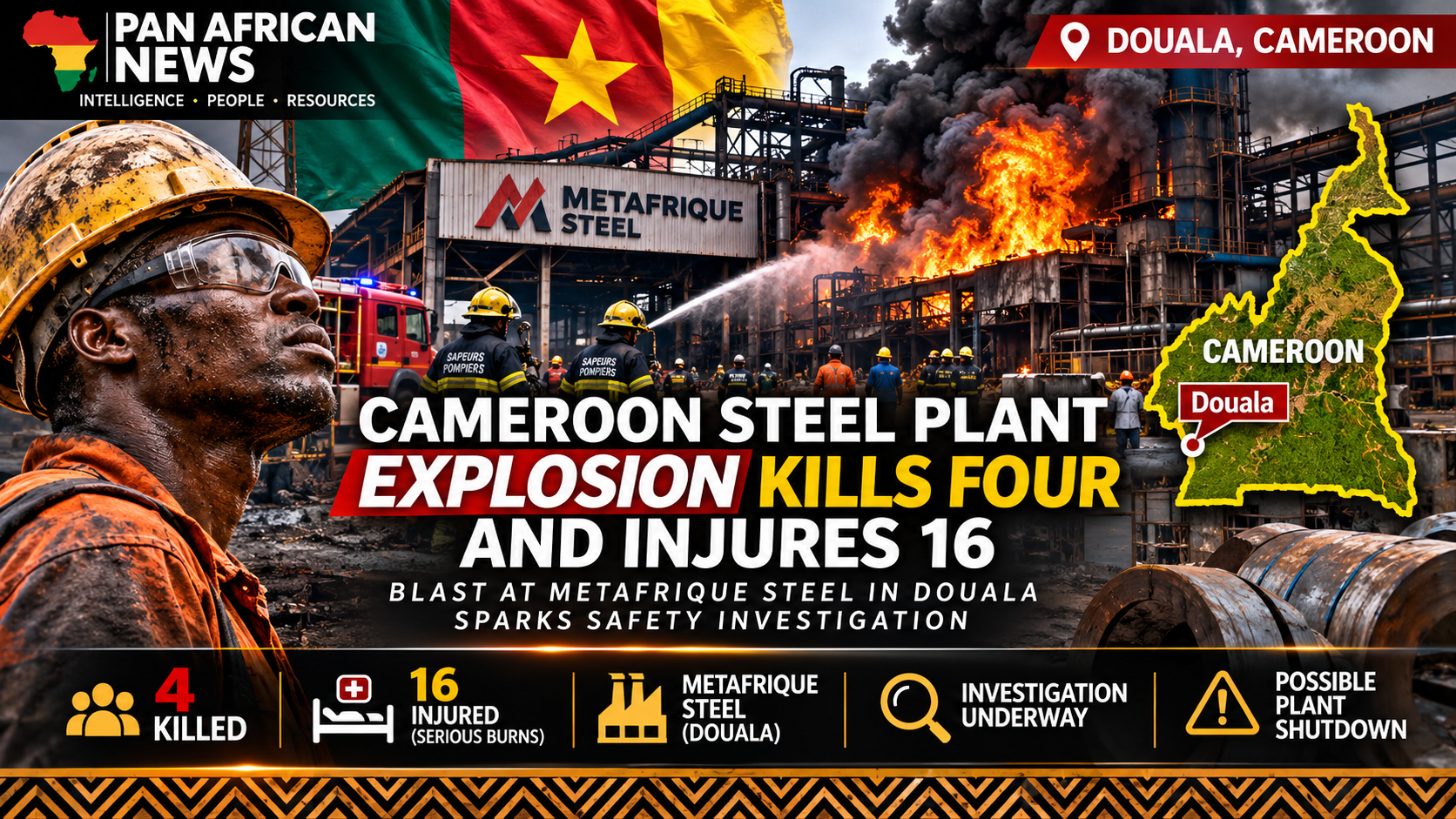
DOUALA, CAMEROON — A major industrial explosion at a steel-processing facility in Cameroon’s commercial capital, Douala, has killed at least four people and left 16 others with severe burns, prompting renewed scrutiny of industrial safety standards and emergency preparedness in one of the country’s most important manufacturing zones.
The explosion occurred on the morning of November 2, 2026, at the facilities of Metafrique Steel in the Bassa Industrial Park. The blast triggered a fire that spread through parts of the facility before emergency responders brought it under control.
According to Cameroon’s Littoral Region Governor, Samuel Dieudonné Ivaha Diboua, four bodies were recovered from the site by an army rescue unit, while 16 injured people were rescued and transported to Douala General Hospital for treatment. The governor warned that the condition of some of the victims was critical because of the severity of their burns. (Reuters)
The incident has now become a major industrial-safety story for Cameroon, particularly because authorities say the company had previously experienced a serious fire.
Explosion Followed by Fire
Initial reports indicate that the incident began with an explosion at approximately 7 a.m. on Monday.
The blast was followed by a fire that spread through the industrial facility, bringing emergency services and rescue personnel to the scene.
Cameroon Tribune reported that firefighters responded rapidly and that 16 injured people were extracted from the facility and transported to hospital. Four burned bodies were subsequently recovered from the affected area. (Cameroon Tribune)
The precise mechanism that triggered the explosion has not yet been established.
Metafrique Steel has described the event as an incident caused by an external factor, while acknowledging that the causes remain under investigation. The company has not publicly provided a detailed technical explanation of what happened. (Reuters)
That leaves the central question unanswered:
What caused the explosion, and could it have been prevented?
16 Workers Hospitalized With Severe Burns
The human cost of the explosion is the immediate priority.
Sixteen people were rescued from the plant with serious burn injuries and transported to Douala General Hospital.
The Littoral governor cautioned against assuming that the death toll would remain unchanged, given the severity of some of the injuries. (Reuters)
The victims’ condition could therefore become an important focus of the investigation in the days ahead.
Authorities have not yet released a comprehensive public breakdown of the identities of those killed and injured.
For families connected to the plant, however, the industrial accident has already become a devastating event.
Governor Questions Factory’s Safety Record
The latest explosion has triggered a particularly sharp response from regional authorities.
Africanews reported that Governor Diboua criticized the company over its compliance with safety measures imposed following a previous fire at the facility in May. He also raised the possibility of shutting down the plant. (Africanews)
Cameroonian publication Investir au Cameroun reported that the governor argued the company had failed to adequately implement safety measures that had been prescribed following earlier incidents.
He called for the company to stop operations and announced that an investigation would examine the circumstances surrounding the latest disaster. (Investir au Cameroun)
At this stage, reports indicate that a possible shutdown has been proposed or considered, rather than confirming that a formal permanent closure order has already been issued. (Investir au Cameroun)
That distinction will be important as the investigation proceeds.
A Second Major Incident in Six Months
The November explosion is particularly concerning because it follows another serious fire at the same company earlier in 2026.
According to reporting from Investir au Cameroun and Cameroon Tribune, Metafrique Steel experienced another major fire around the end of April and beginning of May.
That earlier incident reportedly caused multiple injuries and significant material damage.
The recurrence of a serious industrial incident within approximately six months has intensified questions about whether the plant’s safety systems were sufficiently strengthened after the earlier event. (Cameroon Tribune)
The investigation into the latest explosion will therefore have to examine more than the immediate cause of the blast.
It will also have to establish whether previous recommendations were implemented, whether safety inspections were conducted properly, and whether workers had adequate protection and emergency procedures.
What Is Metafrique Steel?
Metafrique Steel is a manufacturing and trading company operating in Douala’s industrial sector.
The company processes ferrous materials and produces steel products including construction materials.
Its facility is located in the Bassa Industrial Park, an important industrial area within Cameroon’s economic capital.
The company’s operations are therefore connected not only to industrial employment but also to Cameroon’s domestic construction and manufacturing supply chains.
Investir au Cameroun reported that the company employs hundreds of people and has an annual production capacity measured in tens of thousands of tonnes. (Investir au Cameroun)
A prolonged shutdown could consequently have consequences extending beyond the immediate facility.
Why Bassa Matters to Cameroon’s Industrial Economy
Douala is Cameroon’s principal commercial and industrial center.
The Bassa industrial area contains manufacturing, processing, logistics and other industrial operations that support the country’s economy.
Steel production is particularly important because construction activity depends heavily on locally available reinforcement steel and other metal products.
A disruption at a major steel processor could therefore affect:
- construction-material supply;
- industrial employment;
- local manufacturing;
- scrap-metal recycling;
- downstream construction companies;
- government tax revenue;
- and the broader industrial supply chain.
The potential economic consequences make the safety investigation even more important.
Cameroon faces the difficult task of balancing industrial expansion and employment with strict enforcement of workplace safety standards.
The Bigger African Industrial-Safety Question
The Douala explosion also raises a broader issue for African industrial development.
Across the continent, governments are attempting to expand domestic manufacturing, mineral processing and industrial production rather than exporting raw materials and importing finished goods.
That transition is strategically important.
But industrialization brings its own risks.
Steel mills, foundries, chemical plants, refineries, mines and other heavy industrial facilities involve high temperatures, combustible materials, heavy machinery, pressurized systems and potentially hazardous processes.
As African economies industrialize, regulators face increasing pressure to ensure that factories meet modern safety standards.
The question is not whether Africa should industrialize.
It is how Africa industrializes without making workers pay the price for inadequate safety systems.

Investigation Will Be Critical
Authorities have announced an investigation into the explosion.
Several questions will be central to that inquiry.
What triggered the explosion?
Investigators will need to establish whether the initial event involved equipment failure, combustible material, electrical systems, industrial gases, furnace operations or another external factor.
Were previous safety recommendations implemented?
The governor’s comments make this particularly important because the facility had reportedly experienced a previous serious fire.
Were workers adequately protected?
Investigators will need to examine emergency evacuation procedures, protective equipment, fire suppression systems and worker training.
Was the facility operating under appropriate inspections?
The regulatory history of the plant will also matter.
Who bears responsibility?
Ultimately, the investigation could determine whether responsibility rests with the company, contractors, equipment suppliers, regulatory authorities, or a combination of factors.
It would be premature to assign blame before those investigations are completed.
Families Await Answers
Behind the industrial statistics are families now dealing with death and severe injuries.
Four people have lost their lives.
Sixteen others are receiving treatment for serious burns.
And their families are waiting for information about what happened inside the facility.
The company’s response to those families—including medical support, compensation, transparency and cooperation with investigators—will become an important part of the story.
The government, meanwhile, faces pressure to ensure that the investigation is independent enough to establish what happened and whether the plant should be permitted to resume operations.
A Test for Cameroon’s Industrial Regulation
The Metafrique Steel explosion has placed industrial safety back at the center of Cameroon’s public debate.
If the investigation confirms that previously mandated safety measures were not implemented, the incident could become a significant test of the government’s willingness to enforce industrial regulations.
If the investigation instead identifies an unexpected technical failure despite adequate safety systems, the findings could point toward new engineering or regulatory standards.
Either way, the lessons should extend beyond one factory.
Other steel plants, foundries, industrial processors and heavy manufacturing operations across Cameroon and Central Africa will be watching the outcome.
Pan African Intelligence Assessment
The Metafrique Steel explosion should be viewed through two lenses: industrial development and industrial accountability.
Cameroon needs manufacturing capacity.
It needs steel.
It needs factories capable of supplying construction and infrastructure projects.
And it needs industrial jobs.
But economic development cannot be measured solely by production volumes.
Worker safety is itself an economic indicator.
A factory that produces steel while repeatedly exposing workers to preventable hazards is not demonstrating sustainable industrialization.
The November 2 disaster therefore presents Cameroon with an opportunity to establish exactly what happened, determine whether existing safety regulations were followed, and ensure that corrective measures are implemented before affected operations resume.
For the victims and their families, however, the immediate priority is more basic: medical treatment, accountability and answers.
Four people are dead. Sixteen are seriously injured. The investigation must now establish why.
Pan African News will continue tracking the investigation, the condition of the injured workers, any government decision regarding Metafrique Steel’s operations and the broader implications for industrial safety in Cameroon.
SOURCE NOTE
The core incident details in this report are based on reporting from Reuters, Africanews and Cameroon’s Cameroon Tribune, with additional context from Investir au Cameroun. Reuters reported four deaths and 16 severe burn injuries; Africanews additionally reported the governor’s concerns regarding previous safety measures and the possibility of a shutdown. (Reuters)
Leave a Reply