
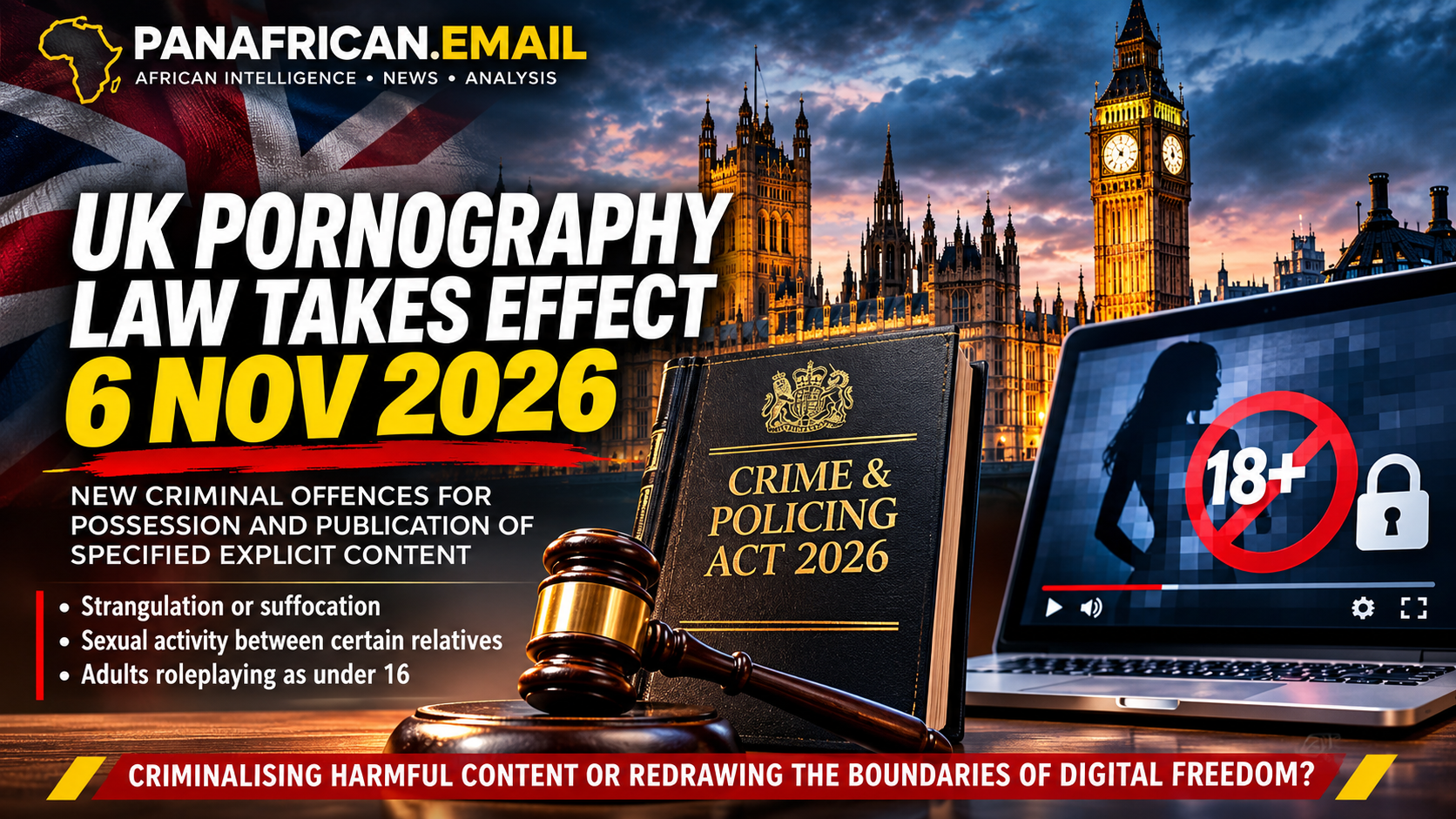
The UK’s New Pornography Law: Criminalising Harmful Content or Redrawing the Boundaries of Digital Freedom?
From November 6, 2026, new criminal offences in England and Wales will target possession and publication of specified categories of pornographic imagery. The legislation raises important questions about digital rights, online censorship, platform responsibility and the future of internet publishing.
01 — The announcement attracting global attention
A post published by World of Statistics on X has drawn attention to a significant change in British criminal law. The post describes the development as a UK pornography ban beginning November 6, 2026.
However, the legal reality is more specific: the Crime and Policing Act 2026 introduces offences relating to particular types of pornographic images. It does not prohibit all pornography.
02 — What changes on November 6?
The new provisions of the Crime and Policing Act 2026 criminalise possession and publication of certain explicit and realistic pornographic images depicting:
01. Strangulation and suffocation
Images explicitly and realistically portraying one person strangling or suffocating another person, where a reasonable person would believe the people depicted are real.
02. Sexual activity between certain relatives
Pornographic depictions of penetrative sexual activity between people who a reasonable person would consider related or pretending to be related. Certain step and foster relationships are also covered.
03. Adults roleplaying as children under 16
Explicit and realistic pornography depicting sexual activity where at least one participant appears to be, or pretends to be, under 16.
The legislation focuses on realistic depictions of people who a reasonable person would consider real. The government says the provisions can also cover qualifying realistic AI-generated images.
03 — Understanding the penalties
The legislation introduces different maximum penalties depending on the category of imagery and whether the offence involves possession or publication.
Maximum imprisonment for possession of specified strangulation or incest pornography.
Maximum imprisonment for possession of specified under-16 roleplay pornography.
Maximum imprisonment for publication offences.
These are maximum penalties, not automatic sentences. Actual outcomes depend on the offence, evidence, applicable defences and judicial assessment.
04 — Possession is different from publication
Possession
The government describes possession as custody or control of an image. This may include images stored on personal devices, in files or in cloud accounts.
Publication
Publication includes making an image available to another person through uploading, posting, sending, sharing or distributing it.
The government states that possession is a continuing act. Existing material covered by the new offences must be permanently deleted or otherwise disposed of before commencement to avoid unlawful possession once the provisions take effect.
The legislation also provides defences in specified circumstances. These include legitimate reasons, certain unsolicited material that is not retained for an unreasonable period, and other narrowly defined circumstances.
05 — The timeline: How Britain arrived here
Independent Pornography Review
Baroness Gabby Bertin’s review examines the relationship between pornography, violence, exploitation and harmful sexual behaviour.
Government announces legislative measures
The government announces additional measures to criminalise possession and publication of specified harmful pornography.
Crime and Policing Act receives Royal Assent
The legislation establishes the statutory framework for the new offences.
Commencement regulations made
Regulations establish November 6 as the commencement date for the specified provisions.
New offences take effect
The specified possession and publication offences come into force.
06 — The technology question: Who controls the internet?
The legislation also has consequences for digital platforms, hosting companies, social networks, content marketplaces and online publishers.
Under the Online Safety Act 2023 framework, specified illegal content is treated as priority illegal content. Online services are expected to adopt proportionate systems to prevent users encountering it and to remove it when identified.
Five areas of potential impact
- Content moderation and automated detection.
- Hosting provider policies and account enforcement.
- Digital storage and cloud content management.
- Cross-border publishing and jurisdiction.
- Protection of victims and the rights of legitimate creators.
This creates a difficult technical challenge. Automated moderation systems must identify prohibited material without unnecessarily removing lawful content.
07 — Freedom of expression versus protection from harm
Supporters argue that the new provisions address material that can normalise violence, abuse and illegal sexual conduct. They point to the potential risks of strangulation and suffocation imagery and the protection of children.
Critics, meanwhile, raise concerns about the breadth of legal definitions, the consequences for adult creators, the risk of over-removal by platforms and the potential effect on lawful expression.
The central question is not simply whether harmful content should be regulated. It is how governments can protect people without creating unnecessarily broad restrictions on digital expression.
The distinction between genuine protection, proportional regulation and excessive censorship will become increasingly important as the law is interpreted and enforced.
08 — Is this a UK-wide ban?
The Ministry of Justice guidance describes the new pornography offences as applying in England and Wales. The statutory provisions have differing territorial extents, so readers in Scotland and Northern Ireland should consult the relevant legislation rather than assume identical rules apply throughout the UK.
It is also inaccurate to describe this as a blanket prohibition on pornography. The legislation targets defined categories of explicit and realistic imagery.
09 — The international implications
Britain’s approach contributes to a wider international debate about the regulation of digital media. Governments increasingly face pressure to address online exploitation, non-consensual imagery, child protection and algorithmically distributed harmful material.
For African governments, technology companies, digital publishers and content creators, the developments offer an opportunity to examine the relationship between online safety, freedom of expression and regulatory sovereignty.
As digital platforms cross national boundaries, publishers must understand that content lawful in one jurisdiction may create legal exposure in another.
10 — What happens next?
The immediate test will be how law enforcement, prosecutors, courts and online platforms interpret and apply the provisions.
Questions concerning legitimate reasons, AI-generated imagery, cloud storage, cross-border distribution and automated content moderation will remain important areas of legal and technological scrutiny.
Can governments regulate harmful digital content without undermining the open internet?
The debate over Britain’s new pornography offences is part of a much larger discussion about who establishes the boundaries of digital freedom, who enforces them and how those decisions affect the global information economy.
Primary documents and further reading
-
UK Ministry of Justice — Crime and Policing Act 2026: Offences relating to pornography
-
The Crime and Policing Act 2026 (Commencement No. 4) Regulations 2026
-
Crime and Policing Act 2026 — Full legislation
-
Ministry of Justice — Pornography factsheet
-
Government announcement — New laws to crack down on harmful pornography
-
World of Statistics — Original X post
Leave a Reply