
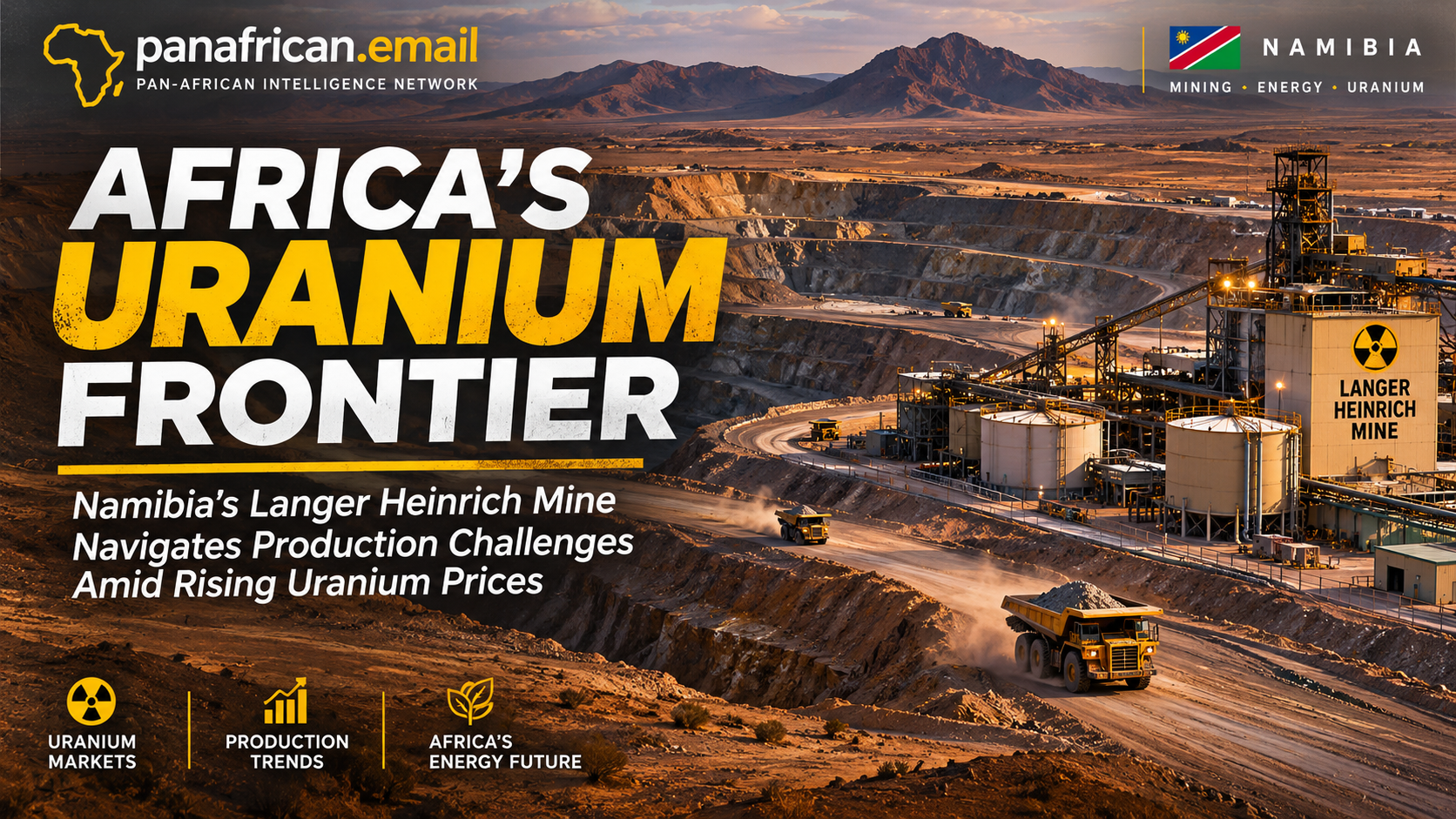
Namibia’s Paladin Uranium Mine: Planned Maintenance Disrupts Production as Uranium Sales Reach $79.40 per Pound
PAN-AFRICAN NEWS | MINING & ENERGY | NAMIBIA | 5 NOVEMBER 2026
A planned maintenance shutdown at Namibia’s Langer Heinrich uranium mine has influenced production performance, highlighting the operational challenges facing one of Africa’s strategically important uranium producers. Despite the temporary disruption, Paladin Energy reported strong sales volumes and an average realised uranium price of $79.40 per pound, underscoring the growing commercial importance of Namibia’s mineral resources.

1. Planned maintenance and production performance
According to Paladin Energy’s quarterly report for the three months ending September 30, 2026, the Langer Heinrich Mine (LHM) produced approximately 1 million pounds of uranium oxide (U₃O₈).
This represented a decline from the 1.23 million pounds produced during the preceding quarter.
The company attributed the lower production to several operational factors:
- A scheduled maintenance shutdown at the processing plant.
- Ore characteristics associated with the mining sequence.
- Processing plant recovery performance.
- Low in-circuit inventory levels at the beginning of the quarter.
The company reported an average plant recovery rate of 85%, compared with 90% in the previous quarter.
The figures indicate that the production slowdown was not attributed to an unexpected mine closure or a loss of mineral resources. Instead, it reflected a combination of planned maintenance and operational conditions during a transition in the mining sequence.
2. Uranium sales reach $79.40 per pound
Despite reduced production, Paladin achieved stronger realised uranium prices.
During the September quarter, the company sold 1.16 million pounds of U₃O₈ at an average realised price of US$79.40 per pound.
This compares with US$70.60 per pound in the preceding quarter.
Quarterly operating performance
1.00M pounds produced
1.16M pounds sold
$79.40 realised price per pound
$61.60 production cost per pound
Comparison with June 2026 quarter
| Metric | June quarter | September quarter |
|---|---|---|
| Production | 1.23M lb | 1.00M lb |
| Sales | 1.35M lb | 1.16M lb |
| Realised price | $70.60 | $79.40 |
| Production cost | $51.60 | $61.60 |
| Plant recovery | 90% | 85% |
Source: Paladin Energy Q1 FY2027 quarterly report, 13 October 2026.
The increase in realised prices reflects stronger uranium pricing and a higher proportion of market-related sales during the quarter. It is important to distinguish the realised price from the spot market price. The $79.40 figure represents the average price Paladin received for its delivered uranium under its sales arrangements.
3. The strategic importance of Langer Heinrich
The Langer Heinrich Mine is situated in Namibia’s Erongo Region, approximately 80 kilometres east of Swakopmund and 85 kilometres northeast of Walvis Bay.
The mine is a major component of Namibia’s uranium industry and an important contributor to the country’s position in the global nuclear fuel supply chain.
Ownership structure:
- 75% – Paladin Energy, Australia
- 25% – China National Nuclear Corporation subsidiary CNNC Overseas Uranium Holding Limited
This partnership connects Australian mining capital, Chinese nuclear fuel interests and Namibian mineral resources within one operating asset.
Langer Heinrich originally began production in 2007, eventually reaching an expanded design capacity of approximately 5.2 million pounds annually. However, the mine entered care and maintenance in 2018 following a prolonged period of depressed uranium prices. Paladin subsequently approved a restart in 2022, with first production achieved on 30 March 2024. Mining from the open pit resumed in 2025.
4. Mining transition and the road to recovery
The September quarter was also affected by the transition into the southern benches of the J Pit.
Paladin reported that mining activities continued according to plan, with 7.73 million tonnes of total material mined during the quarter. Ore mining reached 1.84 million tonnes, while processing throughput totalled 1.17 million tonnes.
The company expects improvements in ore grade and metallurgical recovery as mining advances into the lower southern sections of the pit. During September, the company reported improvements in feed grade, plant performance and in-circuit inventory.
5. What the figures mean for Namibia’s mining economy
Namibia’s uranium industry occupies a strategic position in the international nuclear fuel market. The central questions for Namibia include:
- How much economic value remains within the country?
- How many skilled Namibian workers benefit from mining operations?
- What proportion of procurement is sourced from local businesses?
- How much tax and royalty revenue reaches public finances?
- How effectively are environmental rehabilitation obligations enforced?
- What opportunities exist for Namibian companies to participate in the uranium value chain?
The presence of foreign capital is not inherently problematic. The critical issue is whether Namibia can translate its mineral endowment into long-term domestic economic development.
6. Paladin maintains its FY2027 production outlook
Despite the weaker September-quarter production figure, Paladin maintained its financial-year 2027 operating guidance:
- Annual uranium production of 5.1–5.6 million pounds
- Production costs of US$44–48 per pound
- Higher production during the second half of FY2027
At 30 September, Paladin reported US$209 million in cash and investments, alongside an undrawn US$70 million revolving credit facility.
7. The bigger picture: Africa’s position in the nuclear energy economy
The Langer Heinrich story reflects a much broader transformation taking place across Africa’s mineral economy. Uranium is increasingly important to discussions surrounding energy security, nuclear power expansion and the diversification of electricity generation.
Namibia, alongside Niger, South Africa and other resource-producing countries, occupies an important position in the continent’s uranium and nuclear minerals landscape. Africa’s strategic interests include developing stronger domestic expertise, local processing capabilities where viable, technical education, competitive supply chains, and greater participation in international nuclear fuel markets.
Multimedia: Earnings Call
Hear Paladin management discuss the September quarter results, the planned maintenance, realised prices, and the maintained FY2027 guidance:
Paladin Energy Ltd Q1 2027 Earnings Call | Produces 1 Mlb Uranium at Langer Heinrich Amid Costs
Conclusion
Paladin Energy’s September 2026 operating results demonstrate the complex relationship between mining operations, production scheduling and international commodity markets. The planned maintenance shutdown and mining-sequence transition reduced production at Langer Heinrich, but higher realised uranium prices supported stronger commercial performance.
The company’s decision to maintain its FY2027 production guidance suggests confidence in the anticipated operational recovery. For Namibia, the larger challenge is ensuring that the renewed importance of uranium translates into meaningful national economic benefits.
As international demand for nuclear fuel evolves, Langer Heinrich will remain an important asset to watch—not only for its production figures, but also for what its operations reveal about foreign investment, mineral ownership and Africa’s position in the global energy economy.
Primary sources
- Paladin Energy – September 2026 Quarterly Report (13 October 2026)
- Paladin Energy – Langer Heinrich Mine
- Namibian Uranium Association
Editorial note: The operating figures are based on Paladin’s October 13, 2026 company report. The realised uranium price is not a quoted spot-market price.
Leave a Reply