
By Pan African News Desk | November 7, 2026
A California city introduces a new model for recognizing multi-partner households, raising wider questions about family structures, civil rights and the evolving relationship between society and the law.
The City of West Hollywood, California, has taken a significant step in the evolving international debate over family structures and legal recognition after its City Council unanimously approved an ordinance establishing a registration system for multi-partner domestic relationships.
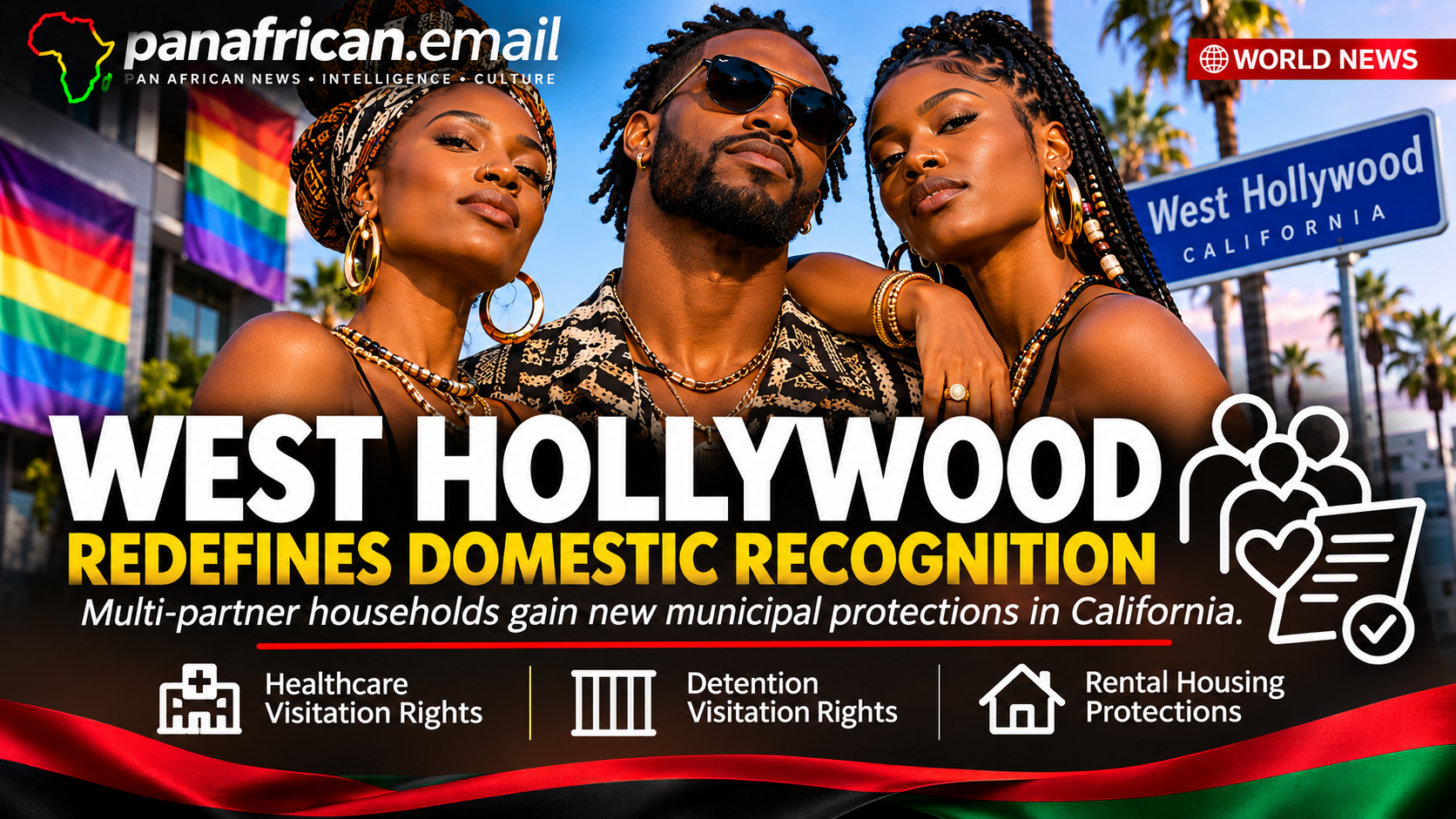
The decision allows three or more adults in committed, consensual relationships to formally register their relationship with the city and obtain specific municipal protections.
Approved on November 2, 2026, the ordinance represents a notable development in local government policy concerning polyamorous relationships and households that do not fit conventional two-person domestic partnership structures.
The measure is expected to take effect on December 2, 2026.
While the development is geographically rooted in California, its implications extend into broader international conversations about personal autonomy, civil registration, the definition of family and the responsibilities of governments toward increasingly diverse households.
A New Legal Framework for Multi-Partner Households
Under Ordinance No. 26-13, West Hollywood is establishing an official registration process for multi-partner domestic relationships.
The legislation creates Chapter 2.86 of the city’s municipal code and extends selected protections to qualifying relationships involving three or more adults.
The registration framework is intended to recognize committed domestic arrangements that existing marriage and domestic partnership systems do not necessarily accommodate.
Among the protections associated with registration are:
- Healthcare visitation: Registered partners receive protections concerning visitation in healthcare facilities.
- Detention visitation: The ordinance extends visitation protections to partners in detention facilities within the city’s jurisdiction.
- Housing protections: Registered partners receive certain protections relating to rental housing, including protections against specific tenancy and rent-related actions.
- Formal municipal registration: Eligible partners can establish an official record of their relationship through the City Clerk.
The ordinance requires relationships to satisfy basic eligibility conditions, including consent and restrictions concerning blood relationships.
Importantly, the measure does not establish multi-person marriage under California law, nor does it create a state-recognized domestic partnership involving more than two people.
Instead, West Hollywood is creating a local framework that provides limited but meaningful recognition and protection under municipal law.
Why West Hollywood Is Taking This Step
West Hollywood has a history of introducing policies intended to recognize changing social structures and expand protections for LGBTQ+ communities.
The latest legislation follows an earlier municipal initiative in March 2026 that prohibited discrimination based on family or relationship structure, including polyamorous and consensually non-monogamous relationships.
That earlier decision also encouraged the development of a registration system for multi-partner households.
The new ordinance advances that policy direction by moving beyond anti-discrimination principles and establishing a practical registration mechanism.
Advocates argue that people in multi-partner relationships can encounter difficulties when navigating institutions designed around conventional family arrangements.
These challenges can arise during medical emergencies, housing disputes, family responsibilities and other situations in which legal documentation and recognized relationships matter.
The new registry seeks to address some of these gaps.
The Global Debate: Who Defines a Family?
The West Hollywood decision highlights a larger question confronting governments around the world: should legal recognition of a household be restricted to traditional relationship structures, or should civil institutions develop mechanisms that accommodate different forms of consensual domestic arrangements?
Across different societies, family structures are influenced by history, culture, religion, economics, customary practices and changing social conditions.
In many African societies, extended family networks have historically played important roles in childcare, inheritance, housing, economic cooperation and intergenerational responsibilities.
However, traditional extended-family systems should not be confused with polyamorous partnerships. They represent different social arrangements with distinct cultural and legal foundations.
The distinction is important when considering the implications of developments such as West Hollywood’s new registration framework.
African governments and communities have their own constitutional arrangements, customary laws, religious traditions and social priorities. A municipal policy adopted in California does not automatically establish a legal or cultural precedent for African jurisdictions.
Nevertheless, the development provides an opportunity to examine how governments define domestic relationships, protect vulnerable household members and balance individual freedoms with established legal and cultural frameworks.
Africa’s Legal and Cultural Landscape
Across Africa, family law is shaped by different national constitutions, statutory legislation, customary practices and religious traditions.
Some jurisdictions recognize forms of customary or religious polygamous marriage, while others maintain predominantly monogamous statutory marriage frameworks.
These arrangements are not equivalent to polyamory.
Polygamous marriage, where legally recognized, is generally governed by specific marriage laws and customary or religious requirements. Polyamory describes consensual romantic or intimate relationships involving multiple partners and does not automatically carry the legal status of marriage.
This distinction matters.
The West Hollywood ordinance is not simply a decision about the number of people in a relationship. It is an experiment in municipal recognition, designed to address practical issues that emerge when existing legal institutions do not accommodate certain household structures.
For African policymakers, the broader questions include:
- How should civil registration systems accommodate different household arrangements?
- What protections should be available to people sharing domestic responsibilities?
- How should housing and inheritance laws respond to changing family structures?
- What safeguards are necessary to prevent coercion, exploitation and discrimination?
- How can governments protect individual rights while respecting constitutional and cultural frameworks?
These are questions that require independent consideration within each country’s legal and social environment.
The Importance of Healthcare and Housing Protections
One of the most significant aspects of the West Hollywood ordinance is its focus on practical protections rather than symbolic recognition alone.
Healthcare visitation, for example, can become a complicated issue when hospitals and medical institutions rely on conventional definitions of immediate family.
A formally registered relationship can provide documentation supporting access and recognition in circumstances where partners might otherwise face administrative barriers.
Housing is another important area.
Modern households frequently involve shared financial responsibilities, multiple occupants and complex arrangements concerning rent and tenancy.
By extending selected rental protections to registered multi-partner relationships, West Hollywood is acknowledging that household stability and legal protection are not necessarily confined to two-person relationships.
These provisions do not create unlimited rights or override state and federal law. Their application remains subject to the scope of the municipal ordinance.
A Growing Movement Beyond West Hollywood
West Hollywood is not the first American municipality to explore formal recognition of multi-partner relationships.
Somerville and Cambridge in Massachusetts previously introduced municipal recognition frameworks for multi-partner domestic relationships.
Berkeley and Oakland in California have also advanced protections concerning family and relationship structures.
These developments indicate a broader policy discussion taking place across several American cities.
The West Hollywood ordinance is particularly notable because it establishes a dedicated municipal registration framework and extends specific protections to qualifying households.
It also demonstrates how local governments can experiment with policy within the boundaries of their legal authority.
However, municipal registration should not be confused with national recognition of marriage or domestic partnership status.
What Happens Next?
With the ordinance scheduled to take effect on December 2, 2026, attention will turn to implementation and the city’s registration procedures.
Eligible applicants will be able to approach the City Clerk to establish a formal record of their relationship, subject to the applicable requirements.
The initiative will also provide an opportunity to assess how the protections operate in practice, particularly in healthcare, detention and housing environments.
There are also questions concerning how the framework accommodates different forms of non-monogamous relationships, including households in which individuals may maintain multiple committed partnerships without everyone necessarily being romantically involved with one another.
The evolution of the policy will therefore be important to observe.
Pan African Perspective: Recognition, Rights and the Future of Public Policy
West Hollywood’s decision is a reminder that laws are not static instruments. They are continuously interpreted, debated and adapted as societies confront new social realities.
For the Pan-African community, the significance of this development lies not in automatically adopting another jurisdiction’s legal framework, but in understanding the relationship between governance, culture, personal freedoms and the protection of individuals.
Africa’s social and legal institutions must be understood within their own historical and constitutional contexts. At the same time, African policymakers, researchers and civil society organizations can benefit from observing how other jurisdictions approach emerging questions of domestic recognition and social protection.
The central policy challenge is ensuring that people are protected from abuse, discrimination and arbitrary treatment while maintaining transparent legal standards and respecting the constitutional frameworks of their respective countries.
West Hollywood has chosen one approach: municipal registration and limited local protections for multi-partner domestic relationships.
Whether similar models emerge elsewhere remains to be seen.
What is clear is that the discussion about the legal definition of family, the responsibilities of public institutions and the protection of individuals within domestic arrangements is continuing to evolve.
Pan African News will continue examining the legal, cultural and institutional developments shaping societies across Africa and the wider world.
Leave a Reply