
By Pan-African News Editorial Desk
Beyond gold: Building opportunities around mining
Mining has long been one of Africa’s most important economic activities. From Ghana’s historic goldfields to the copper belts of Central Africa and the mineral-rich territories of Southern Africa, the industry has shaped national economies, attracted international investment and supported millions of livelihoods.
Yet the true value of mining should not be measured exclusively by production volumes, export earnings or shareholder returns. Its contribution must also be visible in the communities surrounding operations: through employment, education, technical training, infrastructure, environmental protection and opportunities for future generations.
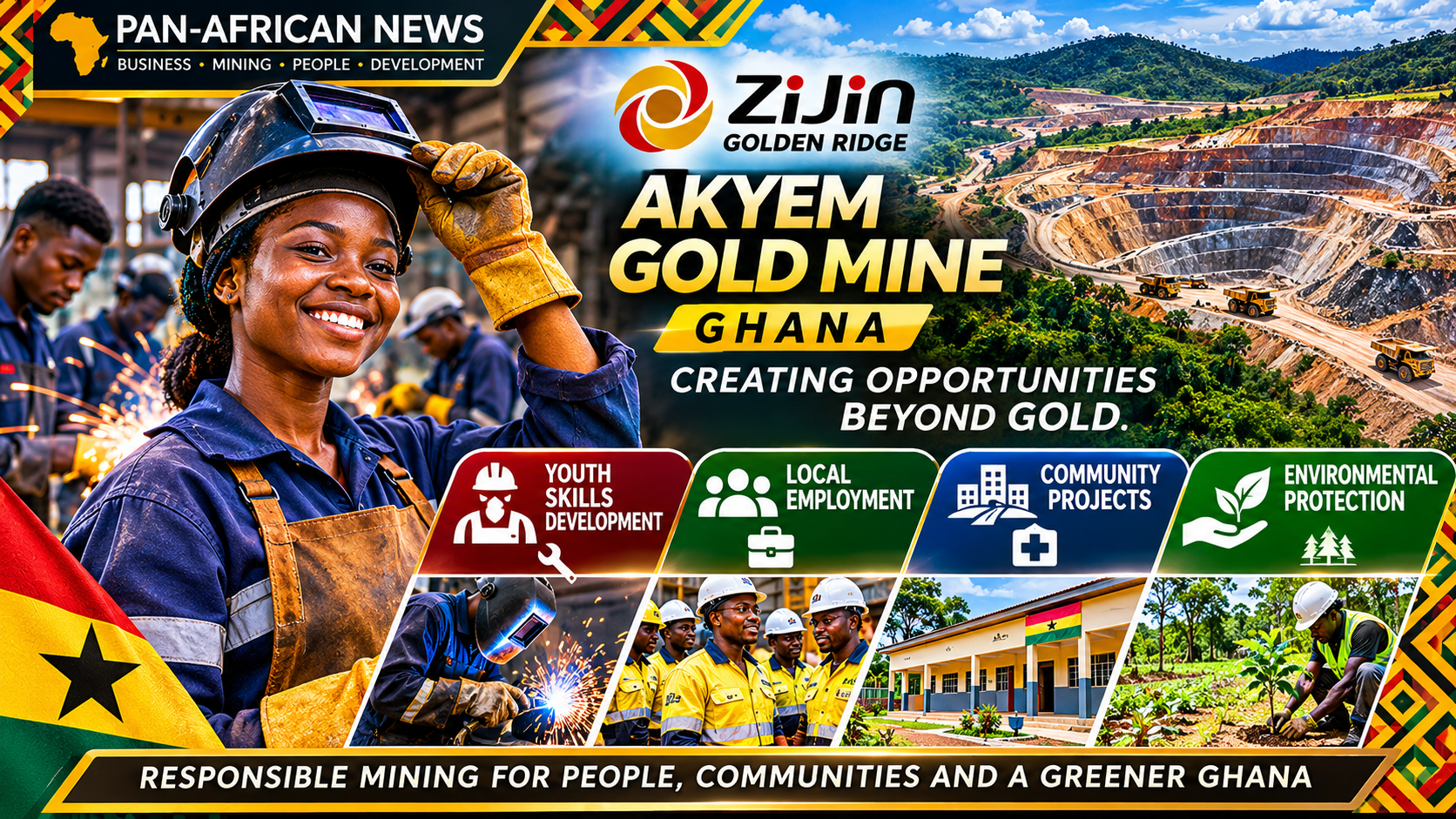
At Ghana’s Akyem Gold Mine, Zijin Golden Ridge Limited (ZGRL) is pursuing a community development strategy that places local skills and economic participation among its priorities.
The company’s activities in the Birim North District of Ghana’s Eastern Region provide an interesting example of how mining investment can be connected to broader community development.
31 young people begin a new technical skills journey
One of the latest initiatives is the Zijin Akyem Rising Initiative (ZARI), a youth development platform introduced to strengthen the technical capabilities and workplace readiness of young people in host communities.
Launched in October 2026, the programme began with 31 participants undertaking practical welding and fabrication training in partnership with the Akyem Vocational and Technical Institute (AVTI).
The initiative addresses an important challenge facing young graduates across Africa: possessing educational qualifications but struggling to secure opportunities to apply their knowledge in real working environments.
The programme is designed to bridge that gap by helping participants align their existing technical skills with industrial standards, operational procedures and workplace safety requirements.
Electrical installation is expected to become the next training area, with plumbing, building construction and masonry also identified as future areas of development.
For young people in mining communities, these trades can create opportunities beyond the mine itself. Welding, electrical installation and construction skills are applicable across manufacturing, infrastructure, engineering, maintenance and entrepreneurship.
This broader employability dimension is particularly important. A successful skills programme should prepare young people not only for possible mining employment but also for careers throughout the wider economy.
Local employment: Bringing economic participation closer to home
Employment remains one of the most important measures by which mining communities evaluate the benefits of resource extraction.
According to figures reported by the Ghana News Agency in April 2026, Zijin Golden Ridge maintained a workforce of 1,235 people during 2025, including direct employees, contractor personnel and national service personnel.
Of that workforce, 597 people were recruited from host communities, representing approximately 48 per cent.
The company reported that this exceeded its 35 per cent local employment target under its community employment agreement.
The distinction between direct employment and contractor employment is important. Both can generate economic opportunities, but the quality, security and progression of those jobs should also be considered.
For Ghana, developing a skilled local workforce has strategic significance. Technical expertise retained within mining communities can support future industrial projects, strengthen local businesses and reduce dependence on imported specialist labour.
Zijin’s apprenticeship and learnership programmes add another dimension to this approach by providing practical exposure, mentorship and technical development.
The larger objective should be to build a generation of Ghanaian technicians, engineers, supervisors and business owners capable of participating in the mining industry at multiple levels.
Community infrastructure: Investment beyond the mine gate
Mining operations require roads, electricity, water systems, housing and other supporting infrastructure. The question is whether the benefits of investment extend to the communities that host these operations.
In March 2026, the Zijin Akyem Development Foundation (ZADeF) announced the commencement of 13 community infrastructure projects valued at more than GH¢4 million.
The projects cover nine communities:
- Old Abirem
- New Abirem
- Afosu
- Adausena
- Mamanso
- Hweakwae
- Praso Kuma
- Akrofonso
- Amanfrom
The development programme covers education and youth development, community infrastructure and well-being, as well as livelihood and cultural support.
These investments demonstrate the importance of connecting mining revenue and corporate community programmes to local development priorities.
Infrastructure projects can have benefits that extend well beyond their initial construction. Improved facilities can support education, healthcare, commercial activity and the delivery of essential services.
However, the long-term success of such projects depends on maintenance, community involvement, transparent procurement and the ability of local institutions to manage the infrastructure after completion.
Environmental protection: Mining must account for nature
Economic development cannot be separated from environmental responsibility.
Ghana’s forests, rivers, agricultural lands and biodiversity are important national assets. Mining operations must therefore demonstrate that environmental management is an operational priority rather than simply a corporate communications exercise.
Zijin Golden Ridge has reported several environmental initiatives at Akyem.
According to the company’s published environmental and social governance information, its 2025 performance included:
- 317 hectares of reforestation.
- An 82.9 per cent water recycling rate.
- 84.6 per cent of solid waste recycled or reused.
- Zero reported water-quality regulatory exceedances.
The company also reports biodiversity monitoring within and around the mine boundary.
Its reforestation programme involves work in the Ajenjua Bepo and Kweikaro forest reserves, undertaken in partnership with Ghana’s Forestry Commission.
The company’s environmental programme also includes the Atewa Biodiversity Offset Project, a ten-year initiative intended to address residual biodiversity impacts associated with mining.
The project is designed around a target of 371 Quality Hectares and includes forest protection, habitat restoration, enrichment planting and community livelihood support.
A particularly important element is the involvement of conservation institutions and the need for measurable biodiversity outcomes.
For mining companies operating in environmentally sensitive regions, the ultimate test is whether conservation commitments translate into demonstrable ecological improvements over time.
These environmental figures are company-reported performance indicators and should continue to be assessed through regulatory oversight, independent verification and transparent public reporting.
Investing in people as well as production
According to figures published by the Ghana News Agency in April 2026, Zijin Golden Ridge reported more than GH¢15.5 million in structured community investment during 2025.
The company also reported GH¢38 million in broader socio-economic interventions covering education, healthcare, housing, agriculture, sanitation, resettlement support, alternative livelihoods and cultural preservation.
These investments illustrate an important principle: the economic footprint of a mine should extend beyond the extraction site.
Mining creates demand for transport, engineering, equipment maintenance, construction, catering, professional services and numerous other commercial activities.
When local businesses can participate in these supply chains, the benefits of mineral production can circulate through the domestic economy.
The opportunity for Ghana is to use its mining industry as a platform for developing stronger local enterprises and technical capabilities.
A Pan-African perspective: From extraction to industrial development
The Akyem experience raises a broader question for Africa.
The continent possesses substantial deposits of gold, bauxite, iron ore, manganese, lithium, copper, cobalt and other strategic minerals. Yet mineral wealth alone does not guarantee widespread prosperity.
The next phase of African mining development must focus on the relationship between resource extraction, industrialisation and human capital.
Ghana, Liberia, the Democratic Republic of Congo, Guinea, Zambia and other mineral-producing countries have an opportunity to build stronger connections between mining companies, vocational institutions, universities, technology developers and local suppliers.
For example, welding and fabrication training can contribute to industrial maintenance capabilities. Electrical installation skills can support energy infrastructure. Heavy-duty equipment training can strengthen logistics and construction. Environmental monitoring can create new opportunities for local scientific and technical professionals.
The development of these capabilities can help African countries retain more value from their mineral industries.
This is particularly important as the global demand for strategic minerals grows alongside investment in renewable energy, electric mobility, infrastructure and advanced manufacturing.
What responsible mining should deliver
Zijin Golden Ridge’s initiatives at Akyem provide several areas worth watching:
1. Skills that lead to economic independence
Training programmes should produce qualifications, practical experience and employment or entrepreneurial pathways that remain valuable beyond a single mining operation.
2. Meaningful local employment
Host communities should have opportunities to access technical, professional and management positions, not only temporary or entry-level work.
3. Strong local supply chains
Mining companies should create opportunities for Ghanaian-owned enterprises to provide goods and services while building the technical standards needed to compete.
4. Environmental accountability
Water quality, forest restoration, biodiversity and responsible tailings management require continuous monitoring and transparent reporting.
5. Community-led development
Local authorities, traditional leadership, educational institutions and residents should have meaningful participation in identifying priorities and evaluating results.
These principles should become standard expectations for mining investment across Africa.
The bigger picture: A new social contract for African mining
The future of African mining should not be defined solely by how much gold, copper or other minerals leave the ground.
It should also be defined by what remains behind.
Are there better-trained young people? Are local companies stronger? Are schools and healthcare facilities better equipped? Are communities more economically resilient? Are forests and water resources being protected?
These are the questions that determine whether mineral wealth contributes to lasting development.
At Akyem, Zijin Golden Ridge is pursuing programmes that connect mining operations with youth development, local employment, community infrastructure and environmental protection.
The next challenge is to sustain these programmes, demonstrate measurable outcomes and ensure that the benefits are experienced across host communities.
For Ghana and the wider African mining industry, the principle is clear:
Responsible mining must create value underground and opportunity above ground.
Africa’s mineral wealth should help build Africa’s human wealth.
Zijin Mining Group | Zijin Golden Ridge Limited | Akyem, Ghana Mapping the relationship between mining investment, vocational training, local workforce development and employment opportunities in Birim North District. Parent mining group and publisher of the LinkedIn announcement. Ghanaian operating company identified in the post as the programme’s local mining company. Training in mechanical, electrical, welding and fabrication trades. Host communities supplying the local youth participants. 87 successful graduates reported by Zijin Mining. Zijin Golden Ridge and its business partners are identified as employment destinations.
Mechanical
Electrical
Welding
Fabrication
Public commenter expressed interest in employment. This indicates demand, not a verified application. A commenter asked when the next apprenticeship intake would take place. This is a potential training-demand signal. Public comments include congratulations and positive feedback on the training initiative. Zijin Mining Group — Building Skills, Creating Opportunities LinkedIn post • Apprenticeship Class of 2026 • GhanaMining Workforce & Skills Network
01 / ORGANIZATIONAL NETWORK
01 — Zijin Mining Group
02 — Zijin Golden Ridge Limited
03 — Apprenticeship Programme
04 — Birim North Communities
05 — Graduates
06 — Employment Network
02 / SKILLS INTELLIGENCE
03 / PUBLIC ENGAGEMENT SIGNALS
04 / INTELLIGENCE OPPORTUNITIES
05 / ORIGINAL SOURCE
Pan-African News will continue following developments across the continent’s mining sector, with a focus on industrial development, responsible resource management, local participation and the communities shaping Africa’s economic future.
Editorial note: Figures and programme details in this report are based on published Ghana News Agency reporting and Zijin Golden Ridge disclosures. Environmental performance and community outcomes should be subject to ongoing independent scrutiny.
Leave a Reply