
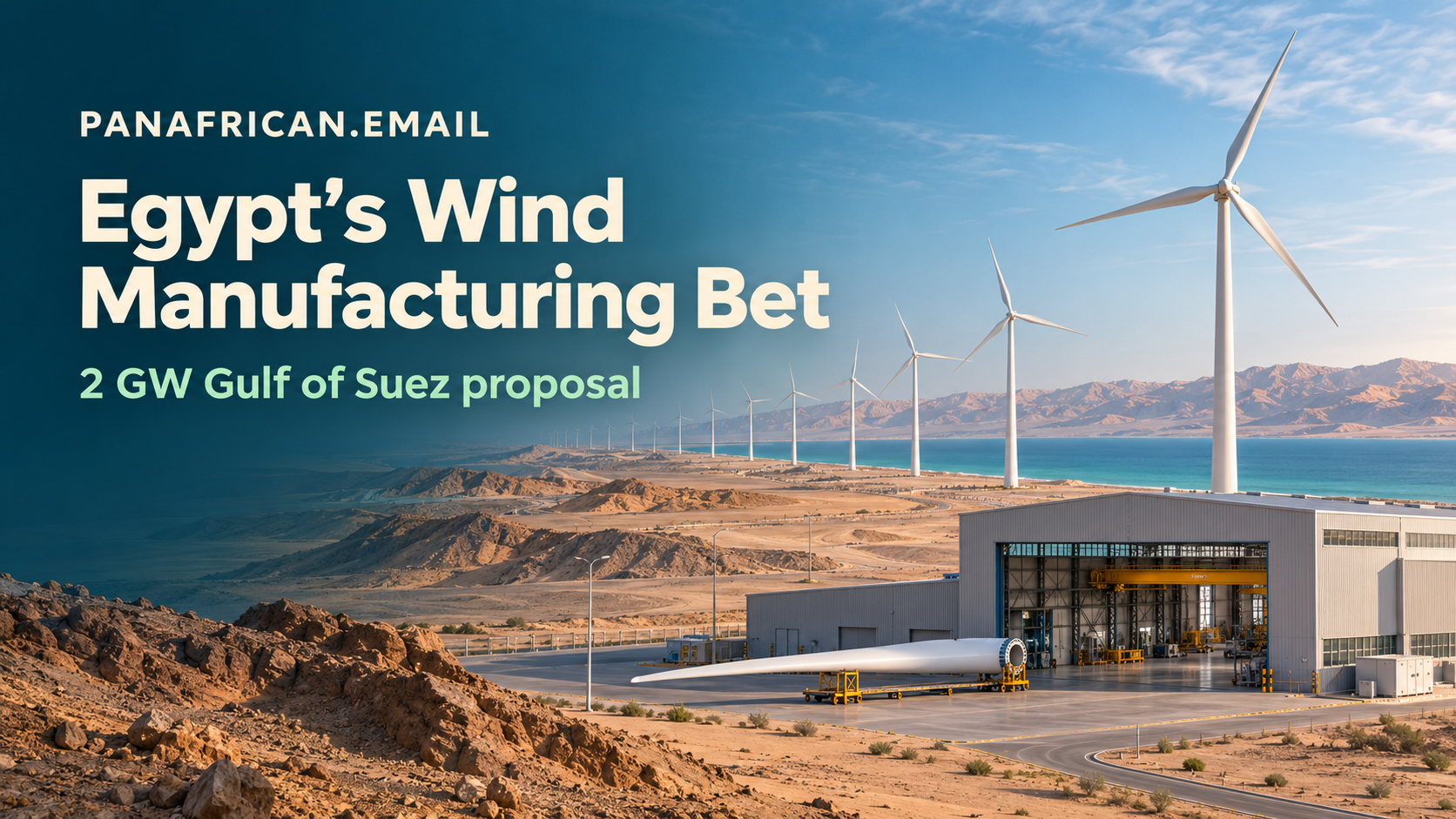
Egypt and China’s SANY Renewable Energy are pairing a proposed Gulf of Suez wind farm with a turbine factory. The farm could add power to Egypt’s grid. The factory could establish a domestic supply base for future projects if production, certification and orders follow.1, 2
A wind farm and a factory
Egypt’s cabinet recorded a memorandum of understanding on 24 June 2026 between SANY Renewable Energy, the Egyptian Electricity Transmission Company and the New and Renewable Energy Authority. On 26 June, Egypt’s State Information Service reported a ceremony marking the start of factory construction. The public announcements establish the plan and ceremony. The sources reviewed do not establish financial close, completed construction, or the start date of the grid-connection countdown.1, 2, 3
| Workstream | Planned scope | Evidence to track |
|---|---|---|
| Wind generation | 2,000 MW in the northern Gulf of Suez, with the government describing implementation in Egyptian pounds. | Definitive agreements, financial close, construction and turbine delivery. |
| Grid connection | Within 23 months of the signing of definitive agreements, as described by the cabinet and AP. | Signature date, transmission completion, first energization and commercial operation. |
| Manufacturing | Egypt’s first wind turbine factory, with a target of 2 GW of turbine capacity per year and a stated delivery target within two years of agreements. | Installed production lines, components made locally, certification and actual deliveries. |
| Regional exports | Domestic projects would be the initial market, with surplus production potentially exported. | Signed orders, recipient markets and the economics of shipping and servicing turbines. |
What 2 GW would add
Egypt’s installed wind capacity
MW at year-end · IRENA
Project scale against the 2025 baseline
Generating capacity · MW
Estimate annual generation
Illustrative sensitivity for a 2,000 MW wind farm. The selected capacity factor is an assumption, and the estimate omits separate curtailment and transmission-loss adjustments.
Illustrative annual generation
Formula: 2,000 MW × 8,760 hours × capacity factor. At 30%, 40% and 50%, the results are 5.26, 7.01 and 8.76 TWh, respectively.
What the Nigeria comparison can tell us
AP traces Lambar Rimi from a 2010 contract to commissioning in September 2025, after a 10 MW solar addition. Nigeria’s House records the wind project’s conception in 2005. Egypt’s 23 months uses a different starting point and describes a future grid target. The comparison highlights the importance of contract execution and grid readiness.3, 5
| Metric | Egypt · Gulf of Suez | Nigeria · Lambar Rimi |
|---|---|---|
| Wind capacity | 2,000 MW proposed | 10 MW wind component, plus 10 MW of solar added later |
| Milestone | June 2026 memorandum and factory launch ceremony | September 2025 commissioning reported by AP |
| Timing basis | Grid target within 23 months of definitive agreements | About 15 years from the 2010 contract, or approximately 20 years from initial conception |
| Industrial component | Planned domestic turbine factory | AP identifies Vergnet as the contracted turbine manufacturer |
What to watch next
Assessment. The wind farm could give a local plant an initial market if procurement is linked to domestic production. Sustained industrial benefits would depend on repeat orders, a supplier base that meets technical standards and documented transfer of skills.
| Signal | What would clarify it |
|---|---|
| Bankability | Signed offtake terms, project financing, and how currency and imported component costs are handled. |
| Production depth | Published local-content obligations identifying which components will be made or assembled in Egypt. |
| Technical capability | Training commitments, turbine certification, operating manuals and maintenance contracts. |
| Grid and site readiness | Transmission milestones, site permits and results of environmental and grid studies. |
| Export demand | Contracts in Africa or the Middle East and evidence of regional service capacity. |
Listen to the briefing
Read the transcript
Egypt is pairing a proposed two thousand megawatt Gulf of Suez wind farm with its first wind turbine factory. The cabinet says the wind farm should connect to the grid within twenty-three months of signing the definitive agreements. The factory is designed to produce up to two gigawatts of turbine capacity per year. That's a manufacturing target. It is separate from the wind farm's generating capacity. For policymakers and suppliers, the milestones to watch are financial close, grid readiness, local content commitments and the first certified turbines.
Sources
- Egyptian Cabinet · 24 June 2026 memorandum and targets, Arabic
- Egypt State Information Service · Memorandum and participating organizations · 26 June factory launch ceremony
- Associated Press · Egypt and Nigeria wind comparison, 16 September 2026
- IRENA · Renewable Capacity Statistics 2026, wind energy data
- Nigeria House of Representatives · 14 February 2024 order paper, item 14
Leave a Reply