
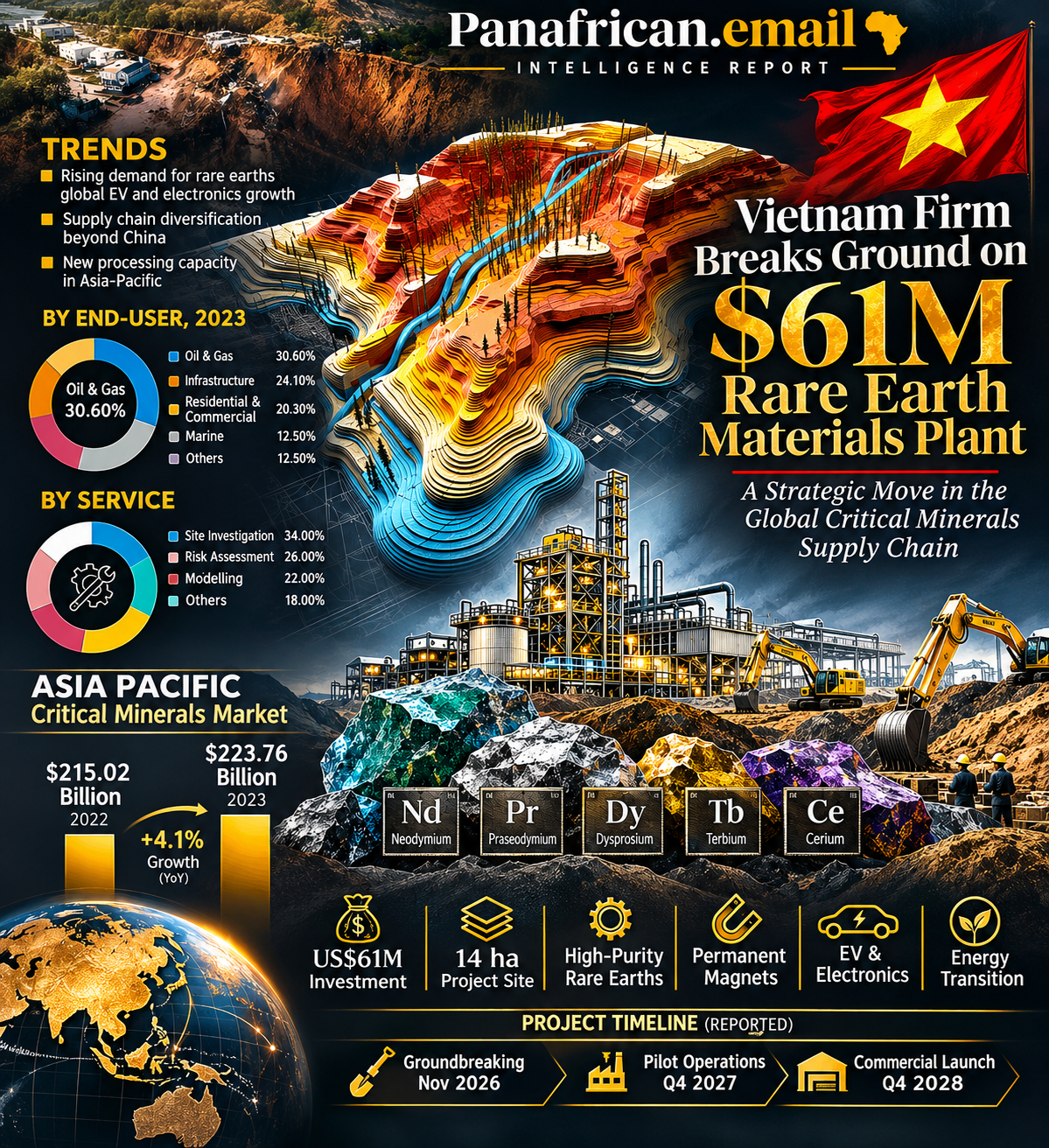
🇻🇳 Vietnam’s $61 Million Rare-Earth Materials Plant
Khanh An Industry breaks ground in Haiphong, advancing a domestic rare-earth refining chain and the production of high-purity oxides for advanced manufacturing.
Critical mineralsProcessing & refiningIndustrial policyAsia–Africa comparisonIndustrial project at a glance
Government sources identify Khanh An Industry Joint Stock Company as the investor and place the facility in the Dinh Vu–Cat Hai economic zone. Feedstock is expected to include mixed oxides from the Ben Den mine in Lao Cai and other legally sourced materials.
Project dashboard
Planned capacity — not current production
Bars show reported design capacity versus the project’s pre-operational status, not an audited production forecast.
Milestones
23 Nov 2026: Groundbreaking ceremony
Q4 2027: Planned commissioning / trial operations
Q4 2028: Targeted commercial operation
Capital intensity (derived indicator)
From mixed rare earths to separated oxides
Where separated rare-earth oxides can be used
| Element / oxide family | Typical downstream application | Project-specific product confirmed? |
|---|---|---|
| Neodymium / praseodymium | High-performance permanent magnets | Not specified by element |
| Dysprosium / terbium | High-temperature magnet performance | Not specified by element |
| Cerium | Polishing and catalysts | Not specified by element |
| Lanthanum | Optics, catalysts and batteries | Not specified by element |
| Yttrium / europium | Phosphors and specialist materials | Not specified by element |
The end uses above are sector examples, not an announced production mix or sales commitments for Khanh An.
Capital allocation: two separate Haiphong projects
The groundbreaking ceremony also included an adjacent port expansion. Their reported capital commitments are different and must not be conflated.
Comparative scale based on reported registered capital. The port project is approximately 15.7 times the rare-earth project’s capital; neither figure represents operating expenditure.
What African mineral economies can learn
Opportunity
Vietnam’s investment illustrates the strategic move from raw mineral extraction toward chemical separation, product purity, industrial clustering and logistics integration. African mineral-producing countries can evaluate similar steps where feedstock, power, water, skills, environmental safeguards and customers align.
Constraints
Rare-earth separation requires specialized chemical expertise, substantial waste management, reliable utilities and long-term offtake arrangements. Replication is not automatic, and an announced plant is not proof of commercial viability.
| Assessment dimension | Vietnam project signal | Questions for African industrial planners |
|---|---|---|
| Feedstock | Domestic mine plus other legal supplies | Is ore chemistry suitable for profitable separation? |
| Processing | Five hydrometallurgical lines planned | Can technical skills and reagent supply be secured? |
| Quality | Individual oxides above 99% targeted | Can purity and traceability meet buyer specifications? |
| Infrastructure | Industrial zone near deepwater port | Are electricity, water, transport and waste controls adequate? |
| Markets | High-tech sectors identified | Which verified buyers will contract output? |
Video and field reporting
Search for footage of the Haiphong groundbreaking on YouTube. Video availability is not independently confirmed; this link avoids misidentifying unrelated footage.
Primary reporting
| Source | What it establishes | Access |
|---|---|---|
| Haiphong government | Investment, site, five lines, capacity, purity, commercial timeline | Official report |
| Reuters / Mining Weekly | Company, feedstock, process and US$61M approximation | News report |
| Voice of Vietnam | Q4 2027 trials, Q4 2028 commercial target | Timeline report |
Processing is the strategic bottleneck
The significance of this announcement is not simply the US$61 million capital figure. It is Vietnam’s effort to expand domestic capabilities in separating rare-earth materials into higher-purity products. The next verification milestones are construction progress, environmental permitting, process commissioning, actual recovery rates, product specifications and signed customer agreements.
Assessment: Confirmed groundbreaking; planned production and future commercial performance remain unverified outcomes.
Leave a Reply