
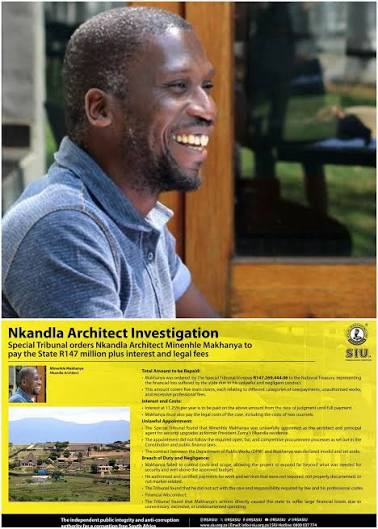
By Panafrican.email News Desk
A South African Special Tribunal has ordered architect and former Nkandla project principal agent Minenhle Makhanya to repay more than R147.2 million to the National Treasury over losses linked to the controversial upgrades at former President Jacob Zuma’s private residence in Nkandla, KwaZulu-Natal.
The judgment, delivered on 26 August 2026, followed legal proceedings brought by the Special Investigating Unit (SIU). The Tribunal found that Makhanya’s appointment and conduct in connection with the project were unlawful and contributed to substantial financial losses for the state.
From R27.9 million to R216 million
The Nkandla project was initially approved at approximately R27.9 million, based on security requirements identified by the South African Police Service (SAPS) and South African National Defence Force (SANDF).
However, according to the SIU investigation, the project eventually expanded to approximately R216 million.
The Tribunal found that Makhanya authorised and oversaw numerous works that went beyond the security requirements identified by the security agencies. These included tunnels, lifts, additional accommodation for security personnel, a laundry, visitors’ facilities, VIP parking, internal roads, air-conditioning, extensive landscaping and a controversial fire pool.
The SIU said these additional works accounted for millions of rand in expenditure that was not supported by the original security assessments.
Tribunal questions Makhanya’s appointment
The Tribunal also found problems with the way Makhanya was appointed as principal agent.
According to the judgment, his appointment was not preceded by a competitive bidding or open tender process. The Tribunal found there was no emergency or other lawful justification for bypassing normal procurement requirements, and Makhanya was not listed as a supplier with the Department of Public Works at the time of his appointment.
The Tribunal subsequently declared the contract relating to his appointment invalid.
Payments and professional responsibilities
The Tribunal found that Makhanya authorised and certified payments for structures and services that were not required by the security assessments.
It also found that he failed to obtain necessary written approvals for certain variations and over-designs, certified payments above market-related costs and approved payments for work that had either not been completed or had not been properly accounted for.
The judgment further found breaches of statutory, professional and contractual obligations, including obligations arising from South Africa’s Architectural Profession Act, the applicable professional code of conduct and contractual requirements.
‘He clearly did not act alone’
The ruling contains an important qualification concerning responsibility for the Nkandla expenditure.
Judge K. Pillay noted that Makhanya did not act alone in allowing the project’s costs to escalate. Nevertheless, the Tribunal held that, as architect and principal agent, he had a responsibility to protect the Department of Public Works from fruitless and wasteful expenditure.
That observation has renewed questions about accountability for one of South Africa’s most controversial public-spending scandals. While Makhanya is the individual against whom the SIU pursued this particular recovery action, the Tribunal acknowledged that other parties were involved in the decisions surrounding the project.
Zuma’s contribution reduces the claim
The final amount ordered against Makhanya was also affected by a payment previously made by Jacob Zuma.
The SIU said it accepted Makhanya’s submission concerning R7.8 million that Zuma had repaid as a contribution toward non-security-related upgrades. That amount was deducted from the amount ultimately deemed recoverable from Makhanya.
Makhanya was also ordered to pay the legal costs associated with the proceedings, including the costs of two counsel.
SIU vows to pursue accountability
Final Report 3.6MB
For the SIU, the judgment represents another step in efforts to recover public money lost through unlawful conduct and strengthen accountability within South Africa’s public sector.
SIU spokesperson Selby Makgotho explained that the case was part of the unit’s broader efforts to implement the findings of its investigations and recover funds belonging to the state.
The SIU also said that evidence of criminal conduct uncovered during its investigations would be referred to the National Prosecuting Authority (NPA) for consideration of further action.
The Nkandla saga has therefore entered another chapter more than a decade after the controversial upgrades first became a national political issue. The latest ruling places personal financial liability on the architect who served as principal agent while simultaneously highlighting the broader network of officials and decision-makers involved in the project.
For South Africans, the case remains a powerful example of the challenges surrounding public procurement, professional accountability and the protection of state resources.
Leave a Reply