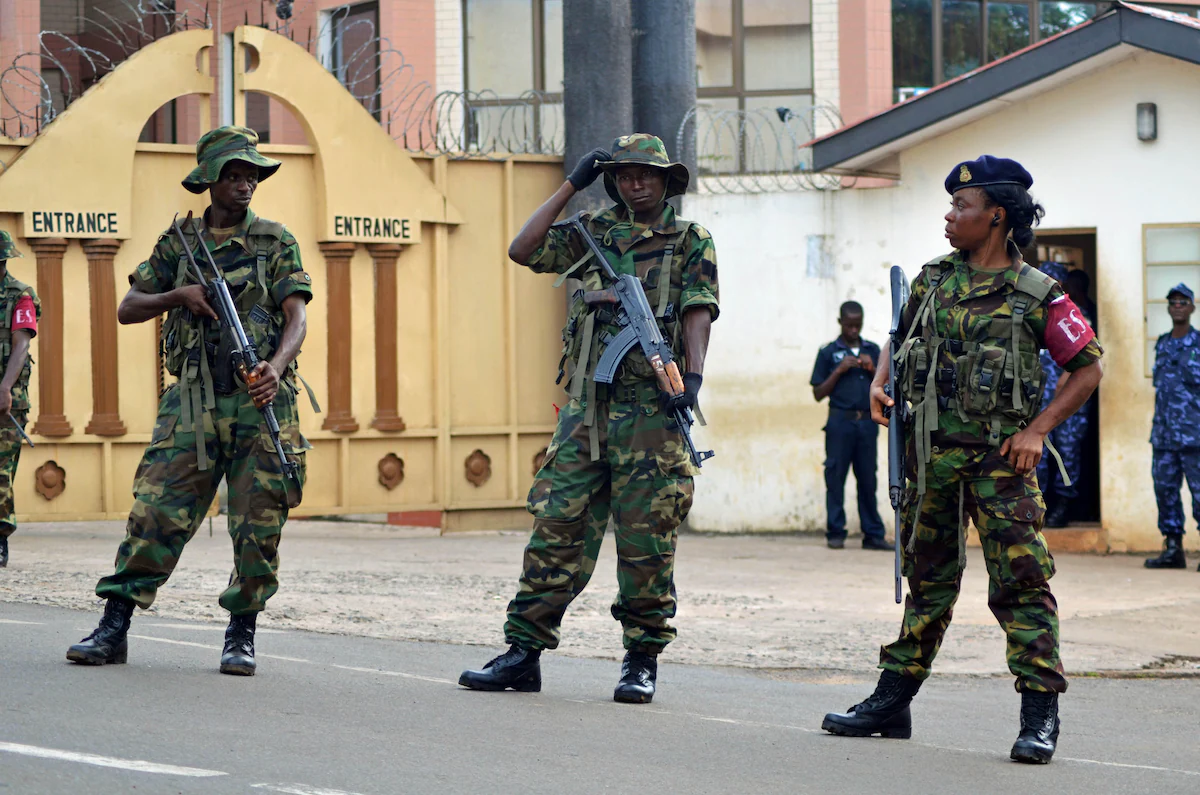
Sierra Leone’s government has announced that several members of its security forces have been apprehended by Guinea’s military following what Conakry describes as a cross‑border incursion. The episode has added fresh tension to a historically sensitive frontier, raising concerns about escalation, miscalculation, and the broader stability of the Mano River region.
According to Freetown’s account, the security personnel were engaged in operations near the contested border area when they were detained on Guinean territory. Sierra Leonean authorities insist their forces did not deliberately violate Guinean sovereignty and have framed the incident as either a navigational error along a poorly demarcated frontier or a misunderstanding in the field. Guinea, for its part, has reportedly treated the episode as a violation of its territorial integrity, prompting firm security and diplomatic responses.
The Sierra Leonean government has called for the immediate and safe return of its detained officers, emphasizing that they are uniformed personnel acting under official orders rather than irregular combatants or criminal actors. Officials in Freetown have underscored the importance of due process, humane treatment, and adherence to regional and international norms when handling the case. They have also appealed to regional mechanisms, signaling openness to mediation and fact‑finding to clarify what transpired along the border.
This incident is occurring against a backdrop of complex regional politics in West Africa, where several states are navigating internal political transitions, security pressures, and recalibrated foreign relations. Both Sierra Leone and Guinea are members of ECOWAS, a bloc that promotes regional integration but has also been under strain due to recent coups and governance crises in other member states. The detention of Sierra Leonean personnel by Guinean forces thus carries implications not only for bilateral relations, but for the credibility of regional security and conflict‑management frameworks.
Local communities along the Sierra Leone–Guinea border, already accustomed to cross‑border trade and shared ethnic ties, are likely to watch the situation nervously. Any prolonged standoff, tightened security, or restrictions on movement could disrupt livelihoods and fuel distrust between populations that often see the border as more administrative than cultural. Civil society voices in both countries may therefore push for de‑escalation, transparent communication, and safeguards against abuses.
Diplomatically, the priority for Sierra Leone will be securing consular access to the detained personnel, clarifying the circumstances of their apprehension, and establishing a joint investigative mechanism with Guinea. For Guinea, balancing domestic expectations of firmness on sovereignty with regional expectations of restraint and dialogue will be key. Ideally, both governments will use existing bilateral channels and ECOWAS frameworks to manage the crisis, prevent nationalist rhetoric from spiraling, and set clearer protocols for military operations near sensitive border zones.
If handled through quiet diplomacy and structured dialogue, the incident could ultimately push both states toward more robust border demarcation, joint patrols, or confidence‑building measures. If mismanaged, however, it risks hardening positions, feeding mutual suspicion, and creating another flashpoint in a region that can ill afford new security crises.
Leave a Reply