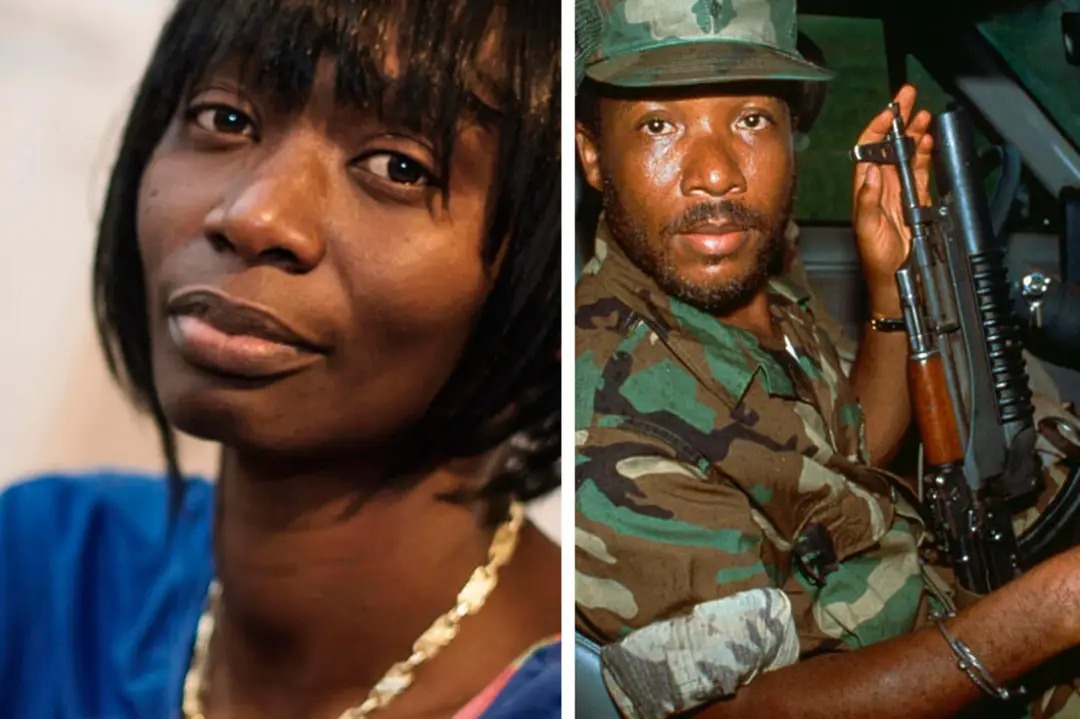
Belgian courts are moving ahead with plans to try former National Patriotic Front of Liberia (NPFL) commander Martina (often spelled Matina) Johnson for alleged war crimes and crimes against humanity committed during Liberia’s first civil war, in what could become one of the most consequential accountability cases for Liberian atrocities in a European court.[1][2][3]
A former NPFL frontline commander faces justice abroad
Martina Johnson is a Liberian national and former frontline commander of Charles Taylor’s National Patriotic Front of Liberia, the rebel movement that launched Liberia’s first civil war between 1989 and 1996.[4][5][6] She is alleged to have played a leading role in “Operation Octopus,” the notorious 1992 NPFL offensive on Monrovia that left hundreds of civilians and aid workers dead and terrorised the capital’s population.[1][3][6]
Johnson has lived in Belgium since the early 2000s and obtained residency there after marrying a Belgian of Liberian origin in the city of Ghent.[2][3] In September 2014 Belgian authorities arrested her on suspicion of war crimes and crimes against humanity, following a complaint filed by Liberian victims and investigations by the Swiss-based legal group Civitas Maxima and its Liberian partner, the Global Justice and Research Project.[1][4][7] Rights organisations hailed the arrest and indictment as a “major step” toward justice for atrocities committed during Liberia’s conflicts.[8][7]
Operation Octopus and the allegations against Johnson
The charges against Johnson centre on her alleged role in Operation Octopus, an NPFL-led siege of Monrovia launched in October 1992 in an effort to topple the interim government and seize full control of Liberia.[1][3][6] During several months of intense fighting, rebel forces, including child soldiers, attacked the capital from multiple fronts, bombarded civilian neighbourhoods and targeted people on the basis of their perceived ethnic or political affiliation.[3][6]
Belgian prosecutors and victim lawyers say Johnson directly participated in mutilations, torture, and mass killings during this offensive, particularly at a military checkpoint at the Dry Rice Market on the outskirts of the city.[1][3][6] Witnesses allege that civilians, including members of the Mandingo and Krahn communities, were singled out, brutalised and in some cases dismembered or summarily executed.[3][7][6] Liberia’s Truth and Reconciliation Commission (TRC) later listed Johnson among the country’s “most notorious perpetrators,” citing her as a commander in Taylor’s forces associated with gross human rights violations.[3][6] Johnson has consistently denied the accusations, and her lawyers insist she was not present at the sites of the alleged crimes.[2][9]
Belgium’s war crimes law and the long road to trial
Johnson’s case rests on Belgium’s ability to prosecute grave international crimes committed outside its territory when the alleged perpetrator has a strong link to the country.[2][9] After Belgium significantly scaled back its universal jurisdiction statute in the early 2000s, the law now allows such prosecutions where the suspect is a Belgian national or long-term resident, or where they are physically present on Belgian territory.[9][10][11] Because Johnson has resided in Belgium since around 2003, Belgian courts assert jurisdiction over the alleged war crimes and crimes against humanity committed in Liberia in the early 1990s.[1][2][9]
The road to a possible trial has been protracted. Liberian victims formally filed a complaint in Belgium in 2012, triggering a judicial investigation that stretched over more than a decade.[1][3][10] Johnson was arrested and indicted in 2014, initially placed under electronic surveillance and later released on bail under strict conditions, including a ban on leaving the country.[2][4] Civil society groups repeatedly criticised the slow pace of investigations and the failure of Belgian authorities to visit Liberia for several years, even as other European jurisdictions moved faster on similar Liberia-related cases.[6][11]
Momentum shifted in 2025. In late September that year, the “Chambre du conseil” (investigating chamber) of the Ghent Court of First Instance held a closed hearing to assess whether the evidence was sufficient to send the case toward trial.[1][2] On 14 October 2025, the chamber formally closed the investigation, finding that the file contained enough evidence to move the case forward and rejecting defence arguments that the proceedings had become invalid due to excessive delays.[1][2] The federal prosecutor’s office requested that Johnson be referred to the Ghent Assize Court on charges of war crimes and crimes against humanity, although a request to have her immediately re-arrested was denied, in part because of her serious liver disease.[2]
In March 2026, Belgian authorities announced that Johnson will appear before the country’s Cour d’assises to answer charges of international crimes, a step that effectively clears the way for a historic trial.[12][13] If it proceeds, Johnson will be the first woman tried in Europe for atrocities linked to Liberia’s civil wars and one of only a handful of NPFL commanders to face criminal proceedings for crimes committed during the conflict.[3][8]
Liberia’s stalled accountability at home
For many Liberians, Johnson’s prosecution in Belgium underscores the stark contrast between efforts for justice abroad and continued impunity at home. Liberia’s civil conflicts from 1989 to 2003 left an estimated 250,000 people dead, displaced hundreds of thousands more, and saw widespread use of child soldiers, sexual violence, and massacres of civilians by all sides.[6][11] Yet, more than two decades after the first war and over a decade after the end of the second, Liberia has never held a domestic criminal trial for war-time atrocities.[6][11]
The 2009 TRC report named dozens of individuals, including former warlords and political figures, as bearing responsibility for serious crimes and recommended establishing a special war crimes court.[3][6] Successive governments, including those of Ellen Johnson Sirleaf and George Weah, failed to implement these recommendations, citing political sensitivities and fears of renewed instability.[6][11] Under President Donald Trump’s administration in the United States, several Liberian figures have been prosecuted in U.S. courts for immigration fraud and torture, but those cases have focused on violations of U.S. law rather than direct prosecution for war crimes committed in Liberia.[8][6][11]
Recently, however, pressure has intensified. Liberian and international NGOs, diaspora communities, and some lawmakers have renewed calls for a war and economic crimes court as part of broader governance reforms.[3][6] Johnson’s case in Belgium, along with earlier trials of Liberian-linked suspects in the United States, Switzerland and the United Kingdom, has shown that foreign jurisdictions can act when Liberia does not.[3][8][6] But many advocates argue that without a home-grown process, Liberia risks outsourcing justice and failing to fully confront its violent past.[6][11]
Pan-African stakes: precedent, power, and memory
For a Pan-African audience, Johnson’s prosecution raises critical questions about where and how justice for African atrocities should be pursued, and who controls the narrative of Liberia’s wars. European courts have increasingly become venues for trials involving African conflicts, from Rwanda and the Democratic Republic of Congo to Guinea and Liberia, often relying on universal jurisdiction laws and the presence of suspects on European soil.[9][10][11] Supporters argue that such cases break entrenched impunity, give victims a voice, and reinforce the principle that grave international crimes have no safe haven.[8][10][11]
Critics, however, worry about selective justice and the optics of Africans being tried far from home, in systems shaped by Europe’s own complex history with the continent.[10][11] They point to the lack of comparable prosecutions for Western actors who supplied arms, financed factions, or profited from Liberia’s war economy.[10][11] In this context, Johnson’s case becomes a test of whether universal jurisdiction can be harnessed in a way that respects African agency and complements, rather than replaces, domestic accountability efforts.
The gender dimension is another important aspect. Johnson is poised to be the first woman tried in connection with Liberia’s civil war in a European court, despite the fact that many women in Liberia experienced the conflicts primarily as victims and survivors of sexual and gender-based violence.[3][8] Her case complicates simplistic narratives of women solely as victims of war, highlighting the uncomfortable reality that women can also be perpetrators and commanders within highly militarised, patriarchal structures.[3][6]
For Liberians and the broader African diaspora, the proceedings in Belgium will be more than a legal process; they will act as a public reckoning with one of the darkest episodes in the country’s history. Testimony about Operation Octopus, the Dry Rice Market checkpoint, and the daily terror of life in Monrovia during the siege will inevitably reopen old wounds but may also document stories that would otherwise be lost to time.[1][3][6] Whether the trial ultimately leads to a conviction or acquittal, it will help to shape how the next generation understands Liberia’s wars and who bears responsibility for them.
Leave a Reply