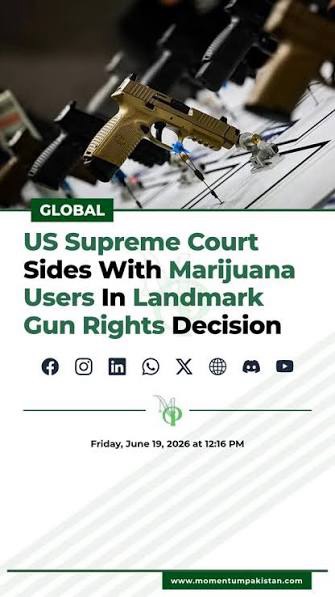
WASHINGTON, D.C. — In a unanimous decision that could reshape the relationship between firearm regulations and cannabis laws in the United States, the U.S. Supreme Court has ruled that the federal government cannot automatically strip individuals of their Second Amendment rights solely because they use marijuana. The ruling marks a significant victory for gun-rights advocates and raises new questions about the future of federal cannabis policy. (Reuters)

The case, United States v. Hemani, centered on Ali Danial Hemani, a Texas resident who admitted to using marijuana regularly. Federal prosecutors charged him under 18 U.S.C. § 922(g)(3), a provision of the Gun Control Act of 1968, which prohibits firearm possession by any person deemed an “unlawful user” of a controlled substance. Marijuana remains illegal under federal law despite being legal for medical or recreational use in many U.S. states. (Justia Law)
Writing for the Court, Justice Neil Gorsuch stated that the government failed to demonstrate that Hemani’s marijuana use alone justified removing his constitutional right to possess a firearm. The Court emphasized that there was no evidence that Hemani was violent, addicted, intoxicated while carrying a weapon, or otherwise posed a danger to the public. (Georgia Public Broadcasting)

The decision does not completely invalidate Section 922(g)(3). Instead, the Court narrowly ruled that the law cannot be broadly applied to all marijuana users without individualized proof that the person presents a genuine danger. The ruling leaves open the possibility that Congress could enact more targeted restrictions affecting individuals who are addicted to drugs or who use firearms while impaired. (Georgia Public Broadcasting)
What Law Was Challenged?
The challenged statute, 18 U.S.C. § 922(g)(3), was enacted as part of the Gun Control Act of 1968. The law bars any “unlawful user of or addicted to any controlled substance” from possessing firearms. For decades, federal authorities interpreted the law to include marijuana users, even in states where cannabis use had been legalized. (Justia Law)
The Supreme Court’s ruling reflects growing legal tensions between federal cannabis prohibition and state-level legalization efforts. More than half of U.S. states now permit some form of legal marijuana use, creating conflicts between state rights, federal drug policy, and constitutional protections. (Reuters)
Implications for Cannabis Reform
Cannabis advocates argue that the decision represents another step toward the normalization of marijuana use in American law. Civil liberties organizations, gun-rights groups, and cannabis reform advocates joined forces in support of Hemani’s challenge, an unusual coalition that underscored the broader constitutional questions involved. (AP News)
The ruling could also influence future legal challenges involving employment rights, banking access, housing discrimination, and federal cannabis scheduling. As lawmakers continue debating marijuana reform, the Court’s decision signals increasing judicial skepticism toward blanket restrictions based solely on cannabis use. (Reuters)
A Continuing Debate
Supporters of the decision argue that constitutional rights should not be denied to responsible adults who legally consume cannabis under state law. Critics, however, warn that combining firearms and drug use could pose public safety risks and contend that Congress should establish clearer standards governing gun ownership and impairment. (The Wall Street Journal)
For now, the Supreme Court has drawn a constitutional line: marijuana use alone is not sufficient grounds for the federal government to revoke an individual’s right to keep and bear arms. The decision is expected to influence gun-rights and cannabis-policy debates for years to come. (Reuters)
⚖️ 🌿 🔫 🇺🇸
Leave a Reply