Washington, D.C. — June 23, 2026
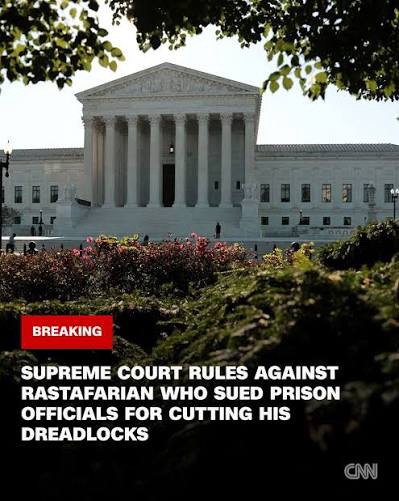
The United States Supreme Court has issued a major ruling with implications for religious liberty, prison reform, and the rights of minority faith communities. In a closely watched 6-3 decision, the Court ruled against a Rastafarian man whose dreadlocks were forcibly shaved by Louisiana prison officials, holding that he cannot seek monetary damages from individual prison employees under federal religious-freedom law. (Reuters)
The case centered on Damon Landor, a devout follower of the Rastafari faith. For Rastafarians, the wearing of uncut dreadlocks is not merely a cultural expression but a sacred religious obligation rooted in biblical teachings and spiritual covenant. Landor had spent nearly two decades growing his dreadlocks, which reportedly reached below his knees. (The Guardian)
The Incident
In 2020, while serving a short prison sentence in Louisiana, Landor was transferred to the Raymond Laborde Correctional Center. Upon arrival, he informed prison staff that his faith prohibited cutting his hair and even presented documentation referencing a previous federal court ruling that had found Louisiana’s policy of cutting Rastafarian inmates’ hair unlawful. According to court records, a prison guard discarded the document and officers subsequently restrained Landor, handcuffed him to a chair, and shaved his head against his will. (The Guardian)
The incident sparked outrage among advocates for religious freedom, civil rights organizations, and members of the Rastafari community, many of whom viewed the act as a direct assault on Landor’s faith and dignity.
The Legal Battle
Landor filed suit under the Religious Land Use and Institutionalized Persons Act (RLUIPA), a federal law enacted in 2000 to protect the religious rights of people in prisons and other institutions. The law prohibits government entities receiving federal funds from imposing substantial burdens on religious exercise without a compelling justification. (Reuters)
The central question before the Supreme Court was not whether Landor’s religious rights had been violated. Even prison officials and state attorneys largely acknowledged that what happened should not have occurred. Instead, the Court was asked to determine whether RLUIPA allows individuals to seek monetary damages directly from state employees who violate those rights. (AP News)
Writing for the majority, Justice Neil Gorsuch concluded that the statute does not authorize such lawsuits against individual state officials. As a result, Landor’s case was dismissed despite the acknowledged violation of his religious freedom. (Reuters)
A Sharp Dissent
The Court’s three liberal justices dissented.
Justice Ketanji Brown Jackson argued that the ruling leaves victims of clear religious discrimination without an effective remedy. Critics of the decision contend that if government employees cannot be held personally accountable for deliberate violations of religious rights, protections guaranteed by federal law may become difficult to enforce in practice. (Reuters)
Civil-rights advocates have warned that the decision could weaken protections for incarcerated individuals belonging to minority faiths, including Muslims, Sikhs, Native American spiritual practitioners, and Rastafarians.
Why This Matters to the African Diaspora
The Rastafari movement emerged in Jamaica during the 1930s and drew inspiration from African liberation movements, Ethiopian history, and the coronation of Emperor Haile Selassie I. Over the decades, Rastafari has become one of the most globally recognized spiritual traditions originating from the African diaspora.
The forced cutting of dreadlocks has long been viewed by Rastafarians as a form of religious persecution. Throughout the Caribbean, Europe, Africa, and North America, legal battles involving Rastafarian religious expression have frequently centered on issues such as grooming policies, employment discrimination, education, and sacramental practices. (Wikipedia)
For many observers, the Landor case highlights the continuing struggle for equal recognition of African-derived faith traditions within Western legal systems.
Looking Ahead
Although Landor’s lawsuit was rejected, the case has already prompted changes. Louisiana has revised its prison grooming policies to better accommodate religious practices and prevent similar incidents from occurring in the future. (AP News)
Nevertheless, legal scholars expect the decision to influence future religious-liberty litigation across the United States. The ruling leaves unresolved broader questions about accountability when government officials knowingly violate constitutional or statutory protections for religious minorities.
For Rastafarians worldwide, the case serves as a reminder that the struggle for religious recognition and respect remains ongoing, even in nations that constitutionally guarantee freedom of religion.
Leave a Reply