
By Panafrican.email | Energy & Geopolitics
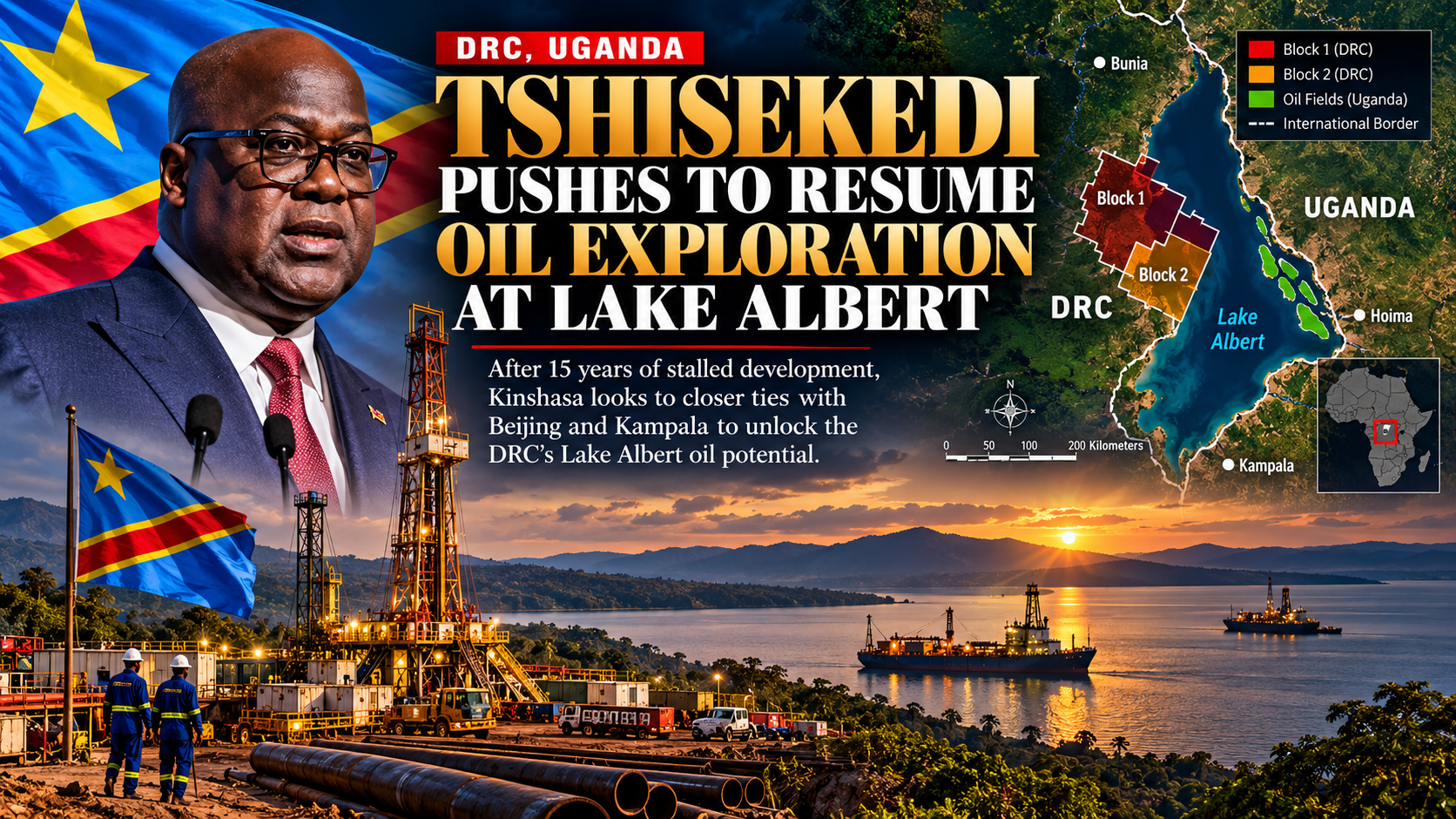
The Democratic Republic of Congo is once again looking toward the oil potential beneath Lake Albert, where the country’s long-stalled Blocks 1 and 2 have remained at the center of a complicated intersection of energy, diplomacy, investment and regional politics.
A new report from Africa Intelligence says President Félix Tshisekedi is pushing for a revival of oil exploration on the Congolese side of Lake Albert, where development has been effectively frozen for around 15 years. The report points to closer relations with Uganda and China as potentially important to unlocking the dormant projects. (Africa Intelligence)
For Kinshasa, the stakes extend beyond finding crude oil. Lake Albert sits within the wider Albertine Graben, an oil-bearing geological region shared by Uganda and the Democratic Republic of Congo. The basin has already produced significant discoveries on the Ugandan side, making the Congolese acreage one of Central Africa’s most closely watched undeveloped petroleum frontiers.
Lake Albert’s unfinished oil story
The history of oil exploration around Lake Albert goes back decades.
Companies including Tullow Oil and Heritage Oil previously conducted extensive exploration on the Ugandan side of the lake and identified substantial petroleum resources. Exploration also extended toward the Congolese side, where Blocks 1 and 2 cover part of the lake and surrounding Albertine Rift.
The Congolese acreage, however, became entangled in contractual disputes and political controversy.
In 2006, Tullow and partners signed an agreement concerning Blocks 1 and 2. Subsequent disagreements over contracts and licensing delayed development. In 2010, the Congolese government awarded the blocks to Caprikat and Foxwhelp, companies registered in the British Virgin Islands, replacing previous arrangements involving Tullow. (Oil & Gas Journal)
The controversy eventually became part of a much broader debate over the transparency and management of Congo’s natural resources.
The result was that one of the region’s potentially valuable petroleum areas remained largely undeveloped.
Why Tshisekedi is looking again
President Félix Tshisekedi has made the expansion of investment and infrastructure a major part of his economic agenda.
Oil development at Lake Albert could potentially provide Congo with another source of government revenue while helping diversify an economy heavily dependent on mining.
The DRC is already one of the world’s most important sources of cobalt and a major producer of copper. Its mineral wealth has attracted enormous international attention, particularly from China and Western governments seeking secure supplies of critical minerals.
Petroleum would add another strategic resource to that equation.
But developing Lake Albert requires more than drilling wells.
The project involves infrastructure, transportation, security, environmental management, financing and relationships with Uganda, which controls the other side of the lake.
That makes diplomacy almost as important as geology.

Uganda is central to the equation
The DRC and Uganda share the Lake Albert petroleum system.
Uganda has moved considerably further toward commercial oil development. Exploration on its side of the Albertine Graben produced discoveries at locations including Kingfisher and Tilenga, creating the foundation for a major national petroleum industry. Historical exploration records show that companies drilled numerous successful wells in the Ugandan portion of the basin. (Oil & Gas Journal)
This creates a practical argument for cooperation.
A coordinated approach could allow the two countries to share infrastructure, technical expertise, logistics and potentially export routes.
Historically, however, the border has also been a source of tension.
Oil exploration in the Albertine region previously became entangled with disagreements over the Uganda-DRC border and accusations surrounding exploration activities. The two countries subsequently worked toward resolving some of those disputes and improving diplomatic relations. (Oil & Gas Journal)
Today, renewed cooperation could turn Lake Albert from a contested frontier into a shared economic zone.
China’s potential role
The other major piece of the emerging equation is China.
China already occupies a major position in the DRC’s mining economy. Chinese companies have become deeply involved in the country’s copper and cobalt industries, while Beijing has developed extensive commercial relationships across Central and East Africa.
A renewed push into Lake Albert would therefore fit into a much larger story about China’s relationship with African energy and infrastructure.
For Kinshasa, Chinese participation could potentially provide financing, engineering capacity and access to companies experienced in large-scale infrastructure development.
But the DRC also has to balance its relationship with China against growing Western interest in its critical minerals and strategic resources.
The country increasingly finds itself at the center of competition over Africa’s natural resources.
The infrastructure problem
Oil exploration is only the beginning.
Even if commercially viable reserves are confirmed and developed, Congo would need a reliable method of transporting crude to international markets.
Uganda’s own petroleum strategy demonstrates the importance of infrastructure. Developing oil fields in the landlocked Albertine region requires extensive transportation networks connecting production areas with export facilities.
For Congo, the challenge could be even more complicated.
The country’s eastern provinces have historically suffered from inadequate infrastructure and persistent insecurity. Roads, pipelines, storage facilities and export terminals would require significant investment.
Any Lake Albert development would therefore have to be viewed as an integrated infrastructure project rather than simply an oil-drilling exercise.
A new East-Central African energy corridor?
The strategic implications could extend well beyond Lake Albert.
The region sits between Central Africa’s resource-rich interior and the Indian Ocean.
Uganda has sought routes toward international markets, while the DRC needs better connections between its eastern provinces and regional transport networks.
If the two countries successfully cooperate, Lake Albert could become part of a wider East-Central African energy and infrastructure corridor.
That could involve Uganda, the DRC, Tanzania and potentially other regional economies.
Such connectivity could have consequences for more than petroleum.
Roads, electricity infrastructure, ports, pipelines and logistics networks built around energy projects can eventually support agriculture, manufacturing and regional trade.
Security remains a critical issue
The eastern DRC remains one of Africa’s most challenging security environments.
Armed groups have operated across parts of North Kivu and Ituri, while tensions involving neighboring countries have repeatedly complicated economic development.
Lake Albert is located in a region where security cannot be separated from resource policy.
Any renewed exploration campaign would therefore require significant attention to protection of workers and infrastructure, relations with local communities and environmental safeguards.
The history of resource development in the DRC also means transparency will be closely watched.
Contracts, ownership structures, government revenues and environmental obligations are likely to become central questions if the project moves forward.
Could oil change the DRC’s eastern economy?
The potential rewards are significant, but oil alone will not transform the region.
The DRC has repeatedly demonstrated that possessing enormous natural resources does not automatically translate into broad-based prosperity.
The country’s mining sector illustrates both sides of the equation.
Copper and cobalt have generated enormous international investment, but communities in resource-producing areas continue to debate employment, environmental damage, infrastructure and the distribution of mining revenues.
Lake Albert presents the same fundamental question:
Can Congo convert natural-resource wealth into lasting economic development for the people living closest to it?
That will depend on how contracts are negotiated, how revenues are managed and whether local communities participate meaningfully in the economic benefits.
A geopolitical resource frontier
Lake Albert is increasingly more than an oil story.
It sits at the intersection of three major African trends: the expansion of regional trade, the competition for natural resources and the growing influence of external powers.
Uganda wants to develop its petroleum resources.
The DRC wants to unlock its own side of the basin.
China remains a major economic partner for Kinshasa.
And international energy companies continue to watch the Albertine Graben because of its geological potential.
That makes the lake a potentially important strategic zone for East and Central Africa.
What happens next?
The immediate challenge for Kinshasa will be turning political interest into an executable development plan.
That means resolving outstanding contractual and regulatory questions, strengthening cooperation with Kampala, attracting technically capable operators and determining how infrastructure would connect Congolese production to export markets.
The government will also face pressure to demonstrate that any new oil agreements are transparent and commercially defensible.
After years of inactivity, the revival of Blocks 1 and 2 would represent a significant change.
But the real test will not be whether Congo can find oil.
It will be whether the country can develop it responsibly, negotiate effectively with its neighbors and convert petroleum revenues into infrastructure, employment and economic opportunity.
For the DRC, Lake Albert could become another chapter in its long history as a resource-rich country.
This time, however, Kinshasa appears determined to make sure the resources beneath its side of the lake do not remain dormant indefinitely.
The Panafrican.email Perspective
The Lake Albert story should be watched as part of Africa’s broader struggle to control the value chain surrounding its natural resources.
Cobalt, copper, oil and other strategic commodities are increasingly drawing competition among global powers. African governments therefore face a critical choice: remain exporters of raw materials or use resource development as a foundation for infrastructure, industrialization and regional integration.
For the DRC and Uganda, Lake Albert could become a test case.
If managed transparently and cooperatively, petroleum development could strengthen regional trade and economic integration.
If handled poorly, the same resource could reproduce the disputes, opaque contracts and unequal benefits that have characterized parts of Central Africa’s resource economy for decades.
The next phase of Lake Albert’s oil story will therefore be about much more than crude.
It will be about who controls Africa’s resources, who finances their development, who builds the infrastructure and — most importantly — who benefits.
Leave a Reply