
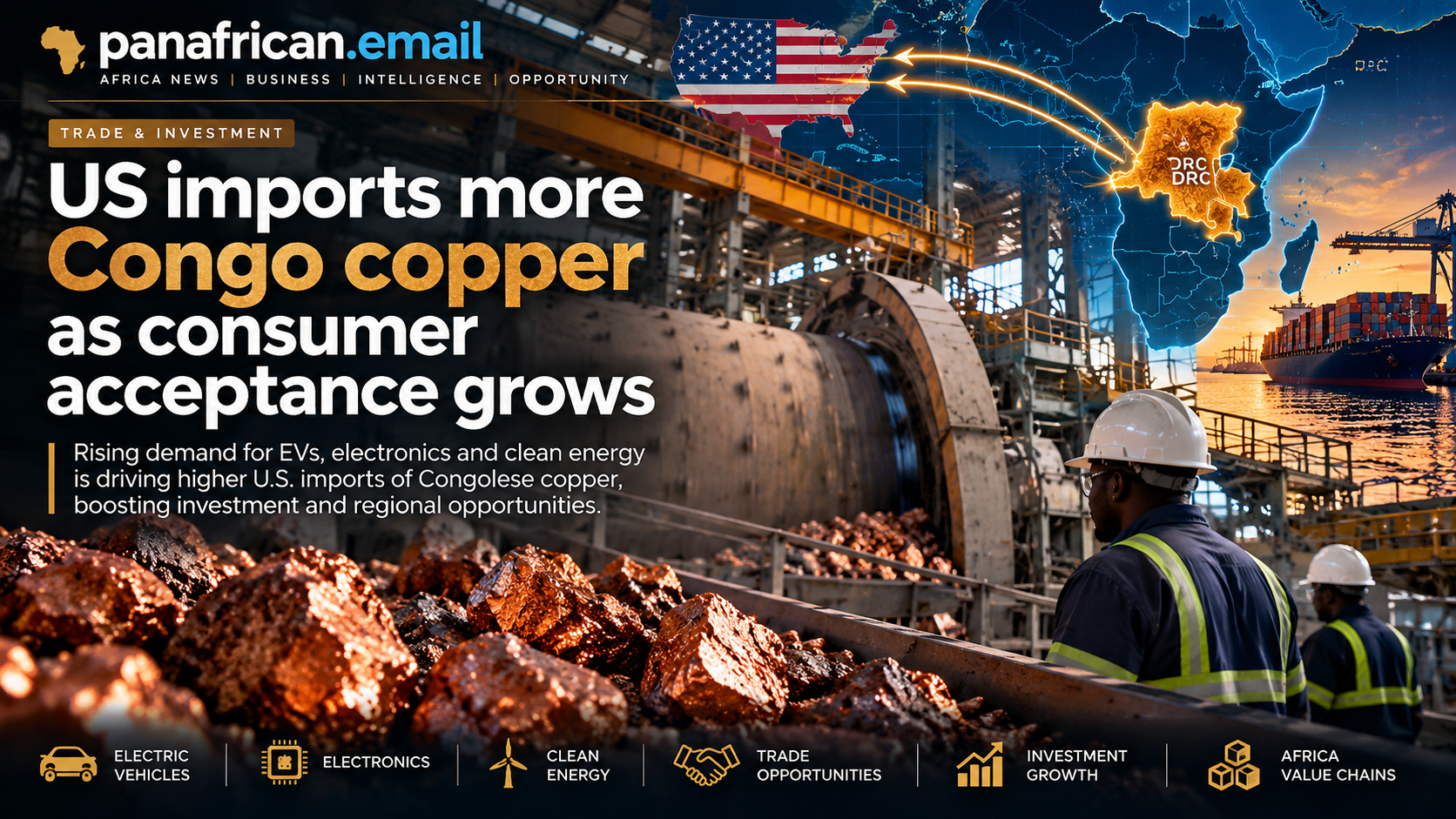
KINSHASA — The Democratic Republic of Congo’s copper industry is becoming increasingly important to competing global supply chains, with the United States taking record volumes while China’s share of Congolese copper purchases has declined.
Reuters reported that U.S. copper imports from the DRC reached 53,290 metric tons in July 2026, giving Congo a 23.9% share of total U.S. copper imports that month. The increase comes as industrial consumers seek additional sources of copper amid tight global supply and changing trade policies.
China remains a major buyer
China remains a central market for Congolese minerals. Reuters reported that China was still Congo’s top copper buyer, although its share of the market declined during the first seven months of 2026. China’s July share was reported at 39.4%.
The changing pattern suggests that Congo’s copper is becoming increasingly connected to multiple markets rather than moving predominantly through one major destination.
A strategic mineral at the centre of global industry
Copper is essential to power grids, construction, electronics, electric vehicles and renewable-energy infrastructure. That makes Congo’s copper resources strategically important as countries expand electricity networks and clean-energy technologies.
The country’s mineral position also includes cobalt and other resources used in advanced manufacturing.
Kinshasa seeks more control
Congo is also strengthening state control over geological information. Reuters reported that the government is working toward a national geological databank, including new airborne surveys and digital mapping. The objective is to improve knowledge of deposits and strengthen the state’s position when negotiating exploration and mining agreements.
Better geological information can reduce uncertainty for investors while also giving the government a stronger evidence base for managing strategic resources.
A new U.S.-Congo minerals track
In September, Reuters reported that Congo had created a DRC-USA Task Force to accelerate implementation of a strategic minerals partnership with the United States. The development reflects Kinshasa’s effort to attract investment from multiple international partners.
For Congo, diversification can create bargaining space. For global buyers, additional supply from Congo can reduce dependence on concentrated sources.
What China means in the new environment
China remains deeply embedded in Congo’s mining economy through investment, processing capacity, trade and long-standing commercial relationships. The rise of U.S. and other Western interest does not eliminate that role, but it changes the competitive environment around Congolese minerals.
The outcome will depend partly on whether Congo can use increased international interest to secure investment in processing, infrastructure, skills and domestic industry rather than simply increasing exports of raw or semi-processed material.

The African opportunity
Congo’s experience reflects a wider African shift. Critical minerals are creating opportunities for governments to negotiate more value-added investment, but the ability to capture that value depends on electricity, transport, technical skills, regulation, financing and industrial capacity.
For panafrican.email/ readers, the Congo story is therefore larger than copper prices. It is about how African countries can position themselves as strategic partners in the technologies shaping the next phase of the global economy.
DRC Copper Makes Inroads in the U.S.,
but China Still Leads
U.S. imports of Democratic Republic of Congo copper cathodes reached
a record level in July 2026, while China continued to absorb substantially
larger monthly volumes.
A changing map for one of Africa’s most strategic minerals.
Copper sits at the center of electric vehicles, electronics,
power infrastructure and the global energy transition. The DRC
remains one of the world’s critical copper-producing regions.
Mineral source
Copper cathodes
Largest destination
Sustained high volumes
Growing imports
July 2026 record
Metric tons shown in the supplied monthly chart.
China remained the largest market across the period shown.
Essential to power networks, electronics, EVs and industrial systems.
U.S. and China imports of DRC copper cathodes
Monthly comparison from January 2025 through July 2026.
Values below are an editorial reconstruction from the supplied chart
and are displayed in metric tons.
China imports
U.S. imports
July 2026: U.S. breakthrough
The supplied chart shows U.S. imports reaching their highest
point of the period in July 2026, at roughly 53,000 metric tons.
The increase is significant even though the U.S. remains below
China’s monthly import volumes.
China remains dominant
China’s import volumes remain substantially higher throughout
the period, demonstrating the continuing importance of China
in the DRC’s copper trade ecosystem.
Why the copper story matters
Copper is not simply a mining commodity. Its importance extends
across the infrastructure and technology systems driving the
modern economy.
Electric vehicles
Copper is essential to motors, wiring, charging systems and
electrical infrastructure.
Electronics
Copper’s electrical conductivity makes it fundamental to
electronics and communications equipment.
Clean energy
Renewable generation, transmission and grid modernization
require large quantities of conductive materials.
Industrial demand
Construction, manufacturing and infrastructure remain
important sources of copper demand.
Investment
Growing international demand increases attention on African
mineral projects and supply chains.
African value chains
The strategic question extends beyond extraction to processing,
manufacturing, infrastructure and local value capture.
Panafrican.email Intelligence Perspective
Can rising global demand translate into greater African value capture?
The expanding U.S. interest in Congolese copper adds another major
destination to an already important global supply chain. For African
policymakers, investors and industrial companies, the longer-term
question is how mineral production can connect to processing,
manufacturing, infrastructure and regional value chains.
Leave a Reply