
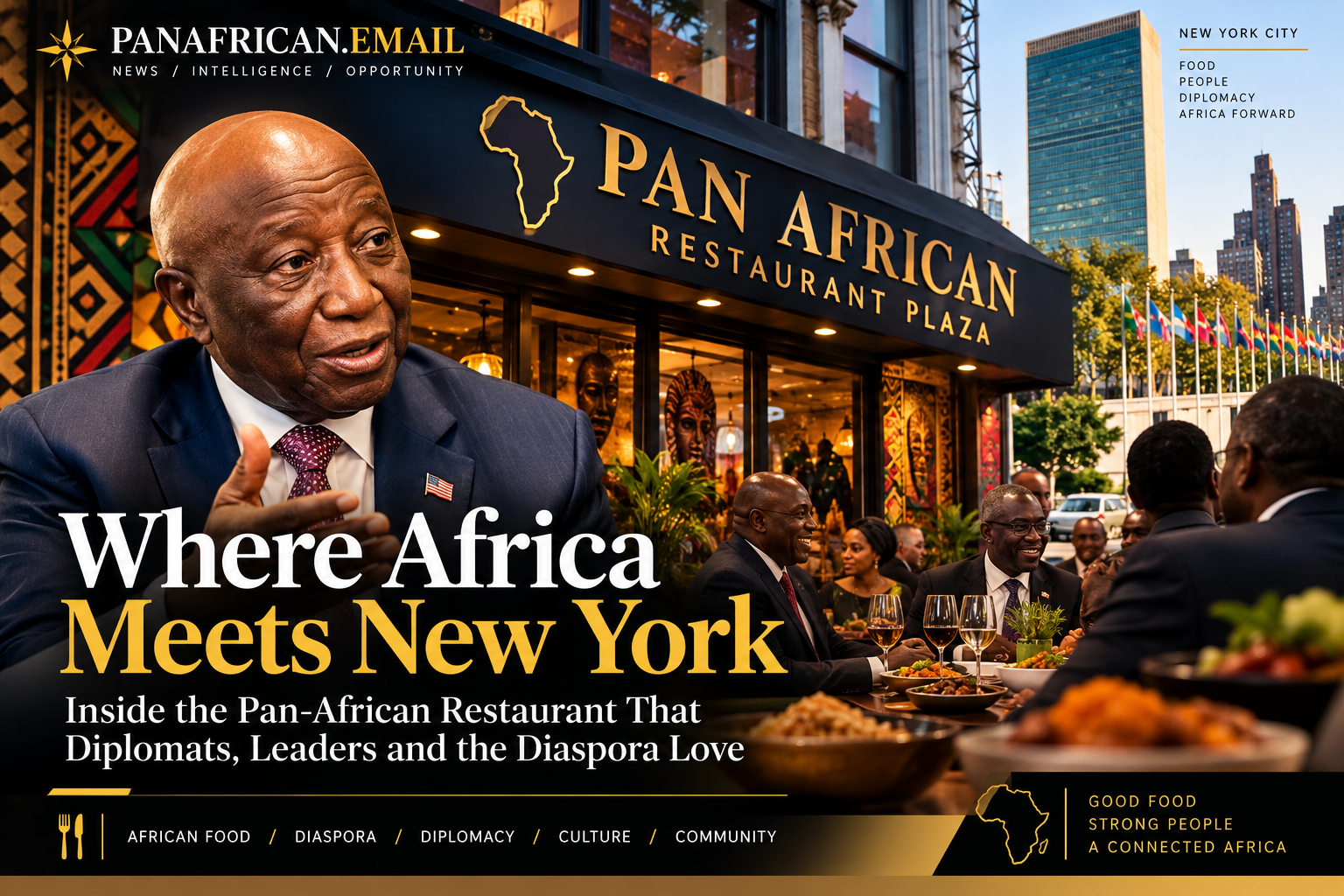
How African restaurants in New York have become places of memory, diplomacy, identity and connection
NEW YORK — There are places where people go simply to eat.
And then there are places where a meal becomes something much larger.
Across New York City, African restaurants have increasingly become meeting points for immigrants, entrepreneurs, artists, community organizers, political figures, diplomats and visiting African leaders. They are places where a plate of jollof rice can start a conversation about national development, where a bowl of fonio can become a reminder of home, and where a restaurant table can connect people separated by an ocean.
A recent video circulating on social media offers a small but revealing example.
In the video, Liberian President Joseph Nyuma Boakai recalls a lighthearted memory from his time at a Pan-African restaurant in New York. He remembers the message he gave customers:
“If you come here, eat and you don’t love the food, tell me. And if you like it, tell others.”
The story is humorous, but underneath it is something deeper.
For African leaders and members of the diaspora, restaurants in New York can represent something more than cuisine. They can become informal cultural institutions.
They are places where Africa is not being explained from a distance.
Africa is sitting at the table.
A restaurant can become a piece of home
For generations of African immigrants, food has been one of the most powerful ways of preserving identity outside the continent.
New York’s African restaurant scene reflects that history.
West African restaurants developed alongside migration from countries including Senegal, Nigeria, Ghana, Guinea and Côte d’Ivoire. What began as places primarily serving immigrant communities gradually became part of New York’s broader culinary culture.
Research on New York’s African dining scene shows that restaurants have served both loyal African patrons and increasingly diverse customers from across the city. (Feet in 2 Worlds)
That evolution matters.
The restaurant is no longer simply a business selling food.
It is simultaneously a cultural archive, social club, meeting place and informal embassy of everyday African life.
The President’s restaurant story
President Boakai’s story captures this phenomenon in a remarkably simple way.
His message to customers — if you don’t like it, tell me; if you like it, tell others — is essentially the language of an entrepreneur who understands that African cuisine grows through personal testimony.
One person tries the food.
Another person hears about it.
Then another.
That is how a restaurant becomes an institution.
And it is also how culture travels.
The significance of the story is heightened by Boakai’s own relationship with public service and international engagement. His career has included senior government positions, agriculture, business and diplomacy, while his administration has emphasized international partnerships, investment and the role of the Liberian diaspora in national development. (LRA Revenue)
That makes a New York restaurant story more interesting than a simple anecdote.
It places food inside the larger African diaspora network.
Why diplomats gravitate toward African restaurants
Diplomats live in a world of official receptions, conferences, embassies, hotels and government buildings.
But diplomacy does not always happen in those places.
Sometimes it happens over dinner.
Food creates an environment where conversations can become less formal. A diplomat can meet a businessperson. A government official can meet members of the diaspora. An entrepreneur can meet someone who understands a particular market. A visiting African leader can reconnect with familiar cuisine thousands of miles from home.
New York is particularly important because it is one of the world’s great diplomatic cities.
The United Nations brings heads of state, ministers, ambassadors and international delegations into the city. At the same time, New York contains one of the most diverse African diasporas in the United States.
The result is a unique intersection:
Diplomacy + Diaspora + Business + Culture + Food.
The restaurant becomes the physical meeting point.
Harlem’s African food corridor
Harlem has been particularly important to this evolution.
African restaurants have operated in and around Harlem for decades, alongside the neighborhood’s historic role as a center of Black political, cultural and intellectual life.
The modern generation has expanded that tradition.
Chef Pierre Thiam’s Teranga, for example, opened inside The Africa Center in Harlem as a Pan-African restaurant built around West African culinary traditions. Its menu incorporated influences from Senegal, Nigeria, Mali, Côte d’Ivoire and Guinea, while emphasizing ingredients such as fonio and other African grains. (Eater NY)
That location is significant.
The Africa Center is not merely a restaurant address. It is an institution built around connections between Africa, the diaspora and the wider world.
Teranga therefore illustrates an important development in African cuisine:
African food is increasingly being presented not simply as ethnic food, but as cultural and intellectual capital.
From immigrant restaurant to cultural institution

The same pattern can be seen elsewhere in New York.
African restaurants have increasingly become spaces where people celebrate birthdays, host political gatherings, organize cultural events, conduct business and welcome visiting dignitaries.
Brooklyn’s Amarachi provides another example.
The restaurant became known as a gathering place for the Black community and hosted prominent visitors, including Nigerian royalty and New York political figures. Its owner described the restaurant’s original mission as bringing together African, Caribbean and African-American experiences. (BKReader)
That is a different kind of restaurant model.
It is not simply:
Kitchen → Food → Customer.
It becomes:
Food → Community → Identity → Network → Opportunity.
That network effect is one reason African restaurants can matter far beyond their menus.
The diplomatic table
There is a reason African diplomats and government officials often feel comfortable in these environments.
Food eliminates distance.
A formal diplomatic reception may require protocol.
A restaurant can offer familiarity.
Someone from Liberia can order food that reminds them of home.
A Ghanaian can sit with a Nigerian.
A Senegalese entrepreneur can meet an American investor.
A Liberian official can speak with members of the diaspora.
A diplomat can move from an official conversation to an ordinary human conversation without leaving the table.
This is the informal side of diplomacy.
It is not necessarily diplomacy in the treaty-making sense.
It is relationship diplomacy.
And relationships are often what make formal diplomacy possible.
New York’s African restaurant scene is becoming more sophisticated
The evolution is also visible in the food itself.
African restaurants in New York increasingly range from neighborhood restaurants and family-owned establishments to sophisticated Pan-African concepts and chef-driven dining rooms.
Teranga demonstrated how West African ingredients could be presented through a modern fast-casual model. (Eater NY)
Chef JJ Johnson’s work similarly helped establish a contemporary Pan-African culinary vocabulary combining African, Caribbean, African-American and other influences. (Eater NY)
And restaurants such as Tatiana by Kwame Onwuachi have pushed African and Caribbean influences into New York’s high-end dining culture, demonstrating that African diasporic food can occupy some of the city’s most prestigious culinary spaces. (Resy | Right This Way)
This is important because representation changes when the cuisine moves from the margins to the center.
The question is no longer:
“Where can I find African food?”
It becomes:
“Which African culinary experience do I want tonight?”
Food as African soft power
There is a larger geopolitical story hiding inside all of this.
Countries spend millions of dollars trying to improve their international image.
Restaurants can accomplish something similar organically.
A successful African restaurant introduces people to African ingredients.
Then African music.
Then African history.
Then African fashion.
Then African entrepreneurs.
Then African destinations.
Then African investment opportunities.
Food becomes an entry point.
That is soft power.
The same principle has been recognized across other national cuisines. Italian restaurants helped globalize Italian culture. Japanese cuisine became an important component of Japan’s international image. Korean food has become part of the global Korean cultural wave.
Africa possesses the same potential — but on a continental scale.
Jollof.
Fonio.
Suya.
Thieboudienne.
Fufu.
Yassa.
Egusi.
Palm butter.
Plantains.
Peanut stews.
These are not merely menu items.
They are cultural assets.
The African restaurant as an informal embassy
There is another way to understand the phenomenon.
An embassy represents a country officially.
A restaurant can represent a culture informally.
The embassy speaks through diplomats.
The restaurant speaks through food.
The embassy has protocol.
The restaurant has hospitality.
The embassy hosts official receptions.
The restaurant hosts conversations that may never appear in a diplomatic communiqué.
That does not make the restaurant a substitute for an embassy.
It makes it something different:
an informal embassy of everyday culture.
And in a city as internationally connected as New York, that role can be extraordinarily powerful.
Why the Boakai story matters
That is why the President Boakai restaurant story deserves more attention than a casual social-media repost might suggest.
At first glance, it is simply a funny story about food.
But look closer.
A Liberian president is remembering a restaurant experience in New York.
A restaurant becomes part of a political leader’s personal memory.
The story is then recorded and circulated through social media.
Liberians and Africans around the world encounter the story.
And suddenly a local restaurant memory becomes part of a much larger African diaspora conversation.
That is how cultural intelligence works.
The signal is not always in the headline.
Sometimes it is hidden inside an ordinary story.
New York’s African table is becoming a network
The next phase of African restaurants in New York may therefore be less about opening another restaurant and more about building ecosystems.
Imagine a Pan-African restaurant connected to:
- African entrepreneurs
- diaspora investors
- diplomatic missions
- African cultural institutions
- universities
- journalists
- chefs
- artists
- technology companies
- tourism organizations
- African manufacturers
- agricultural exporters
- government trade agencies
The restaurant then becomes a physical node in a much larger network.
A place where relationships begin.
A place where information moves.
A place where ideas cross borders.
A place where Africa meets America without requiring a conference room.
The Panafrican.email intelligence angle
For Panafrican.email, this is precisely the type of story that deserves to be treated as more than a restaurant review.
The social-media video is a source observation.
The subject is Joseph Nyuma Boakai.
The location is New York.
The cultural signal is Pan-African hospitality.
The network signal is diaspora connection.
The institutional signal is informal diplomacy.
And the economic signal is African cultural soft power.
That creates a chain:
SOURCE → OBSERVATION → PERSON → PLACE → CULTURAL SIGNAL → DIASPORA NETWORK → DIPLOMATIC SIGNAL → BUSINESS OPPORTUNITY
This is where social intelligence becomes useful.
A short video can reveal something that conventional news reporting might miss:
where African people actually meet.
The Table Is the Territory
The future of African influence in New York will not be determined only inside conference rooms.
It will also happen around restaurant tables.
A president remembering a meal.
A diplomat meeting an entrepreneur.
A chef introducing fonio to a new audience.
A Liberian sharing palm butter.
A Ghanaian serving jollof.
A Nigerian introducing suya.
A Senegalese chef explaining the history of a grain.
A young African-American New Yorker discovering a cuisine connected to an ancestral continent.
These encounters create relationships.
Relationships create networks.
Networks create influence.
And influence eventually becomes economic, political and cultural power.
The Pan-African restaurant is therefore more than a place to eat.
It is part of the infrastructure of the African diaspora.
In New York, the table has become a meeting point between Africa and the world.
And sometimes, the most important diplomatic conversation begins with a simple question:
“Have you tried the food?”
PANAFRICAN.EMAIL — SOCIAL INTELLIGENCE SIGNAL
SIGNAL: Pan-African Restaurant Diplomacy
SOURCE: Social-media video featuring President Joseph Nyuma Boakai
LOCATION: New York City
SUBJECT: Joseph Nyuma Boakai / Liberian diaspora
SIGNAL CLASS: CULTURE + DIASPORA + DIPLOMACY
SECONDARY SIGNALS: Hospitality • African identity • Diaspora networks • Soft power • Business relationships
INTELLIGENCE ASSESSMENT: African restaurants in major global cities are increasingly functioning as informal cultural and relationship hubs connecting diaspora communities, political figures, entrepreneurs and international visitors.
Leave a Reply