
PANAFRICAN.EMAIL · MINING & TECHNOLOGY
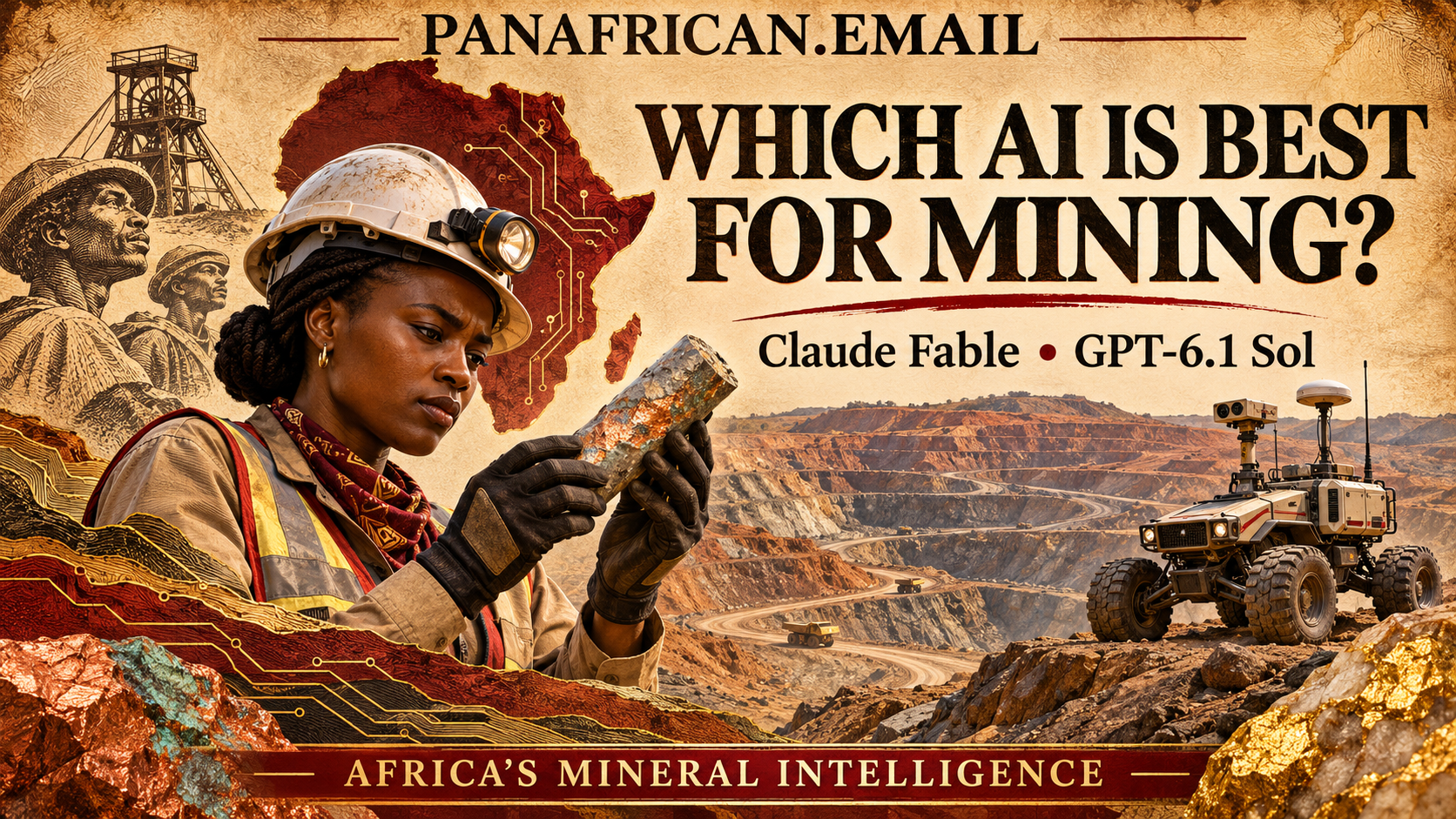
Which AI Is Best for Mining? Claude Fable, GPT-6.1 Sol and Africa’s Mineral Intelligence Opportunity
AI can help read geological reports, build exploration tools and test operating scenarios. Choosing the right system starts with the mining problem—and the evidence behind its answers.
12 November 2026 · Analysis · Mineral mining and exploration
A mining team can now ask an AI assistant to compare technical reports, write a drill-data validation script or develop an interactive terrain interface. The harder question is whether those outputs improve a real exploration or operating decision.
For African mining businesses, geological surveys and researchers, the opportunity reaches beyond buying a chatbot subscription. It lies in building systems that connect local geological knowledge, dependable measurements and skilled people.
First, Fable is part of Claude
“Claude versus Fable” can create confusion: Claude is Anthropic’s AI family, and Fable is a model line within it. The rover project supplied for this article was attributed by the requester to Fable 5. That attribution should be kept separate from any claim that its exact model, code or physical accuracy has been independently verified.
Anthropic’s current Fable page lists Fable 5.2, announced on 9 November 2026, and describes capabilities in technical work, coding, scientific research and interactive 3D design. Those are vendor descriptions; they do not establish superiority in African mineral exploration. Source: Anthropic.
Explore the supplied Fable rover project
The embedded project below offers readers a way to explore the work supplied with this report. A rover interface can inspire mining education, terrain visualization and operator-interface prototypes. A browser demonstration alone cannot establish real-world navigation reliability, geological accuracy or readiness for mine deployment.
Project attributed to Fable 5 by the requester. The live application could not be independently inspected during preparation. If it does not load here, open the rover project directly. Embedding depends on the project’s security settings and the publishing site’s permissions.
Where Claude Fable could fit a mining team
A useful pilot for Fable would combine a difficult technical question with a controlled collection of source documents and working tools. Examples include tracing inconsistent assumptions across a feasibility study, reviewing a geological-data pipeline or developing an educational simulation whose calculations can be checked.
The attraction is the potential to connect research, code and explanation in one workflow. A team could ask for a prototype, inspect the assumptions and require reproducible tests. These are proposed applications, not evidence that the linked rover contains a validated mining simulator.
For document analysis, every extracted figure should retain its page reference, unit and reporting date. A compelling summary can still confuse a mineral resource with a reserve, or treat an exploration target as an established deposit. Professional review remains central to the workflow.
Where GPT-6.1 Sol could fit
Official OpenAI documentation positions GPT-6.1 Sol for complex coding, computer use and professional work. It supports text and image inputs, structured outputs and tool-based workflows, including file search and code execution when configured. These features make it a candidate for building the software around mining information. Source: OpenAI model documentation.
Proposed uses include checking drill-collar tables for missing coordinates, extracting assay results into a review queue, connecting a dashboard to a GIS database and generating repeatable reconciliation reports. Calculations should run in inspectable code, with results checked against known examples.
The same documentation lists standard API text rates of US$2 per million input tokens and US$10 per million output tokens. Those rates are only part of a project’s cost: tools, hosting, review, retries and pricing conditions also matter. A subscription and API billing are separate purchasing arrangements.
Choose by the work that needs doing
| Mining task | Candidate approach | What must be demonstrated |
|---|---|---|
| Technical-report review | Compare Claude Fable and GPT-6.1 Sol on the same source pack | Correct figures, units, page citations and resource classifications |
| Custom dashboards and data pipelines | Start with GPT-6.1 Sol; test Fable on difficult engineering work | Working code, dependable integrations and acceptable cost per accepted result |
| Terrain interfaces and training simulations | Test Claude Fable alongside other coding models | Usability and independently checked terrain, physics and scenario assumptions |
| Mineral prospectivity | Geoscience-specific statistical and machine-learning systems | Spatially independent validation, calibrated uncertainty and field follow-up |
| Predictive maintenance | Models trained and tested on the relevant equipment’s sensor history | Useful warning time, false-alarm rates and performance under changing conditions |
| Vehicle or plant control | Engineered industrial automation with defined operating limits | Site validation, fail-safe behavior and accountable operational approval |
The table gives proposed selection criteria, not measured model rankings.
The strongest mining AI extends beyond a language model
KoBold Metals illustrates a specialist approach. The company describes TerraShed as a system for organizing disparate geoscience information, and Machine Prospector as predictive models updated with field observations and accompanied by quantified uncertainty. Its stated workflow connects geological data, modelling and decisions. Source: KoBold Metals’ description of its technology.
This is a useful distinction for readers assessing AI claims. A language model can help an analyst interrogate a database or write modelling code. Whether a target is geologically promising depends on the underlying evidence, model design and validation. Fluent explanations cannot establish ore grade, continuity or economic recoverability.
Africa’s advantage depends on who owns the information
For Liberia, Ghana, Guinea, Zambia and the wider continent, one practical starting point is a searchable archive of geological maps, historical reports and laboratory records, with permissions and provenance attached. AI assistants could help specialists retrieve and compare that material while preserving the source trail.
Public agencies and local operators should negotiate clear terms for access, retention, export and reuse of their information. Sensitive exploration coordinates and commercially valuable datasets deserve explicit handling rules. Building local geological and software capacity also helps institutions evaluate a supplier’s claims and retain useful knowledge when a contract ends.
A smaller, well-maintained national or company dataset may produce more useful answers than a larger collection with uncertain coordinates, inconsistent units and missing dates. Data preparation is therefore part of the mining investment.
Watch the supplied videos
The following links were supplied as companion media. Their titles, transcripts and claims could not be independently retrieved during preparation; this article does not use them as evidence of mining performance.
Watch the supplied YouTube video.
Companion video shared by @makevoid.
If the X player is unavailable, open the video on X.
Run a mining test before choosing a winner
Give each candidate the same approved dataset, tools and task instructions. Include difficult examples: scanned assay tables, conflicting units, duplicate sample identifiers and records with missing coordinate reference systems. Have specialists score outputs without knowing which model produced them.
Measure factual accuracy, citation accuracy, reproducibility, time saved and total cost per accepted result. For predictive models, reserve geographically distinct data for testing so nearby samples do not create misleadingly optimistic scores. Report unsuccessful cases alongside successful demonstrations.
For a small team beginning today, our proposed sequence is to pilot GPT-6.1 Sol on one bounded software or reporting task, compare Claude Fable on the hardest cases, and assess specialist geoscience systems for exploration prediction. The winner should earn its place through results the team can reproduce and defend.
Leave a Reply