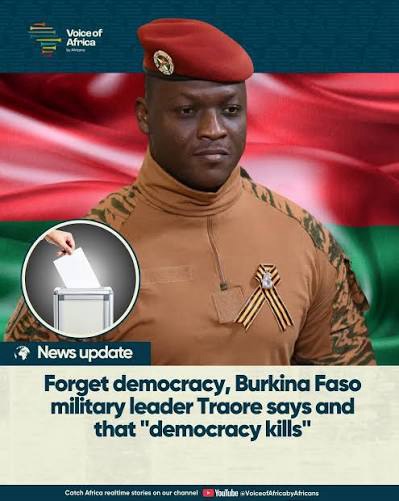
Burkina Faso’s military ruler, Captain Ibrahim Traoré, has stated that the West African nation should “forget about democracy for now,” indicating no immediate plans to restore civilian rule as his junta continues to focus on fighting Islamist insurgents.
Speaking on national television during a broadcast roundtable, Traoré said the country’s priority remains national security, not elections. “We cannot talk about democracy when our very existence is under threat,” he asserted, dismissing previous commitments for a return to democratic rule in 2024.
Since taking power in a 2022 coup, Traoré’s government has positioned itself as a self-styled “revolutionary regime,” seeking to reclaim control over vast northern and eastern regions that have been plagued by militant violence for nearly a decade. The junta argues that stability and sovereignty must come before any political transition.
Earlier this year, the military administration officially dissolved political parties and suspended key democratic institutions, a move that drew criticism from regional and international partners. Yet, within the country, Traoré continues to command significant support among youth and nationalist movements who view the current government as charting a break from Western dependence and ineffective democratic systems.
Observers note that the new political direction echoes sentiments across parts of the Sahel, where military regimes in Mali and Niger have likewise distanced themselves from Western influence and delayed transitions to civilian-led governments. Analysts say these shifts reflect growing frustration with foreign-backed democratic models that have failed to deliver peace or development amid deepening insecurity.
However, human rights groups and local civil society organizations remain alarmed. Recent data from international monitors indicate a sharp rise in civilian casualties attributed to operations by government forces and allied militias. Critics warn that the prolonged absence of democratic oversight could deepen abuses and fuel grievances.
For now, Traoré appears unshaken by such warnings. His rhetoric suggests a continued pivot toward a governance model centered on security and self-reliance — one he insists is more suited to Burkina Faso’s realities than imported democratic blueprints.
As the country braces for what may be an extended period of military-led rule, Burkinabè citizens face a complex question at the heart of Africa’s Sahelian crisis: can security and sovereignty truly thrive without democracy?
Leave a Reply