
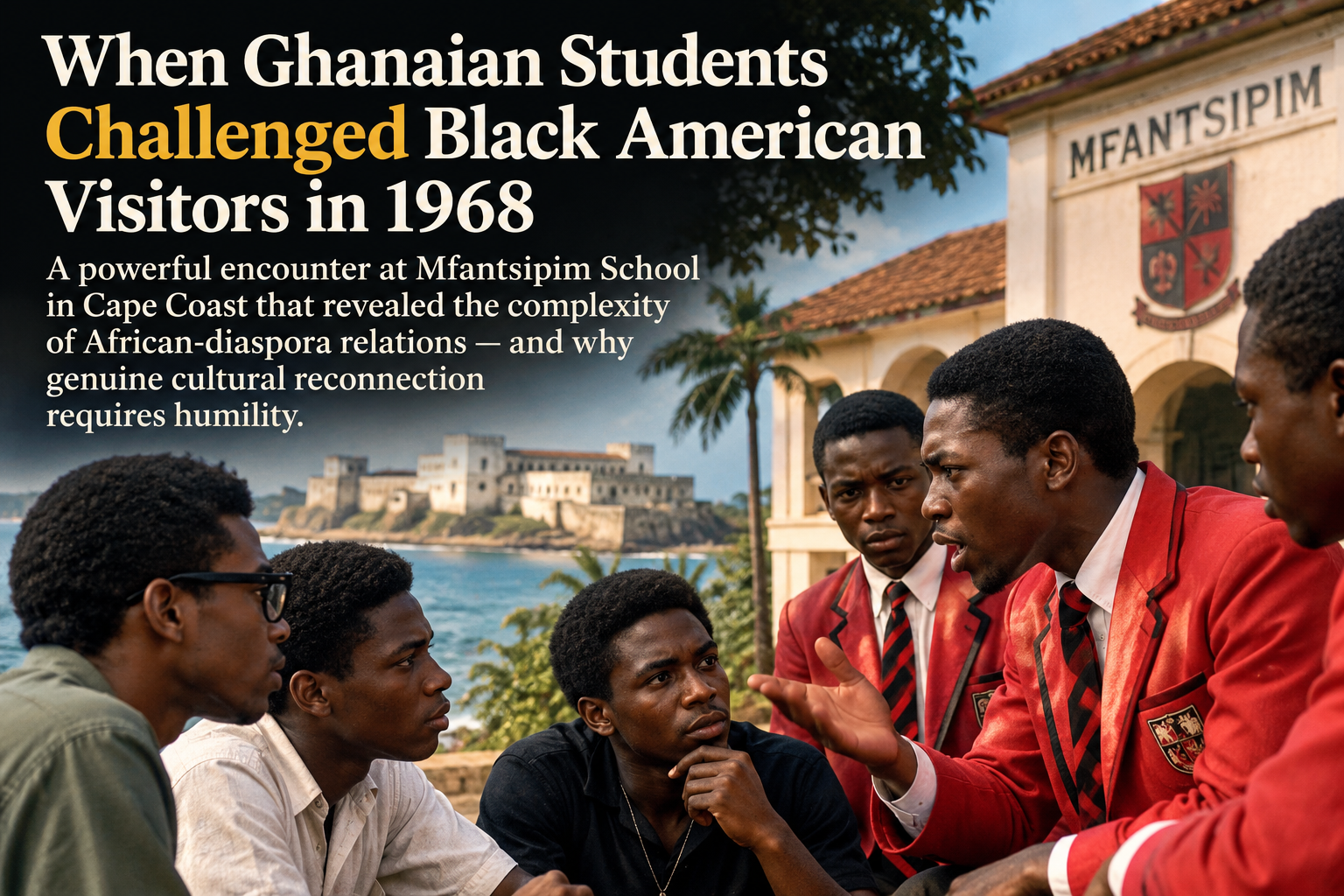
Cape Coast, Ghana — 1968
In 1968, a remarkable cultural encounter unfolded at Mfantsipim School in Cape Coast when three Black American teenagers visiting Ghana to reconnect with their African roots found themselves in a heated exchange with Ghanaian students.
The encounter captured something deeper than an argument. It revealed the complexity of reconnecting across the African diaspora—and the humility required when people separated by history, geography, and circumstance attempt to understand one another.
The young Americans arrived in Ghana carrying a powerful question that had shaped generations of Black people in the United States: Where are our roots?
For many African Americans of the era, Africa was not simply a distant continent. It represented an ancestral homeland obscured by the history of enslavement, colonialism, segregation, and displacement.
Ghana, meanwhile, had become an important destination for members of the African diaspora seeking connection with the continent. Following Ghana’s independence in 1957 under Kwame Nkrumah, the country increasingly presented itself as a bridge between continental Africans and people of African descent around the world.
But cultural reconnection does not erase historical differences.
During the exchange at Mfantsipim, the visiting teenagers reportedly compared the presence of household servants in Ghanaian homes with slavery. The comparison immediately provoked a response from the Ghanaian students.
Their reaction reflected a fundamentally different lived experience.
To the Ghanaian students, the existence of domestic servants in a postcolonial Ghanaian household could not simply be equated with the racialized system of chattel slavery that had shaped the history of Black America. Their society had its own traditions of labor, class, status, colonial rule, and economic inequality.
The students therefore challenged the visitors’ interpretation.
What followed was more than a disagreement between teenagers. It was a collision between two historical memories.
One side was approaching Ghana through the inherited trauma of the African American experience. The other was responding from within the social and historical realities of Ghana itself.
A Reunion That Required Listening
The significance of the encounter lies precisely in its discomfort.
Diaspora connections can sometimes create the assumption that people of African descent automatically share identical experiences. They do not.
The history of an African American family shaped by slavery and segregation is not identical to the history of a Ghanaian family shaped by indigenous institutions, European colonialism, independence, and postcolonial nation-building.
Neither experience needs to erase the other.
The young visitors were searching for something profoundly personal: an ancestral connection. The Ghanaian students, however, were reminding them that Africa was not merely an answer to an American historical question.
Africa was—and is—home to societies with their own histories, contradictions, achievements, inequalities, languages, cultures, and political struggles.
That distinction matters.

The Humility of Reconnection
Perhaps the most important lesson from the 1968 encounter is the importance of humility.
Reconnecting with Africa requires more than arriving on the continent and expecting to find a perfectly preserved version of an ancestral past. It requires listening to Africans describe their own societies on their own terms.
At the same time, continental Africans engaging with the diaspora must recognize that African Americans carry histories that are equally real and often deeply painful.
The bridge between Africa and its diaspora cannot be built through competing claims over who suffered more or who possesses the more authentic understanding of Black identity.
It is built through conversation.
The young people at Mfantsipim were, in their own way, participating in that process.
Their disagreement demonstrated that reconnection is not always comfortable. Sometimes the first step toward genuine understanding is discovering how much remains unknown to both sides.
Beyond the Argument
More than half a century later, the encounter remains relevant.
The relationship between Africa and the African diaspora continues to grow through tourism, education, scholarship, investment, culture, music, fashion, religion, and technology.
Ghana remains one of the most visible meeting points for these relationships.
But meaningful connection requires something more enduring than heritage.
It requires curiosity without arrogance, pride without dismissal, and identity without assumptions.
For Africans on the continent, engaging with the diaspora can be an opportunity to understand how centuries of displacement transformed African identities abroad.
For Africans in the diaspora, returning to the continent can be an opportunity to discover that ancestral connection is not a finished story waiting to be recovered. It is a relationship that must be built through listening and mutual respect.
The heated exchange at Mfantsipim therefore offers a lesson that reaches beyond 1968.
Sometimes cultures connect most deeply not when they agree immediately, but when they challenge one another—and then remain willing to listen.
Connection begins with recognition. Understanding begins with humility.
Leave a Reply