
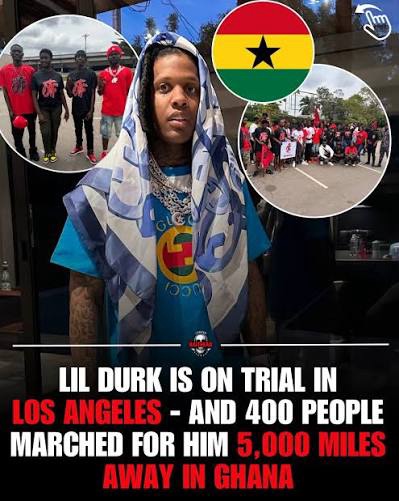
Accra, Ghana — Hundreds of young people in Ghana have reportedly taken to the streets in support of Chicago rapper Lil Durk, demonstrating the extraordinary global reach of American hip-hop and the increasingly powerful role of social media in connecting music communities across continents.
Reports indicate that approximately 400 young people participated in gatherings in Accra, Kumasi and other parts of Ghana this week. The demonstrations were reportedly organised through a WhatsApp group operated by OTF Ghana, a community of supporters associated with Durk’s Only The Family (OTF) movement.
According to the organiser, interest in the demonstrations has continued to grow, with people reportedly requesting to join the WhatsApp group on a daily basis.
The message behind the gatherings was straightforward: supporters wanted to demonstrate that Lil Durk is not alone as he faces a major federal criminal case in the United States.
“We were creating awareness that Durk is not alone in this hard time,” the organiser said.
The demonstrations provide another example of how hip-hop has developed beyond being simply an American musical genre. Artists who emerged from specific neighbourhoods in the United States can now build passionate audiences thousands of miles away, including in African countries where young people have developed deep connections with American rap culture.
Lil Durk’s Federal Trial
The demonstrations come at a significant moment in Lil Durk’s legal proceedings.
Jury selection began Thursday in federal court in Los Angeles, nearly two years after the rapper was arrested in October 2024.
Durk, whose legal name is Durk Derrick Banks, is facing federal charges alongside two associates connected to OTF. Prosecutors allege that the defendants participated in a conspiracy involving a murder-for-hire scheme and the use of interstate facilities in connection with a murder that resulted in a death.
The case stems from a 2022 shooting in Los Angeles.
If convicted on the charges carrying the applicable mandatory sentence, Durk could face life imprisonment.
Durk has pleaded not guilty and has consistently maintained his innocence. His defense has challenged the government’s allegations and argued that prosecutors do not have sufficient evidence establishing that he was responsible for the shooting.
A crucial point in the proceedings is that Durk was not physically present in Los Angeles when the shooting occurred. His defense is expected to challenge the prosecution’s effort to establish his alleged involvement through evidence concerning communications, relationships and events surrounding the shooting.
Ultimately, the federal jury will be responsible for evaluating the evidence presented in court.
Remembering Lul Pab
While the case has generated enormous attention around Lil Durk and his supporters, the proceedings also concern a person who lost his life.
Saviay’a Robinson, widely known as Lul Pab, was 24 when he was killed in a 2022 shooting at a Los Angeles petrol station.
Robinson was the cousin of rapper Quando Rondo and, according to reporting surrounding the case, was not the intended target of the shooting.
His death is an important part of the story because the legal proceedings are ultimately connected to a real loss of life.
As supporters rally behind Durk and his defense team, the trial will also require the court to consider the circumstances that led to Robinson’s death and whether prosecutors can prove the allegations against the defendants beyond the required legal standard.
How Chicago Drill Reached Ghana
The demonstrations in Ghana raise a fascinating cultural question.
Chicago drill emerged from communities on Chicago’s South Side and became one of the most influential sounds in contemporary hip-hop. Artists associated with the movement frequently reflected the realities of violence, poverty, street politics, grief and survival in their communities.
Yet the music eventually crossed the Atlantic.
Through YouTube, streaming platforms, TikTok, Instagram and other social networks, Chicago artists became recognizable to young audiences across Africa. Ghanaian listeners have embraced American hip-hop alongside Ghanaian genres such as hiplife, Afrobeats and drill.
Ghana itself has developed its own drill movement, most notably through Asakaa, a sound associated particularly with Kumasi that incorporates elements of hip-hop and trap into Ghanaian musical traditions.
That connection makes the reported demonstrations particularly significant.
The young people marching in Ghana are thousands of miles from Chicago and Los Angeles, yet they have formed communities around an artist whose music originated in a very different social environment.
WhatsApp and the New Architecture of Fandom
Perhaps the most striking element of the demonstrations is how quickly they were organised.
According to the organisers, the gatherings were coordinated primarily through a single WhatsApp group.
This represents a major change in how cultural movements and fan communities can form.
In previous generations, organising hundreds of people required established organisations, physical meeting places, printed materials, radio announcements or traditional media.
Today, a WhatsApp group can potentially connect hundreds or thousands of people almost instantly.
A music fan in Kumasi can communicate directly with another supporter in Accra. Information can be circulated within seconds, while social-media platforms can transform a local fan community into an international movement.
The result is that fandom is no longer necessarily passive.
Fans can organise events, create campaigns, produce merchandise, establish online communities and publicly advocate for artists they identify with.
More Than American Music
The Ghana demonstrations also illustrate the complicated relationship between African youth and African-American popular culture.
For decades, American music, film and fashion have influenced African audiences. But the relationship increasingly operates in both directions.
African artists are now global stars, while African audiences actively participate in American cultural movements.
The popularity of Lil Durk among some young Ghanaians is therefore part of a much larger global cultural exchange.
The same digital networks that allow Ghanaian musicians to reach Chicago can allow Chicago musicians to develop audiences in Ghana.
The Atlantic Ocean no longer represents the cultural barrier it once did.
What Does the Demonstration Mean?
The question is whether the demonstrations represent something larger than ordinary celebrity fandom.
For supporters, the message appears to be one of solidarity with an artist they believe is facing a difficult period. Their demonstration does not determine the outcome of the federal case, but it demonstrates the emotional connection that music can create between an artist and audiences who have never met him.
At the same time, the existence of a devoted fan base does not determine legal guilt or innocence.
That distinction remains important.
The federal court will consider evidence presented during the trial, while the public will continue to debate the case outside the courtroom.
For the people gathered in Ghana, however, the meaning appears to extend beyond the legal proceedings.
They are saying that an artist from Chicago has built a community far beyond Chicago.
The Global Reach of Drill
The story ultimately presents an unusual image: young Ghanaians gathering in the streets to support a rapper whose musical identity was shaped thousands of miles away.
Chicago drill began as a local expression of life on the South Side. It has since become an international cultural phenomenon.
Its sounds have travelled across borders. Its artists have accumulated global audiences. And its supporters now communicate through digital networks that can turn a local fan club into an international community almost overnight.
The jury in Los Angeles will determine what the evidence says about Lil Durk’s legal case.
But another question has already been answered.
The music travelled.
And somewhere between Chicago, Los Angeles, Accra and Kumasi, an artist’s local story became part of a global conversation.
For the Pan African News Blog, the demonstrations offer a broader lesson: in the digital age, cultural geography is changing. A song created in one neighbourhood can inspire a movement on another continent, and a WhatsApp group can connect people separated by thousands of miles.
The case against Lil Durk will ultimately be decided in court.
His cultural reach, however, is already global.
Leave a Reply