
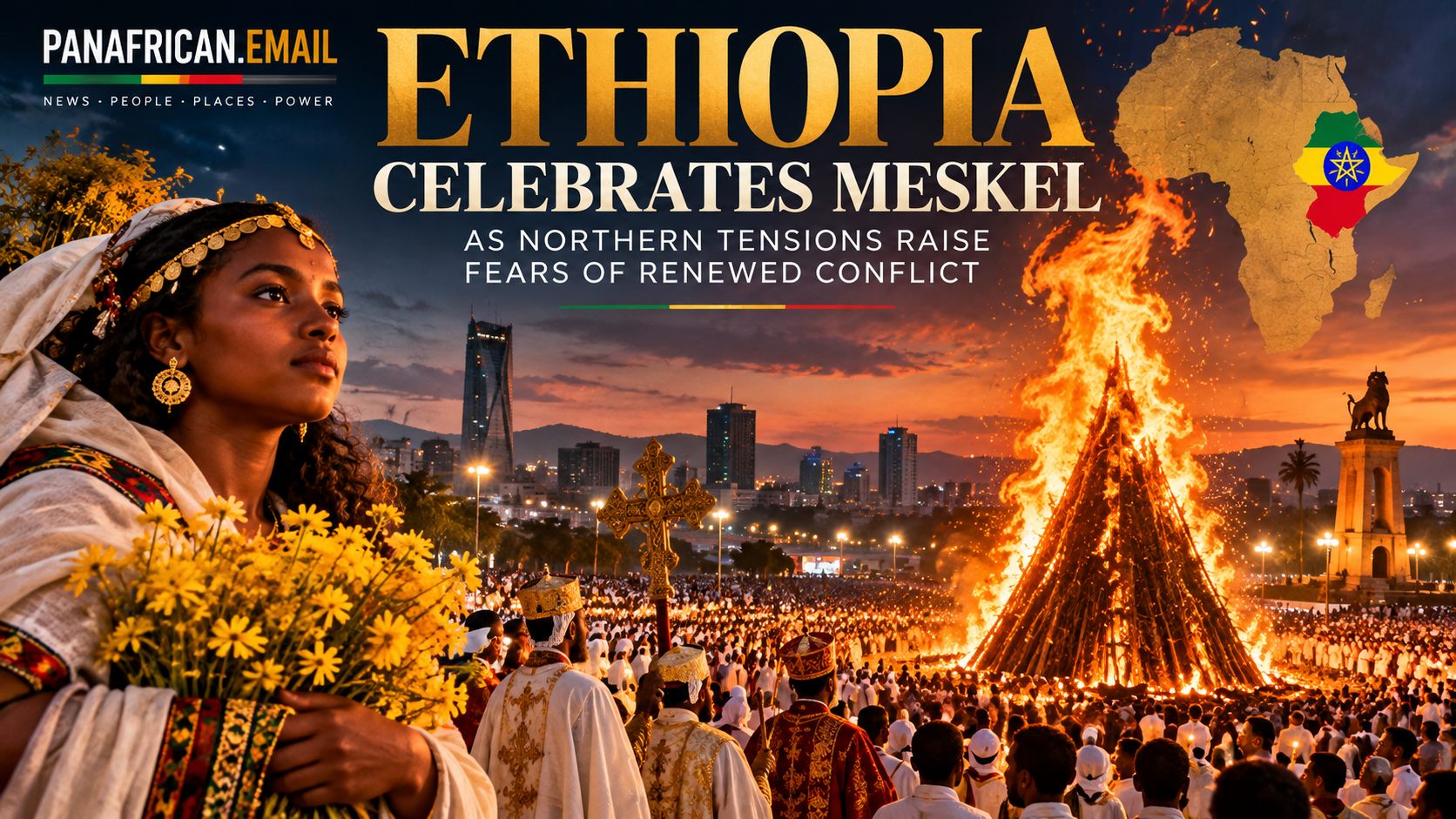
ADDIS ABABA, ETHIOPIA — Tens of thousands of people gathered in Addis Ababa for Meskel, one of Ethiopia’s most significant religious and cultural celebrations, as the country marked the festival amid renewed concerns over security in its northern regions.
The celebrations on Saturday, September 26, brought religious leaders, government officials, diplomats, visitors and thousands of worshippers to Meskel Square in the heart of the Ethiopian capital. The gathering came at a moment when calls for national unity and peaceful coexistence have taken on particular significance following reports of renewed fighting in northern Ethiopia.
A Festival Rooted in Ethiopian History
Meskel, traditionally celebrated on September 27, commemorates the discovery of the True Cross according to Ethiopian Orthodox Christian tradition. During leap years, the celebration takes place on September 28.
The festival was inscribed on UNESCO’s Representative List of the Intangible Cultural Heritage of Humanity in 2013.
The celebration traditionally begins with the Demera, a large ceremonial bonfire. On the eve of Meskel, communities across Ethiopia gather around bonfires at churches, villages and households.
In Addis Ababa, religious and government leaders participated in the lighting of the massive Demera at Meskel Square. Priests, deacons and Sunday School students took part in processions featuring spiritual chants and traditional songs.
The celebration also reflects Ethiopia’s broader cultural traditions, with families and communities gathering for traditional food, drinks, seasonal greetings and visits. The yellow Adey Abeba flower, which blooms around the beginning of the Ethiopian new year, remains closely associated with the season.
Calls for National Unity
The festival’s message of community has taken on added importance amid concerns about political and military tensions.
Ethiopia’s Minister of Culture and Sport, Shewit Shanka, emphasized Meskel’s importance beyond its religious dimension, describing it as part of the country’s history, identity, cultural heritage and national unity.
Prime Minister Abiy Ahmed also used his Meskel message to call for greater unity among Ethiopians.
The Prime Minister described Meskel as a festival that brings families, neighborhoods and communities together, emphasizing its social as well as religious character.
For many Ethiopians, the celebration therefore represented both continuity and a moment of reflection during a period of uncertainty.
Renewed Tensions in Northern Ethiopia

The festive atmosphere comes against the backdrop of reports of increasing tensions in northern Ethiopia.
Ethiopia experienced a devastating conflict between federal forces and forces aligned with the Tigray People’s Liberation Front (TPLF) from November 2020 until the signing of the Pretoria Cessation of Hostilities Agreement in November 2022.
The conflict caused extensive loss of life and displacement and left millions of people requiring humanitarian assistance.
Recent developments have raised concerns that instability could again intensify.
The United Nations has expressed concern over the deterioration of the security situation in northern Ethiopia and reports of fighting on multiple fronts. UN spokesperson Stéphane Dujarric said the organization was particularly concerned about reports involving drones and harm to civilians.
The African Union has likewise called for restraint and urged the parties to prevent further escalation while encouraging dialogue within the framework of the Pretoria agreement.
Conflicting Claims Surround Recent Fighting
The Ethiopian National Defense Force has reported fighting involving forces it identified as TPLF fighters.
According to a statement attributed to the Ethiopian military, government forces repelled an attempted offensive in the northeastern part of the country and reported that 272 fighters were killed.
The military said the fighting occurred after forces attempted to move into parts of North Wollo in the Amhara region.
Those casualty figures are claims from the Ethiopian military and should not be treated as independently verified casualty totals. Access to conflict zones can be limited, making independent verification of battlefield claims difficult.
The renewed tensions also come amid reports of a new alliance involving several Ethiopian opposition and armed groups, adding another layer of complexity to the country’s political and security environment.
Between Celebration and Uncertainty
Meskel’s celebration in Addis Ababa offered a powerful contrast: thousands gathered around a traditional fire representing faith, history and community while concerns about renewed conflict remained in the background.
Ethiopia’s challenge now extends beyond the preservation of its cultural traditions. The durability of the 2022 peace agreement, the protection of civilians and the ability of political actors to resolve disputes through dialogue will remain important factors in determining the country’s path forward.
For communities that endured the devastating war in Tigray, the possibility of renewed hostilities carries particularly serious implications.
As Ethiopia celebrates Meskel, its traditional message of gathering and coexistence is being expressed against a complicated national backdrop—one in which calls for peace must contend with renewed military and political tensions.
PanAfrican.email will continue to follow developments in Ethiopia, including the security situation in Tigray and neighboring regions, regional diplomatic efforts, and their implications for the Horn of Africa.
Leave a Reply