
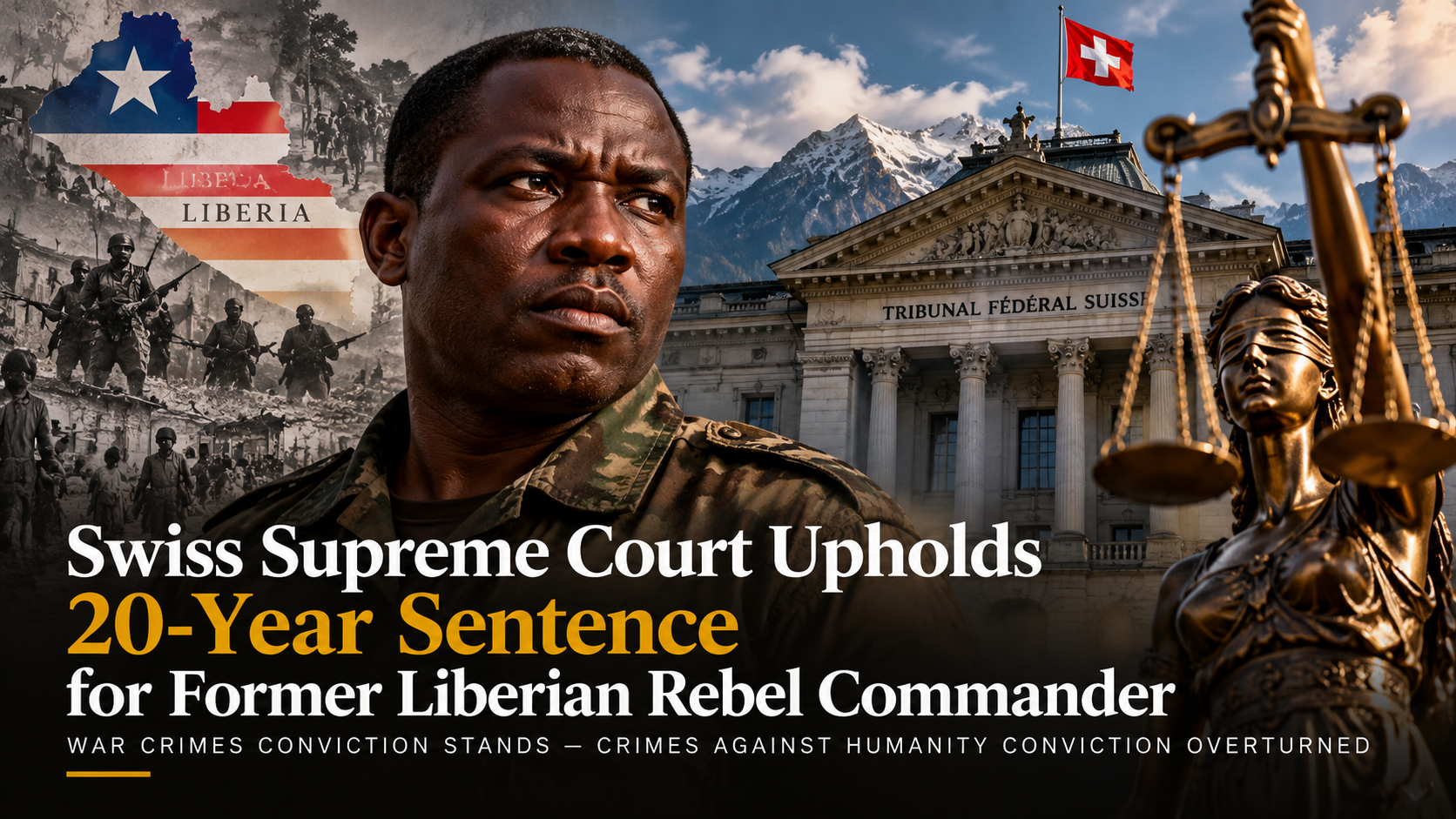
Liberia’s civil-war legacy reaches a final Swiss courtroom as Alieu Kosiah’s war-crimes conviction stands — while a separate crimes-against-humanity conviction is overturned on legal grounds.
MONROVIA, Liberia — Switzerland’s highest court has upheld a 20-year prison sentence against former Liberian rebel commander Alieu Kosiah, bringing to a close a landmark case stemming from atrocities committed during Liberia’s first civil war.
The Swiss Federal Supreme Court rejected Kosiah’s appeal against his conviction for war crimes committed between 1993 and 1995 in Lofa County, northwestern Liberia. The ruling makes the case the first war-crimes conviction handed down by a Swiss civilian court to become final. (Reuters)
Kosiah, now 51, was a commander in the United Liberation Movement of Liberia for Democracy (ULIMO), a rebel movement that fought the forces of then-President Charles Taylor during Liberia’s first civil war.
The conflict formed part of two devastating civil wars that engulfed Liberia between 1989 and 2003 and resulted in an estimated 250,000 deaths. (Al Jazeera)
A Conviction Rooted in Liberia’s Lofa County
The case centered on crimes prosecutors said were committed in Lofa County between 1993 and 1995.
Kosiah was convicted of numerous war crimes, including killings of civilians and unarmed soldiers, rape, cruel and degrading treatment of civilians, looting, desecration of a corpse and the use of a child soldier in hostilities.
Swiss prosecutors had also accused him of additional atrocities, including acts involving forced transportation of goods and ammunition and other abuses committed during the conflict. (ECCHR)
In 2021, Switzerland’s Federal Criminal Court sentenced Kosiah to 20 years in prison. The verdict followed years of investigation after Liberian survivors brought complaints against him in Switzerland in 2014. (SWI swissinfo.ch)
Kosiah was arrested in Switzerland in November 2014, where he had been living.
The Supreme Court’s Important Distinction
Friday’s ruling did not uphold every aspect of the earlier judgments.
The Supreme Court overturned Kosiah’s separate conviction for crimes against humanity.
The reason was not that the court found the underlying conduct acceptable. Instead, Swiss judges concluded that the country’s statutory offence of crimes against humanity, introduced into Swiss law in 2011, could not legally be applied retroactively to conduct that allegedly occurred during Liberia’s civil war in the 1990s.
The principle at issue is one of legality: a person cannot be convicted under a criminal provision that was not part of the applicable law when the conduct occurred. (SWI swissinfo.ch)
That decision, however, did not reduce the 20-year sentence, because the war-crimes convictions remained intact. (SWI swissinfo.ch)
A Landmark Case for Liberia
The significance of the case extends beyond Switzerland.
The prosecution was made possible through the principle of universal jurisdiction, under which certain states can investigate and prosecute individuals accused of serious international crimes even when the alleged crimes occurred outside their territory.
Liberian survivors assisted by the organization Civitas Maxima filed complaints in Switzerland in 2014. Their efforts ultimately resulted in one of the most significant international prosecutions connected to Liberia’s civil wars. (ECCHR)
Alain Werner, director of Civitas Maxima, described the Supreme Court ruling as a landmark decision made possible by the courage of the victims who participated in the case. (Reuters)
For survivors, the ruling represents something larger than the imprisonment of one former commander: it demonstrates that the passage of decades does not necessarily eliminate the possibility of accountability.
Liberia’s Unfinished Justice Question
The Kosiah case also highlights one of the most enduring questions surrounding Liberia’s post-war history: how should the country confront alleged atrocities committed during its civil wars?
Liberia’s wars left thousands of victims, displaced communities and generations affected by violence. Yet accountability for alleged wartime crimes has remained a difficult and politically sensitive issue.
The Swiss proceedings demonstrate what can happen when survivors pursue justice outside Liberia’s borders.
At the same time, the case underscores the limitations of international justice. The Supreme Court’s decision to overturn the crimes-against-humanity conviction illustrates how legal systems must balance accountability with fundamental principles governing criminal law.
What the Ruling Means
For Kosiah, the practical result is clear: the 20-year prison sentence for war crimes remains in place.
For Liberia, the ruling represents another chapter in the long international effort to establish accountability for crimes committed during the country’s civil wars.
And for survivors, the case carries a message that has resonated across international justice proceedings: testimony can survive the passage of time, borders do not necessarily provide permanent protection from prosecution, and historical violence can eventually reach a courtroom.
The Swiss Supreme Court’s decision therefore closes one legal chapter — but it does not close Liberia’s broader historical debate over justice, accountability and reconciliation.
Panafrican.email Intelligence Desk
Liberia | Justice | West Africa | International Law
Leave a Reply