






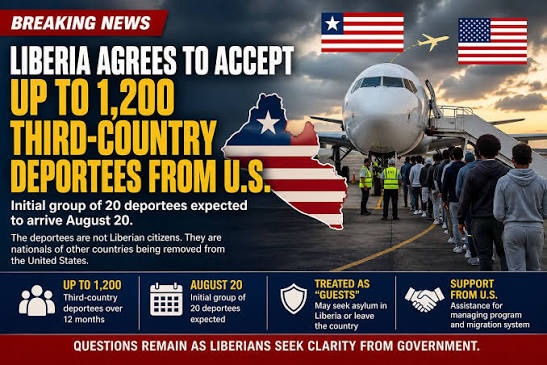
MONROVIA, Liberia — August 21, 2026 — Liberia has received the first group of migrants deported from the United States under a controversial new third-country transfer arrangement that could bring as many as 1,200 people to Liberia over the next 12 months.
The first batch of 20 deportees arrived at Roberts International Airport on Thursday, August 20, marking the operational start of the agreement between Monrovia and Washington. The flight arrived at approximately 12:45 p.m. local time after departing from Louisiana in the United States and making a stop in Dakar, Senegal, according to Reuters, citing Liberian security sources and flight-monitoring information. (Reuters)
Who Is Being Sent to Liberia?
The Liberian government has described those being transferred as third-country nationals—people who are neither Liberian nor American and who are being removed from U.S. territory.
The broader group of up to 1,200 people is expected to include nationals from Africa, North America, South America and the Caribbean. Liberian Information Minister Jerolinmek Piah told Reuters that many of those expected under the arrangement are from Latin America, including Venezuela, Cuba and Colombia. (Reuters)
However, the government has not publicly released the nationalities of the 20 people who arrived on August 20. This distinction is important: while Venezuelans, Cubans and Colombians are expected to make up part of the wider program, it has not been confirmed that specific nationalities comprise the first 20-person batch. (Reuters)
Liberian authorities have said the individuals arriving under the agreement are medically cleared to travel. Justice Minister Natu Oswald Tweh also said Liberian authorities had screened the list of people scheduled for transfer, with most reportedly involved in immigration violations and related offenses. (WCIV)
Liberia Says the Deportees Are “Guests”

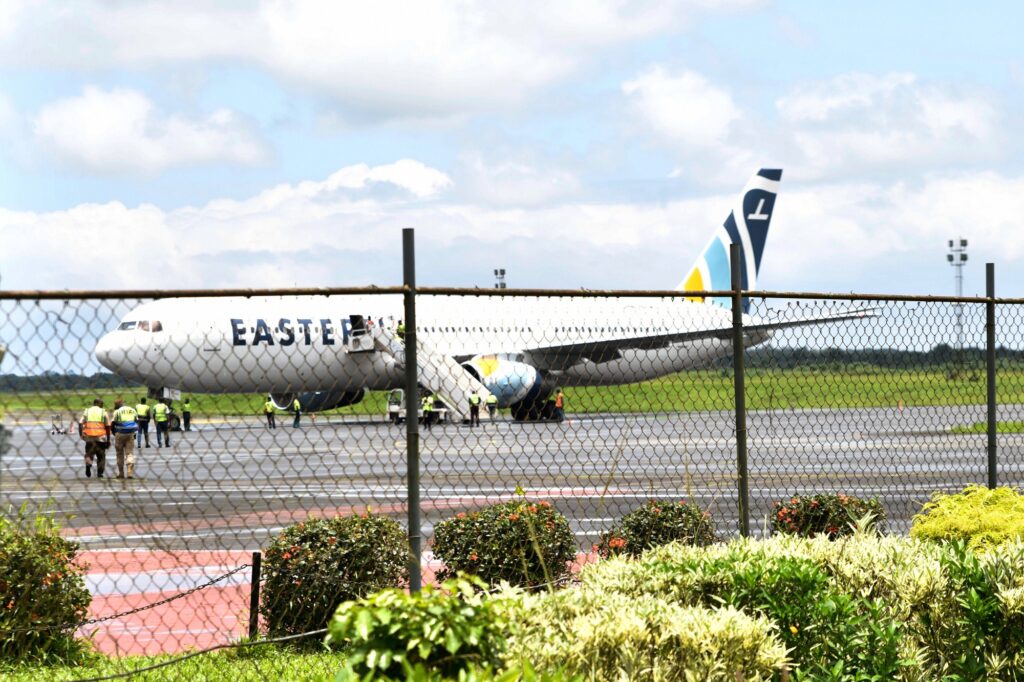
The Boakai administration has sought to distinguish the arrangement from a conventional prison or detention transfer.
Liberian officials say the arrivals will be treated as guests of the Republic of Liberia, rather than prisoners. They will have the ability to leave Liberia if they choose and may apply for asylum or other protection under Liberian law. (Al Jazeera)
The government says the arrangement reflects Liberia’s historic role as a country associated with refuge and resettlement, particularly its historical connection to formerly enslaved Black Americans and its experience receiving people displaced by political crises.
The government has also said reception facilities and temporary accommodations were prepared for the arrivals. (APAnews – Agence de Presse Africaine)
A Deal Dating Back to 2025
Although the announcement became public this week, the arrangement is not entirely new.
According to Liberian officials, the agreement is based on an exchange of diplomatic notes dated September 4 and September 10, 2025. The arrangement provides for the “dignified, safe and timely” transfer of people being removed from the United States to Liberia. (FrontPage Africa)
Liberia announced on August 18 that it had agreed to receive as many as 1,200 third-country deportees over a one-year period. The first group of 20 was scheduled for August 20—and that first transfer has now taken place. (Reuters)
The agreement makes Liberia one of the more significant African participants in the Trump administration’s expanding third-country deportation policy.
Why Are These Migrants Being Sent to a Country They Are Not From?
The arrangement is part of a broader U.S. immigration strategy in which migrants who cannot readily be returned to their countries of origin are transferred to third countries.
In some cases, U.S. immigration judges have determined that individuals cannot be returned directly to their home countries because they could face persecution, torture or other serious abuse. The Trump administration has increasingly pursued agreements with countries willing to receive such individuals. (Reuters)
The United States has reached similar arrangements with several African countries, including Ghana, Sierra Leone, Cameroon, the Democratic Republic of Congo, the Central African Republic and Equatorial Guinea. (Reuters)
Human-rights organizations have criticized the practice, arguing that transferring migrants to countries where they have no prior connection can create serious legal and humanitarian concerns, particularly when individuals have protection from removal to their home countries. (AP News)
IOM and UN Refugee Agency to Assist
Liberian officials say the International Organization for Migration (IOM) and the United Nations refugee agency will assist with services for the people transferred to Liberia. (Reuters)
The government has characterized the arrangement as humanitarian rather than a financial transaction. Liberia says it did not demand compensation for accepting the deportees, although Washington is providing assistance related to migration management and strengthening Liberia’s migration system.
Reuters reported that the United States awarded Liberia $5 million this year for migration-management activities. (Reuters)
Questions About Transparency Remain
Despite assurances from the Liberian government, the agreement has generated debate both inside Liberia and internationally.
Some Liberians have questioned whether a country still dealing with significant economic, employment and social-service challenges has the capacity to accommodate as many as 1,200 additional migrants.
Others have raised questions about the precise legal status of the arrivals, their length of stay, the conditions under which they may leave Liberia and whether future batches could include people with active protection claims in U.S. immigration proceedings.
The lack of publicly released information about the identities and nationalities of the first 20 arrivals has added to those questions.
For now, Liberia says the migrants are free to depart or seek protection in the country, while international organizations are expected to assist with their reception and needs. (Reuters)
The August 20 Arrival Marks the Beginning, Not the End
The arrival of 20 people on August 20 represents only the first installment of a much larger arrangement.
If the full agreement is implemented, Liberia could receive up to 1,200 third-country deportees during the coming year. That would make the program one of the largest U.S. third-country deportation arrangements involving an African nation. (AP News)
For Liberia, the coming months will test whether its promise to receive the migrants as guests can be reconciled with the practical realities of housing, legal services, asylum processing, employment, security and eventual resettlement or departure.
For the United States, the Liberia arrangement represents another major component of an immigration strategy increasingly dependent on agreements with countries outside migrants’ countries of origin.
And for the 20 people who landed at Roberts International Airport on August 20, Liberia is now the latest chapter in a complicated journey—one that may ultimately determine whether they remain in West Africa, seek asylum there, or find another path forward.
Key Facts
- Maximum number: Up to 1,200 third-country nationals
- Program period: Up to 12 months
- First arrival: August 20, 2026
- First batch: 20 people
- Arrival airport: Roberts International Airport, near Monrovia
- Flight origin: Louisiana, United States
- Transit stop: Dakar, Senegal
- Confirmed nationalities of first 20: Not publicly disclosed
- Expected nationalities across wider program: Officials have cited Venezuela, Cuba, Colombia and other African and Western Hemisphere countries
- Status in Liberia: Government says arrivals are guests, not prisoners
- Available options: Leave Liberia or seek asylum/protection
- Humanitarian assistance: IOM and UN refugee agency
- U.S. migration-management support: $5 million reported for Liberia in 2026