
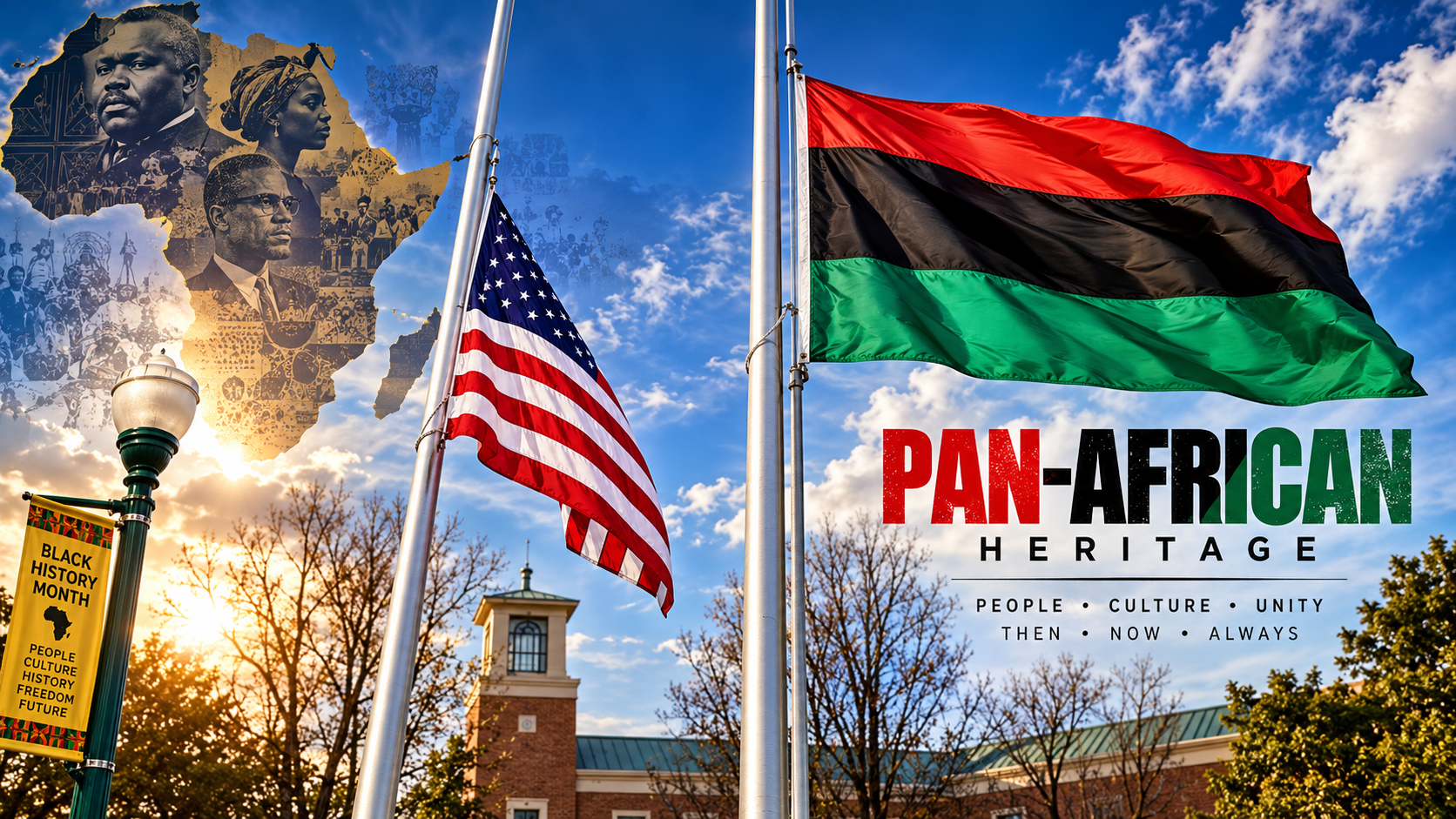
The red, black and green Pan-African flag has increasingly appeared on government buildings, civic plazas, colleges and public institutions across the United States. What was once primarily a symbol carried by Black liberation, African American and Pan-African movements has, in a growing number of communities, become part of official public ceremonies recognizing Black history and the African diaspora.
The movement has a particularly visible footprint in California.
The modern Pan-African flag was adopted by the Universal Negro Improvement Association (UNIA) in 1920. Its three colors—red, black and green—came to symbolize African-descended people, liberation and the resources and heritage of Africa. California municipalities have increasingly incorporated the flag into Black History Month and Juneteenth observances.
Tracy, California
Tracy is one of the Central Valley cities where the Pan-African flag became the subject of an official civic resolution.
Tracy’s City Council authorized the display of the Pan-African flag at City Hall during Black History Month. City records show that the city had previously authorized the flag’s display for February 2021, and the issue returned to the Council in 2023 amid discussion over the city’s flag policy.
The Tracy example is significant because it demonstrates that the flag’s presence is not limited to large metropolitan centers. A city in California’s Central Valley incorporated the Pan-African flag into its official civic recognition of Black history.
The discussion also illustrates something important about public symbols: deciding which flags may be displayed on municipal property can become a matter of local policy, civic participation and community history.
Long Beach, California
Long Beach provides one of the most prominent recent Southern California examples.
In February 2025, the Long Beach City Council unanimously approved raising the Pan-African flag during Black History Month. The proposal called for the flag to be displayed alongside the American flag, California state flag and Long Beach flag at the Civic Center plaza.
The tradition continued in 2026.
Long Beach City College held its own Pan-African flag-raising ceremony on February 10, 2026, describing the ceremony as a recognition of the African diaspora and the contributions of Black communities.
That distinction is worth noting: Long Beach has both a municipal civic example and an educational-institution example.
Richmond, California
Richmond has been raising the Pan-African flag during Black History Month since 2021, according to the city’s official Black History Corner.
The city says the tradition continued through subsequent years, including 2022, when city officials and community leaders participated in a virtual flag-raising event.
Richmond’s history gives the flag ceremony an especially local context because the city has a documented history of African American businesses and civic institutions.
Hayward, California
Hayward began a Pan-African flag-raising tradition in 2022.
A City of Hayward announcement described the February 22, 2022 ceremony at City Hall Plaza as the city’s first raising of the Pan-African flag. The event was intended to recognize the African diaspora and struggles for Black liberation, freedom and equity.
Hayward’s City Council also considered a proposal to make the practice an annual civic observance extending beyond Black History Month to include Juneteenth and August 17, the birthday of Marcus Garvey.
Antioch, California
Antioch formally addressed the Pan-African flag through its City Council in 2024.
The city’s staff report recommended directing the City Manager to fly the Pan-African flag at City Hall throughout February in recognition of Black History Month. The report specifically identifies the flag as also being known as the Afro-American Flag and Black Liberation Flag and documents the symbolism of its red, black and green colors.
Antioch subsequently incorporated the flag into its February civic activities. Contemporary local reporting documented the Pan-African flag displayed at the City Council dais and the city’s plans to raise it at City Hall.
San José, California
San Jose has also incorporated Pan-African flag raising into its Black History Month programming.
The City of San José promoted a 2025 Black History Month ceremony at City Hall Plaza and Rotunda involving the raising of the Pan-African flag. The event included remarks, music, food and dance.
The tradition continued in 2026, with a Pan-African flag-raising event at San José City Hall associated with the city’s Black History Month programming.
Chula Vista, California
Chula Vista joined this group in 2026.
The city held a Pan-African Flag Raising Ceremony at Chula Vista City Hall on February 17, 2026. The event was explicitly described as honoring Black History Month and celebrating the history, culture and contributions of the African American community.
Costa Mesa and Orange County
Another important example is found at the Orange County Fair & Event Center in Costa Mesa.
In February 2022, officials raised the Pan-African flag at the state-run fairgrounds during a public ceremony. The Los Angeles Times reported that the flag was scheduled to remain up throughout February.
The practice subsequently became part of the site’s Black History Month programming.
This is not exactly the same as a city government raising the flag at City Hall, but it is an important Southern California example of the Pan-African colors entering an official public institution.
Ferndale, Michigan
The practice extends far beyond California.
Ferndale has raised the Pan-African flag outside City Hall for five consecutive years, according to the city’s 2026 announcement.
Ferndale’s City Council again approved the flag for the entire month of February 2026. The city describes the flag as representing people of the African diaspora and the Black liberation movement in the United States.
A growing American civic map
The documented examples show several different forms of Pan-African flag recognition:

From a movement symbol to a civic symbol
There is a larger historical story behind these ceremonies.
The Pan-African flag emerged from a movement that connected African Americans with the wider African diaspora. Its appearance at American city halls therefore represents more than a decorative addition to a collection of municipal flags. In these documented ceremonies, public institutions have used it to acknowledge African American history, African diaspora identity, Black cultural contributions and the continuing significance of liberation movements.
California is particularly notable because the examples span the Central Valley, Bay Area, Southern California and San Diego County—from Tracy and Hayward to Richmond, San José, Long Beach and Chula Vista.
And Long Beach provides an especially interesting case: the flag moved from a civic ceremony into an educational setting at Long Beach City College, where the college described the ceremony as honoring the African diaspora.
Taken together, these examples show the red, black and green appearing in an expanding range of American public spaces—from City Hall flagpoles to college campuses and public cultural institutions.
For Panafrican.email, this could become a larger “Pan-African Flag Cities of America” project: a documented map showing every U.S. city, county, college and public institution where the Pan-African flag has been officially raised, with the year, location, resolution and ceremony attached to each point.
Leave a Reply