


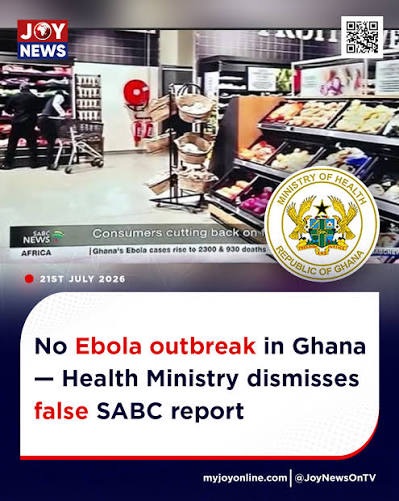
In an era where information travels across borders in seconds, the responsibility of news organizations has never been greater. This reality was underscored when South Africa’s public broadcaster, SABC News, mistakenly aired a news ticker claiming that Ghana had recorded 2,300 Ebola cases and 930 deaths. The figures were entirely false and sparked immediate concern across the continent before Ghanaian authorities intervened. (Ghana Fact)
The erroneous report appeared during an SABC television broadcast as a scrolling ticker beneath another news story. Although there was no accompanying report about an Ebola outbreak in Ghana, the ticker alone was enough to trigger confusion and alarm. In a world where viewers often absorb headlines without waiting for detailed explanations, the damage was immediate. (Ghana Fact)
Ghana Responds Swiftly
Ghana’s Ministry of Health quickly issued a statement dismissing the report as false and reassuring both citizens and the international community that Ghana had not recorded any case of Ebola Virus Disease (EVD). The Ministry described the reported figures as “false, misleading, and should be disregarded.”
Officials also clarified that recent inspections of laboratories, treatment centres, and border entry points by the Health Minister were part of routine public health preparedness measures—not a response to an Ebola outbreak. The Ministry urged the public to rely on official information from the Ministry of Health and the Ghana Health Service while avoiding the spread of unverified reports. (Graphic Online)
SABC Acknowledges the Error
Following public criticism and Ghana’s official rebuttal, SABC News admitted that it had incorrectly attributed Ebola statistics to Ghana. The broadcaster issued an on-air apology, stating that the incorrect information had appeared in its news scroll and expressing regret for the error and any distress it caused. (Ghana Fact)
Investigations suggest that the statistics shown on the ticker were likely associated with an Ebola outbreak elsewhere in Africa but were mistakenly labelled as relating to Ghana. Regardless of how the mix-up occurred, the incident highlights the importance of rigorous editorial verification before health-related information reaches the public. (Ghana Fact)
The Cost of Misinformation
False reports about infectious diseases carry consequences far beyond damaged reputations. They can undermine tourism, disrupt trade, create unnecessary panic, and weaken public confidence in health authorities. For a country like Ghana, which has invested heavily in disease surveillance and emergency preparedness, inaccurate reporting threatens years of public health communication efforts.
Health misinformation is particularly dangerous because it spreads faster than corrections. Even after an apology is issued, many people may continue believing the original false claim.
A Lesson for African Media
This incident serves as an important reminder that Africa’s media houses share a collective responsibility. As continental broadcasters increasingly report on developments across borders, editorial standards must be strengthened to ensure that facts are verified before publication.
Cross-border journalism should strengthen African unity by informing audiences accurately—not by amplifying avoidable errors that damage trust between neighbouring countries.
SABC’s prompt correction and apology were important steps toward accountability. However, the episode reinforces a broader lesson for every newsroom on the continent: credibility remains the media’s most valuable asset, and accuracy must always come before speed.
As African journalism continues to grow in influence, incidents like this should encourage stronger fact-checking practices, closer collaboration with official institutions, and a renewed commitment to responsible reporting. The credibility of the continent’s media—and the confidence of its audiences—depends on it.