
WASHINGTON, D.C. — The long-running American debate over Daylight Saving Time is entering a new phase as lawmakers consider whether the United States should finally end the twice-yearly practice of changing its clocks.
The Sunshine Protection Act has gained renewed attention in Washington after advancing through the U.S. House of Representatives. The legislation proposes making Daylight Saving Time permanent across most of the United States, eliminating the annual transition between daylight and standard time.
However, the proposal has not yet become federal law. Until Congress passes legislation and it is signed by the president, Americans remain subject to the existing federal schedule.
What Happens in 2027?
Under the current law, Americans are still scheduled to change their clocks twice in 2027.
The clocks are scheduled to spring forward on March 14, 2027, beginning the annual period of Daylight Saving Time.
The clocks are then scheduled to fall back on November 7, 2027, returning most of the country to Standard Time.
That schedule could change if Congress approves legislation ending the seasonal clock changes before those dates.
What Would Permanent Daylight Saving Time Mean?
If the Sunshine Protection Act becomes law, Americans would effectively keep the clock one hour ahead of Standard Time throughout the year.
The change would not create additional daylight. Instead, it would shift when daylight occurs on the clock.
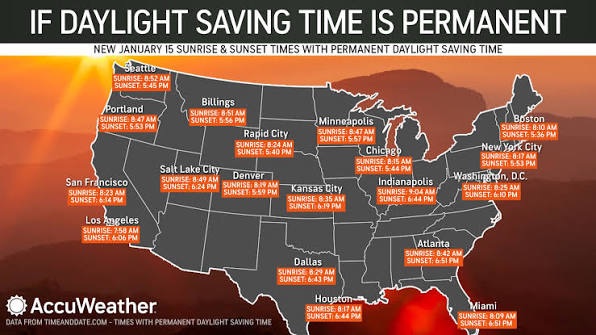
In California and other western states, for example, permanent Daylight Saving Time would mean later sunsets during winter, but it would also mean later sunrises.
A winter morning that currently becomes light around 7:00 a.m. could instead remain dark until approximately 8:00 a.m., depending on the location and date. At the same time, evening daylight could extend roughly an additional hour.
Why Is the Issue So Controversial?
Supporters argue that eliminating clock changes would make life simpler for families, businesses, transportation systems and other organizations that must adjust their schedules twice every year.
Critics, however, have raised concerns about permanently keeping Daylight Saving Time because winter mornings would become darker, particularly for children traveling to school and workers commuting early in the morning.
Some experts and lawmakers have instead advocated for permanent Standard Time, arguing that it better aligns waking and working schedules with natural daylight.
The disagreement means that the central question is no longer simply whether the clocks should stop changing. It is which time should become permanent.
A Decision Still Ahead
For now, Americans should continue following the existing Daylight Saving Time calendar.
The prospect of eliminating the seasonal clock change remains a matter for Congress, and the final outcome could have consequences for everything from school schedules and transportation to business operations and daily life.
If federal legislation is ultimately approved, the United States could be approaching the end of a tradition that has required Americans to repeatedly ask one familiar question twice a year:
“Do we move the clocks forward or back?”
For the moment, however, the clocks are still scheduled to change in 2027.
Panafrican.email News Desk
Leave a Reply