
For decades, the British Empire projected itself as a global champion of civilization, democracy, and the rule of law. Yet beneath that carefully crafted image lies one of the darkest chapters in colonial history—Britain’s violent suppression of Kenya’s Mau Mau independence movement.
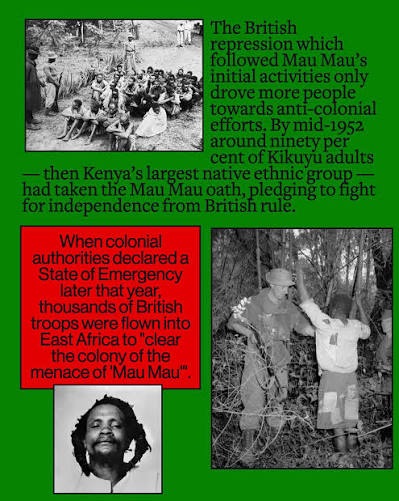
Between 1952 and 1960, the British colonial administration launched a ruthless counterinsurgency campaign against the Mau Mau, a movement largely composed of members of the Kikuyu community who were fighting to reclaim their land, freedom, and dignity after decades of colonial dispossession.
What followed was not merely a military conflict. It was a systematic campaign of terror that relied on torture, mass detention, forced labor, sexual violence, and widespread human rights abuses. Much of this history remained hidden for generations, concealed by official secrecy and the destruction of colonial records.
The Roots of the Mau Mau Uprising
British colonial rule in Kenya transformed fertile African lands into settler-owned estates, displacing thousands of Indigenous communities. The Kikuyu, Embu, and Meru peoples were among those most affected by land seizures, discriminatory laws, heavy taxation, and forced labor.
As peaceful efforts to demand reform repeatedly failed, frustration grew. By the early 1950s, resistance had evolved into the Mau Mau movement, whose primary goal was to end colonial rule and restore land ownership to African communities.
In October 1952, the British government declared a State of Emergency, marking the beginning of one of the most brutal counterinsurgency campaigns in modern colonial history.
A System Built on Torture
Rather than treating the conflict as a conventional military campaign, British authorities created a vast network of detention camps and “rehabilitation” centers across Kenya.
Hundreds of thousands of Kenyans were detained, often without trial or formal charges.
Inside these camps, survivors later described horrifying abuses, including:
– Severe beatings and whippings.
– Electric shocks.
– Water torture.
– Forced labor under brutal conditions.
– Sexual assault and rape.
– Mutilation.
– Forced castration of male detainees.
– Psychological torture and prolonged solitary confinement.
– Starvation and collective punishment.
Historians argue these abuses were not isolated incidents carried out by rogue officers. Instead, evidence suggests violence became an integral part of the colonial strategy to crush resistance and force confessions or loyalty to the British administration.
The “Pipeline” of Detention
Colonial officials developed what became known as the “Pipeline,” a system of detention camps through which prisoners were moved depending on whether authorities considered them “rehabilitated.”
Conditions throughout the Pipeline were notoriously harsh. Many detainees were subjected to relentless interrogations, forced labor, and physical abuse designed to break both body and spirit.
Villages were also transformed into heavily guarded settlements where entire communities lived under strict surveillance, movement restrictions, and food controls.
The Human Cost
The exact number of people who died during the Emergency remains disputed.
Official colonial figures reported relatively low death tolls among detainees, but many historians argue the true number was far higher. Beyond those who lost their lives, countless others endured lifelong physical injuries, psychological trauma, displacement, and the destruction of families and communities.
The conflict reshaped Kenyan society and left scars that continue to affect generations.
Erasing the Evidence
As Kenya moved toward independence, British officials undertook a deliberate effort to remove or destroy sensitive colonial documents.
Thousands of files detailing abuses, interrogation methods, intelligence operations, and official correspondence were secretly shipped to Britain or destroyed altogether.
For years, the absence of these records made it easier for successive governments to dismiss or minimize allegations of widespread torture.
The silence surrounding these events meant many survivors spent decades waiting for their experiences to be acknowledged.
Survivors Refuse to Be Silenced
Despite official denials, survivors continued sharing their testimonies.
Former detainees described brutal interrogations, inhumane detention conditions, and lasting trauma. Their stories were supported by historians, journalists, and eventually by previously hidden government documents that emerged years later.
These accounts challenged long-standing narratives that portrayed Britain’s colonial administration as relatively humane compared with other European empires.
Instead, they revealed an organized system in which violence became a central instrument of colonial control.
The Historic Legal Battle
In the early twenty-first century, elderly Kenyan survivors brought legal action against the British government.
Their persistence led to the discovery of thousands of previously undisclosed colonial files preserved in British archives. These documents provided significant evidence supporting longstanding allegations of abuse during the Emergency.
In 2013, the British government reached a settlement with more than 5,000 Kenyan survivors.
Britain agreed to pay compensation and expressed regret for the abuses suffered by detainees.
However, the government stopped short of issuing a full and unequivocal apology for the colonial system that enabled those crimes.
Why This History Still Matters
The Mau Mau Emergency remains one of the clearest examples of the violence that underpinned European colonial rule in Africa.
For many Africans, remembering this history is not about reopening old wounds but about acknowledging historical truth, honoring survivors, and ensuring that colonial injustices are neither forgotten nor repeated.
The struggle for independence across the continent came at an immense human cost. Understanding these histories is essential to preserving the voices of those who resisted oppression and to challenging narratives that continue to romanticize colonialism.
As more archival evidence comes to light and survivors’ testimonies gain wider recognition, the story of Kenya’s Mau Mau movement stands as a powerful reminder that freedom was won through extraordinary sacrifice—and that historical accountability remains an unfinished journey.
Leave a Reply